




Join Djinn Guide: Get 50% Off a Personal Reading
Get new guides to jinn, folklore and occult history. Confirm your subscription to unlock a 50% code for a first personal reading with our partner PuraTarot.
Discover the unseen
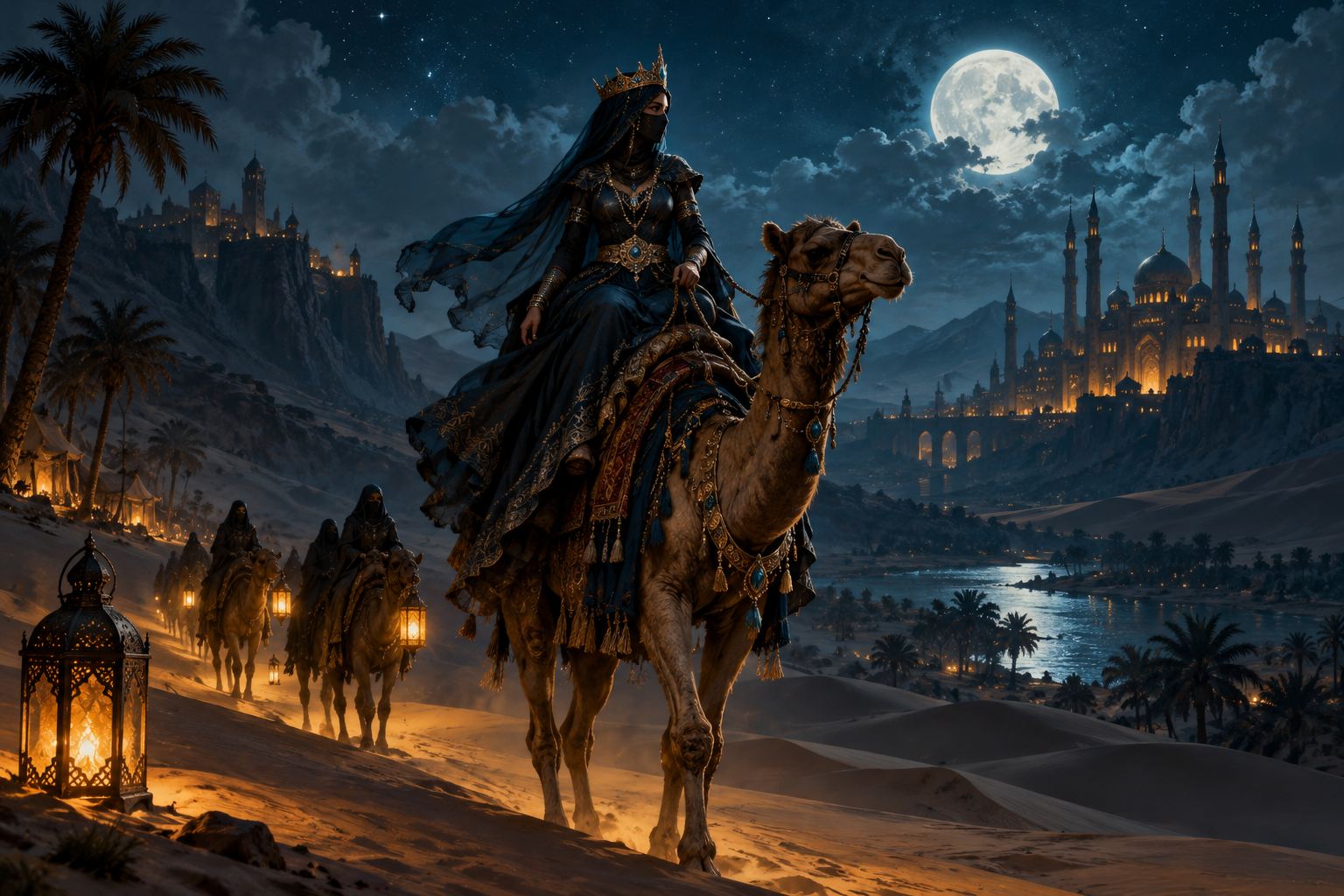
Gremory demon explained: the 56th spirit of the Ars Goetia, a duke who appears as a crowned woman on a camel. Rank, legions, offices, sigil and sources.
Quick answer: Gremory (also spelled Gomory or Gamori) is the 56th spirit of the Ars Goetia, ranked as a duke and said to command 26 legions. The Lemegeton describes Gremory appearing as a beautiful woman with a duchess's crown tied about her waist, riding a great camel. The spirit's offices are to tell of things past, present and future, to reveal hidden treasure, and to procure the love of women. Gremory is one of only a few Goetia spirits described in female form.
Related guides: the full list of 72 demons, Goetia ranks and hierarchy, names, offices and seals of the Goetia, Sitri, prince of the Goetia, Dantalion the many-faced duke, Bune, the three-headed duke.
| Spirit | Number and rank | Legions | Form in the Lemegeton | Main offices |
|---|---|---|---|---|
| Gremory (Gomory) | 56, Duke | 26 | Beautiful woman, duchess's crown at her waist, riding a camel | Past, present and future; hidden treasure; love of women |
| Sitri | 12, Prince | 60 | Leopard's face with griffin's wings, then a human form | Kindles love; makes people reveal themselves |
| Dantalion | 71, Duke | 36 | Man with many faces, holding a book | Teaches arts and sciences; reads thoughts; sways love |
| Bune | 26, Duke | 30 | Dragon with three heads (dog, griffin, man) | Gives riches and eloquence; moves the dead |
Key Takeaways
The Gremory demon is the fifty-sixth of the 72 spirits cataloged in the Ars Goetia, the first book of the Lemegeton or Lesser Key of Solomon. In the 1904 edition prepared by S. L. MacGregor Mathers and Aleister Crowley, the entry reads that Gremory, or Gamori, is a strong and powerful duke who appears in the form of a beautiful woman with a duchess’s crown tied about her waist, riding on a great camel. The spirit is said to govern 26 legions, a modest number next to kings such as Bael or Paimon.
The offices assigned to Gremory are three. The spirit tells of all things past, present and to come. It reveals hidden treasures and where they lie. And it procures the love of women, both young and old. These are stock functions in the grimoire tradition, shared with several other spirits, but the combination of prophecy, treasure and love in one entry gives Gremory a distinct profile among the dukes.
Spelling varies by source. Weyer writes Gomory, the Mathers edition prints Gremory with Gamori as an alternative, and some manuscripts give Gemory. All refer to the same entry. For context on how the 72 spirits are organized, see names, offices and seals of the Goetia.
The oldest printed form of the entry is in Johann Weyer’s Pseudomonarchia Daemonum (1577), an appendix to his work against witch trials. Weyer’s Gomory is “a strong and mighty duke” who appears like a fair woman with a duchess’s crown about her middle, riding on a camel. The spirit answers truly of things present, past and future and of hidden treasure, and procures the love of women, especially of young women. Weyer gives 26 legions. Reginald Scot translated this into English in his Discoverie of Witchcraft (1584), which is where the wording quoted above comes from.
The Lemegeton manuscripts of the seventeenth century, which Mathers later collated, keep the same description but add a seal for each spirit and the standard framework of conjurations. Compared with Weyer’s text, the Goetia entry is nearly identical in substance, which is typical: the Ars Goetia and Weyer’s list appear to descend from a common earlier source, with the order of spirits shuffled.
Collin de Plancy’s Dictionnaire Infernal (first published 1818) repeats the Weyer summary under Gomory. The 1863 edition, illustrated by Louis Le Breton, includes an engraving of a crowned woman seated on a camel, which has become the standard visual reference for the spirit. Le Breton’s images are later inventions that interpret the text, not independent sources about the spirit.
Does this touch your own situation? Many readers come to these pages because something in their home, dreams or family feels unexplained. Reading history helps, but it cannot look at your specific case.
Consult the Sheikh Private, confidential, and free to ask.
Every Goetia spirit has a seal, and the Gremory sigil printed in the Mathers edition is a compact, roughly symmetrical figure built from curved lines, with small circles closing several of the line ends and a horizontal bar through the middle. Like most Goetia seals it has no obvious pictorial content; it is an abstract signature rather than a drawing of a camel or a crown. Manuscript versions differ in small details, such as the number of terminal circles and the angle of the strokes, so there is no single authoritative form.
In the grimoire the seal is described as the spirit’s “character,” to be worn or shown by the operator. Djinn Guide does not reproduce or explain ritual use of seals; the point here is simply that the sigil is part of the entry’s identity, the way a coat of arms belongs to a noble house. Readers interested in how such marks developed can read our guide to what a sigil is and where seals come from.
Only a handful of the 72 spirits are described in female form, and Gremory is the clearest case. Scholars of the grimoire tradition generally read these descriptions as symbolic rather than literal. The camel suggests the Arabian or eastern setting that the Solomonic legend trades on, the same imaginative geography as the jinn of the Arabian Nights. The crown tied about the waist, rather than worn on the head, is an odd detail that may encode rank held loosely or in disguise, though no early source explains it.
Knowledge of past, present and future is the most common office in the Goetia, attributed to dozens of spirits. It reflects the grimoires’ roots in late medieval divination.
Treasure-finding spirits appear throughout European magic from the fifteenth century on, when treasure hunting with spirit aid was a recognized, and frequently prosecuted, activity.
The office of procuring love connects Gremory to Sitri, prince of the Goetia, as well as Beleth and Zepar. Love magic was among the most common charges in witchcraft and sorcery trials, so its presence in the catalog mirrors what people actually sought from practitioners.
Weyer and the Lemegeton still call the spirit “he” and “duke” despite the female form, a reminder that the gender of the appearance was not thought to define the spirit itself.
The duke is the most common rank in the Goetia; roughly two dozen of the 72 spirits hold it. Within that group Gremory stands out for form rather than power. Bune, for example, appears as a three-headed dragon and deals in riches and the dead; Dantalion carries a book and shows many faces; Agares rides a crocodile with a hawk on his fist. Gremory’s woman on a camel is, by comparison, gentle imagery. Our guide to Goetia ranks and hierarchy explains what the rank of duke was thought to imply.
In terms of legions, 26 is in the lower half of the catalog. Numbers range from a handful to 85 or more, and the Lemegeton gives no clear rule linking rank to legion count. The figures are best understood as part of the catalog’s bureaucratic flavor, which imitates a royal court with its nobles, ministers and troops, rather than as data about anything.
The table above sets Gremory beside Sitri, Dantalion and Bune, spirits with overlapping offices. Readers who want the whole set can consult the full list of 72 demons.
The first misunderstanding is that Gremory is a “duchess” by title. The grimoires call the spirit a duke and use masculine pronouns; “duchess” describes only the crown and the appearance. The popular phrase “Duchess Gremory” comes from modern fiction, not from the source texts.
The second is that Gremory has a biblical or ancient Near Eastern origin. Unlike Astaroth, whose name descends from the goddess Astarte, or Bael from the Canaanite Baal, Gremory’s name has no secure etymology. Attempts to connect it to Latin or Hebrew words are speculative. The spirit appears to be a creation of the late medieval grimoire tradition.
The third is that the Le Breton engraving shows what the spirit “really” looks like. The 1863 illustrations were commissioned to make the Dictionnaire Infernal more striking and were drawn from the text descriptions. They are influential, charming and entirely nineteenth-century.
Most people who search for the Gremory demon today arrive by way of fiction. The Japanese light novel and anime series High School DxD gives its heroine, Rias Gremory, a surname taken directly from the Goetia, and the series populates its devil clans with other Goetia names. The Shin Megami Tensei and Persona video game franchises include Gremory as a recruitable demon, usually depicted as a woman riding a camel in a nod to the source. Role-playing games and collectible card games have followed suit.
These portrayals keep the name and the camel and discard the rest. None of them is a guide to the grimoire, and none should be mistaken for one. The historical interest of Gremory lies in what the entry tells us about sixteenth- and seventeenth-century ideas of spirits, nobility and desire, as a small window onto demonology as a field of study.
Start with the oldest layer, Weyer’s 1577 text and Scot’s 1584 translation, then compare the Lemegeton manuscripts and the Mathers edition. Noting what changes, mostly spelling and the added seal, and what stays the same shows how stable the tradition was across three centuries. The Dictionnaire Infernal is a tertiary source; it summarizes rather than adds.
Then ask what the entry assumes about its readers. People wanted to know the future, find lost money and win affection. The Gremory entry packages all three, which tells you more about early modern Europe than about any spirit. Djinn Guide presents this material as cultural history and does not provide instructions for invoking, binding or working with any spirit.
Still have a question about your own experience? Describe what you are seeing, feeling or dreaming, and when it started. The Sheikh reads every message personally and replies in private.
Is love on your mind? Gremory’s reputation in the grimoires shows how often these old texts circled back to matters of the heart. If a relationship question of your own is on your mind, the Relationship Harmony Ritual from our partner PuraTarot offers a reflective way to focus on harmony in your own bond. Join the free Djinn Guide newsletter and, once you confirm, you will unlock a 50% code for your first reading.
Further reading
As an Amazon Associate we earn from qualifying purchases.
Gremory is the 56th spirit of the Ars Goetia, a duke said to command 26 legions. The Lemegeton describes the spirit as a beautiful woman with a duchess's crown tied about her waist, riding a camel, with offices of prophecy, finding hidden treasure and procuring love.
The spirit appears in female form, but the source texts still call Gremory a duke and use "he." In the grimoire tradition the appearance is a shape the spirit takes, not a statement of gender. Gremory is nonetheless one of very few Goetia spirits shown as a woman.
The seal printed in the Mathers and Crowley edition is a compact abstract figure of curved strokes with small circles at several line ends and a central horizontal bar. Manuscripts vary in minor details. It is a signature-like character rather than a picture, as with most Goetia seals.
Yes. Gomory is the spelling used by Johann Weyer in 1577 and by Collin de Plancy's Dictionnaire Infernal. Gremory and Gamori are the spellings in the Lemegeton and the Mathers edition. All describe the same crowned woman on a camel with the same offices and 26 legions.
The best-known example is Rias Gremory in High School DxD, whose family name comes from the Goetia. Gremory also appears as a demon in the Shin Megami Tensei and Persona series, usually depicted riding a camel. These are modern fictional uses, not sources about the historical grimoire entry.
Disclaimer
This article discusses a figure from early modern grimoires for historical and educational purposes. Descriptions of spirits, offices and seals are reported from the sources, not endorsed, and Djinn Guide provides no instructions for ritual practice and makes no claims about results.
Did this guide help you understand the subject? Rate it and share your honest opinion to help other readers. Every review is checked by our editors before it appears.
There are no reviews yet. Be the first one to write one.


Sheikh Youssef
Tayeb El Merzouki
For inquiries about personalized spiritual work, private rituals, and traditional talismans, connect directly with Sheikh Youssef Tayeb El Merzouki.
Chat on WhatsApp