







Join Djinn Guide: Get 50% Off a Personal Reading
Get new guides to jinn, folklore and occult history. Confirm your subscription to unlock a 50% code for a first personal reading with our partner PuraTarot.
Discover the unseen
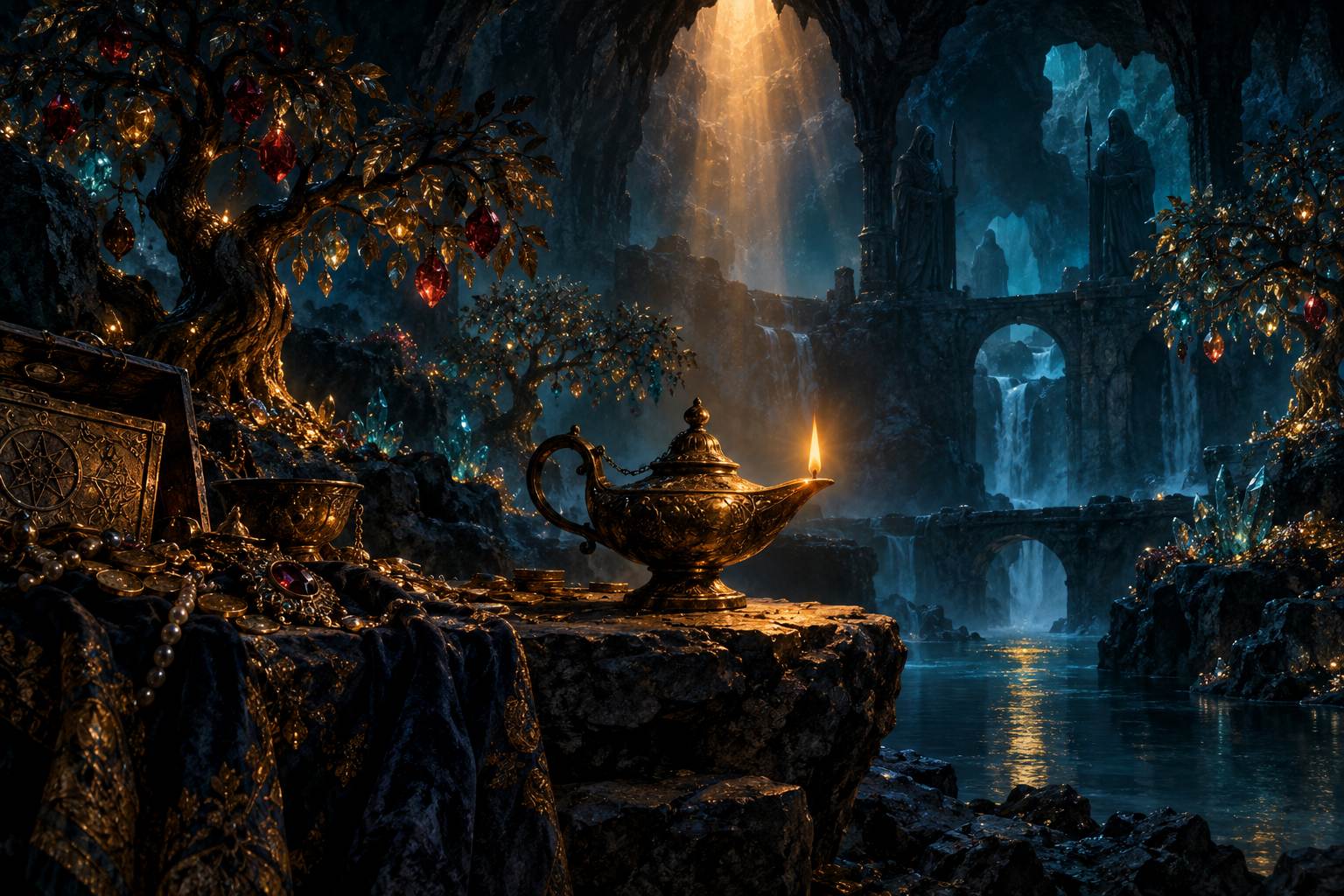
The original Aladdin story explained: who told it, why it is set in China, the two genies of ring and lamp, and how it entered the Arabian Nights.
Quick answer: The original Aladdin story is not found in any Arabic manuscript of the One Thousand and One Nights. It was told in Paris in 1709 by Hanna Diyab, a young Maronite Christian from Aleppo, to the French scholar Antoine Galland, who wrote it up in French and published it in 1712. The tale is set in an unnamed city of China, features a Maghrebi magician posing as Aladdin's uncle, and has two genies: one bound to a ring, the other to the lamp.
Related guides: Aladdin's ring genie and lamp genie, history of the 1001 Nights, Ali Baba and the Forty Thieves, jinn in the Arabian Nights, Scheherazade and the frame story, jinn, djinn, and genie as words.
| Element | Original Aladdin story (Galland, 1712) | Disney film (1992) |
|---|---|---|
| Setting | A city in China, described with Middle Eastern customs | Agrabah, a fictional Arabian city |
| Aladdin's family | Son of a poor tailor named Mustafa; his mother is a major character | Orphan street thief with a pet monkey |
| The villain | A Maghrebi (North African) sorcerer posing as his uncle | Jafar, the sultan's vizier |
| Genies | Two: the genie of the ring and the genie of the lamp | One genie of the lamp; the ring has no spirit |
| Wishes | No limit; the genies obey whoever holds the object | Three wishes with rules |
| The princess | Badroulbadour, daughter of the sultan | Jasmine |
| Second villain | The magician's brother, disguised as a holy woman | None |
| Ending | Aladdin kills both sorcerers and later succeeds the sultan | Genie is freed; Aladdin marries Jasmine |
Key Takeaways
The original Aladdin story, properly titled ‘Aladdin and the Wonderful Lamp’ (Histoire d’Aladdin ou la lampe merveilleuse in French), first appeared in print in volumes nine and ten of Antoine Galland’s Les mille et une nuits, published in Paris in 1712. Galland, a French orientalist, had begun translating a fifteenth-century Syrian Arabic manuscript of the Nights in 1704. That manuscript ends after roughly 282 nights, and it does not contain Aladdin, Ali Baba, or several other stories that readers now consider the heart of the collection.
To fill his later volumes, Galland turned to a living source. In March 1709 he met Hanna Diyab, a Maronite Christian from Aleppo in his early twenties, who had traveled to Paris in the company of the French traveler Paul Lucas. Over several meetings, Diyab told Galland a set of tales, which Galland summarized in his diary and later expanded into full French narratives. Aladdin was one of them. Galland’s diary entry of 25 March 1709 records the Aladdin story being told; the full French text that followed is the oldest version of the tale in existence.
Because of this origin, scholars call Aladdin an ‘orphan tale’: a story with no Arabic parent manuscript, known only through Galland’s French and the sources that depend on it. The same is true of Ali Baba and the Forty Thieves.
For three centuries, Hanna Diyab was a footnote in Galland’s diary. That changed with the identification of a manuscript in the Vatican Library: Diyab’s own memoir, written in Arabic around 1763, describing his travels from Aleppo through the Mediterranean to Paris and back. A French translation appeared in 2015 and an English one, The Book of Travels, in 2021. The memoir shows a young man with a gift for narrative, a keen eye for cities and courts, and a sense of humor about his own misadventures.
Diyab had briefly tried the religious life in a monastery in Lebanon before joining Paul Lucas as a servant and interpreter. Lucas brought him to Paris, where Diyab visited Versailles, saw the court of Louis XIV, and sat with Galland. The memoir mentions Galland and the tales, confirming Diyab’s role. It also contains episodes that echo motifs in Aladdin and Ali Baba, which has led scholars to argue that Diyab shaped these stories from his own storytelling tradition and experiences rather than reciting fixed Arabic texts.
Diyab later returned to Aleppo, married, and became a cloth merchant. He is now recognized as a co-author of some of the most famous stories in world literature. For the broader picture of how the collection grew, see the history of the 1001 Nights.
Does this touch your own situation? Many readers come to these pages because something in their home, dreams or family feels unexplained. Reading history helps, but it cannot look at your specific case.
Consult the Sheikh Private, confidential, and free to ask.
Galland’s Aladdin is long, nearly a short novel. Its main movements are as follows.
Aladdin, the idle son of a dead tailor named Mustafa, lives with his mother in a city of China. A magician from the Maghreb arrives, claims to be Aladdin’s uncle, and leads him to a hidden underground treasury. Aladdin is given a ring for protection and told to fetch an old lamp. When he refuses to hand the lamp up before climbing out, the magician seals him inside.
Rubbing his hands in despair, Aladdin touches the ring and summons its genie, who frees him. At home, his mother cleans the lamp and a second, far mightier genie appears. The lamp genie provides food, then wealth, and eventually everything Aladdin asks for. The two spirits are distinct, as explained in Aladdin’s ring genie and lamp genie.
Aladdin falls in love with Princess Badroulbadour, sends his mother to the sultan with jewels, and after rivalry with the vizier’s son wins her hand. The lamp genie builds a palace of marble and jewels overnight.
The magician returns, trades new lamps for old, obtains the lamp, and carries the palace and princess to Africa. Aladdin uses the ring genie to follow, the princess drugs the magician, and Aladdin kills him.
In a final episode, the magician’s brother disguises himself as a holy woman to kill Aladdin; the lamp genie warns Aladdin, who kills him too. Aladdin later succeeds the sultan.
The Chinese setting puzzles modern readers, since nothing in the story feels Chinese. The sultan has a grand vizier, the people are Muslims who pray and follow Islamic customs, and the magician comes from the Maghreb. The answer lies in how Middle Eastern storytellers used ‘China.’ In the Nights and in Arabic and Persian popular literature, China stood for the far edge of the known world, a place of wealth and wonder where anything could happen. The ‘Hunchback’ cycle of the Nights is also set in China, and the frame story itself calls Shahriyar a king of the lands ‘between India and China.’
In other words, China in the original Aladdin story is a storyteller’s convention, like ‘a land far, far away,’ not a geographical claim. Galland did not try to make the setting more Chinese, and neither did Diyab’s own imagination; the city’s markets, baths, and palace gardens are those of Aleppo or Damascus transplanted eastward.
Nineteenth-century illustrators and stage productions took the setting literally, dressing Aladdin in Chinese costume and giving the characters Chinese names. The British pantomime tradition made Aladdin’s mother ‘Widow Twankey,’ named after a Chinese tea. The Disney film reversed the process and moved the story to an Arabian city called Agrabah. Both choices are later layers on a tale that was always vague about its map.
In Galland’s text, the genies are jinn in the Arabic sense: powerful, bound, and obedient to whoever holds the object. They are not blue, they do not joke, and they do not grant three wishes. The lamp genie describes himself as the slave of the lamp and of all who hold it, and he carries out every command without limit, from a silver dish of food to a palace with twenty-four windows framed in gems. The ring genie is weaker and cannot undo the lamp genie’s work, which is why he cannot bring the stolen palace back but can carry Aladdin to it.
This is the standard picture of a bound spirit in the Nights. The story of the Fisherman and the Jinni shows a spirit sealed by Solomon in a jar; Aladdin’s genies are sealed in a ring and a lamp. The three-wishes rule comes from European folktales and from later adaptations, not from the Arabic tradition. For a look at how these spirits behave across the collection, see jinn in the Arabian Nights.
The word ‘genie’ itself is a product of Galland’s translation. He rendered the Arabic jinni with the French génie, an existing word for a guardian spirit derived from the Latin genius, and English translators kept it. The familiar wish-granting genie of popular culture is therefore a French-English creation built on an Arabic idea.
Once Galland’s Aladdin became famous, readers assumed an Arabic text must exist. In the nineteenth century, two Arabic manuscripts of the story surfaced and were treated as the originals. One, associated with the Syrian priest Dom Denis Chavis in the 1780s, was shown by the scholar Muhsin Mahdi to be a translation of Galland’s French back into Arabic. The other, copied by Michel Sabbagh in Paris in the early 1800s and once dated to 1703, was likewise exposed as a back-translation made from Galland. Both had fooled serious scholars, including Hermann Zotenberg, who printed the Sabbagh text in 1888.
The consequence is striking. Every Arabic version of Aladdin descends from Galland. Richard Burton’s famous English translation (1885 to 1888) included Aladdin in its Supplemental Nights using the Zotenberg text, and Edward Lane’s earlier edition (1838 to 1840) included it from Galland. When modern Arabic editions of the Nights print Aladdin, they are printing a story that traveled from Aleppo to Paris to French to Arabic.
This does not make the story less authentic as a tale. Diyab was an Arabic-speaking storyteller from a city at the center of the Nights tradition, and the motifs he used, the treasure cave, the bound spirit, the magician from the West, are deeply rooted in Arabic and Persian narrative. It simply means that the ‘original’ is a French text shaped by a Syrian voice.
Several beliefs about Aladdin do not survive contact with the sources. The idea that Aladdin is an ancient Arabian folktale is the most widespread; the tale is three centuries old in writing and its earliest form is French. The belief that Scheherazade tells Aladdin in the frame story of the Nights is true only of editions built on Galland, since the Syrian manuscript he translated ends long before.
Other confusions involve the characters. Jafar, the villain of the Disney film, is borrowed from history (Ja’far al-Barmaki, the vizier of Harun al-Rashid, who appears elsewhere in the Nights) and from the 1940 film The Thief of Bagdad; he is not in the original. The magic carpet is also absent from Galland’s Aladdin, though flying carpets appear in other tales. And the princess is Badroulbadour, from the Arabic Badr al-Budur, ‘full moon of full moons,’ not Jasmine. Readers who want the real story are often surprised by how much darker and more violent it is, with two sorcerers killed and a princess who takes an active hand in poisoning one of them.
Aladdin is one of the most adapted stories in the world, and understanding its origin changes how it reads. It is a tale about a poor boy and his mother, told by a young merchant’s son far from home to a French scholar who needed material. It belongs to Aleppo and to Paris at once. Modern debates about the Disney films, their Arabian setting, and their portrayal of the Middle East make more sense when readers know that the original was a Syrian storyteller’s China, filtered through eighteenth-century French.
For students of jinn lore, the story is also a key document. Its two bound spirits show the logic of the Solomonic tradition, in which jinn are confined in objects and compelled to serve, as it reached a popular audience. Reading the original Aladdin story, rather than its adaptations, is the best way to see how a story about a lamp became a story about the jinn.
Still have a question about your own experience? Describe what you are seeing, feeling or dreaming, and when it started. The Sheikh reads every message personally and replies in private.
If you could ask one question, what would it be? Aladdin’s tale turns on wishes and what they reveal about us, and our partner PuraTarot offers a Custom Spiritual Session for readers with a specific personal question, a dream or a decision they want to reflect on. Join the free Djinn Guide newsletter and, once you confirm, you will unlock a 50% code for your first reading.
Further reading
As an Amazon Associate we earn from qualifying purchases.
It is 'Aladdin and the Wonderful Lamp,' first written in French by Antoine Galland and published in 1712, based on a tale told to him in 1709 by Hanna Diyab of Aleppo. No earlier Arabic manuscript contains it. The story has two genies, a Maghrebi magician, and a Chinese setting.
The original story is set in a city in China, but the setting is a storyteller's convention for a distant land. The characters are Muslims with a sultan and vizier, and the customs described are Middle Eastern. Disney moved the story to the fictional Arabian city of Agrabah.
Hanna Diyab, a Maronite Christian from Aleppo in Syria, told it to Galland in Paris in March 1709. Diyab's own travel memoir, written around 1763, was found in the Vatican Library and translated into English in 2021 as The Book of Travels.
Two. The genie of the ring, given to Aladdin by the magician, rescues him from the cave and later carries him to Africa. The genie of the lamp is far more powerful and provides wealth, builds the palace, and warns Aladdin about the magician's brother.
Only in editions descended from Galland's French translation. The medieval Arabic manuscripts of the Nights do not include it. The nineteenth-century Arabic texts of Aladdin were later shown to be translations of Galland back into Arabic.
Disclaimer
This article describes the literary history of the Aladdin story and the beliefs about jinn it reflects for educational purposes. Stories are presented as stories and no claims are made about spirits or magic.
Did this guide help you understand the subject? Rate it and share your honest opinion to help other readers. Every review is checked by our editors before it appears.
There are no reviews yet. Be the first one to write one.


Sheikh Youssef
Tayeb El Merzouki
For inquiries about personalized spiritual work, private rituals, and traditional talismans, connect directly with Sheikh Youssef Tayeb El Merzouki.
Chat on WhatsApp