





Join Djinn Guide: Get 50% Off a Personal Reading
Get new guides to jinn, folklore and occult history. Confirm your subscription to unlock a 50% code for a first personal reading with our partner PuraTarot.
Discover the unseen
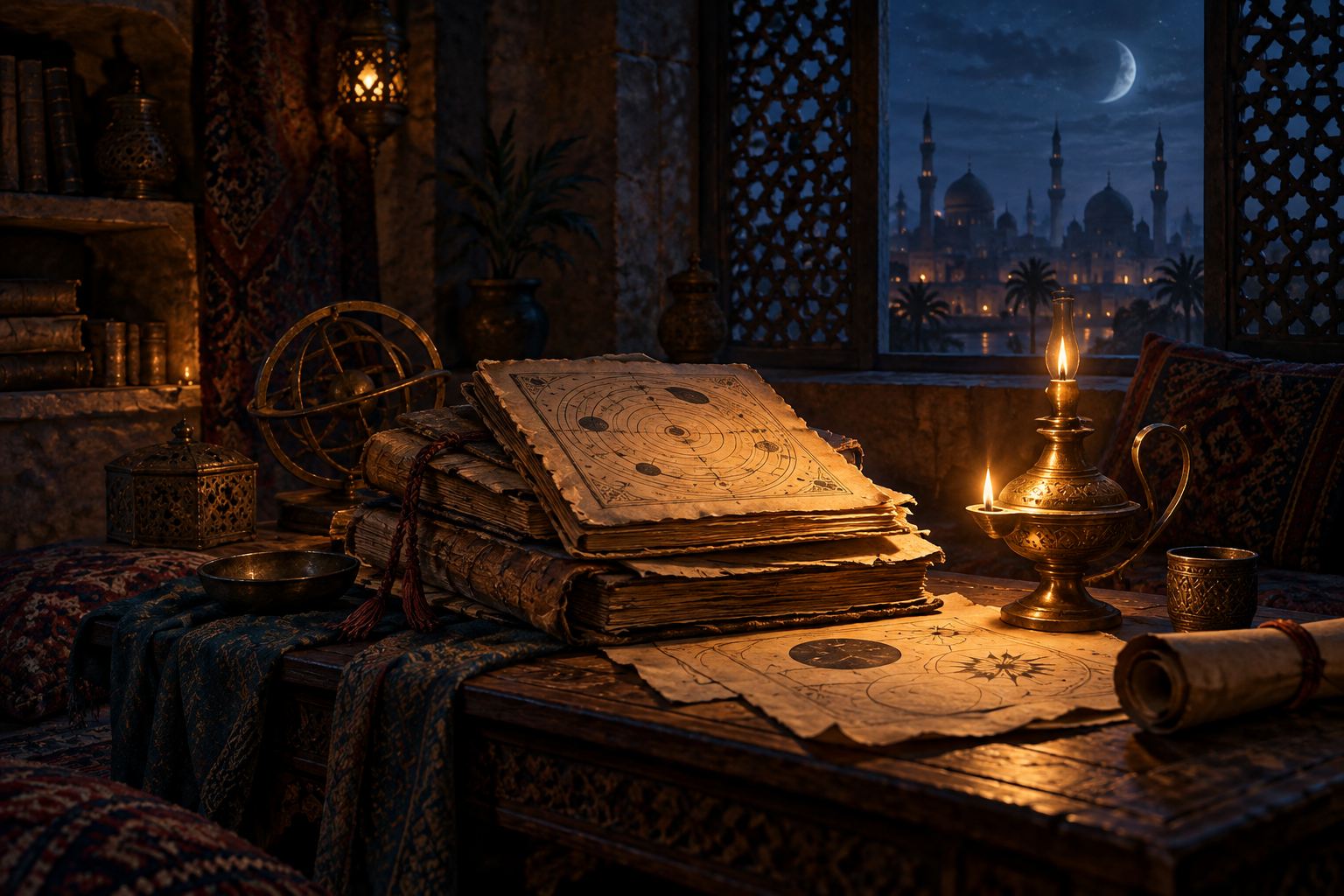
1001 Nights history explained: Persian roots, the 9th-century fragment, the Syrian manuscript, Galland's orphan tales, Lane, Burton and modern editions.
Quick answer: The 1001 Nights, known in Arabic as Alf Layla wa-Layla and in English as the Arabian Nights, is a collection of tales framed by the story of Scheherazade, who tells a new tale each night to delay her execution. It grew from a lost Persian book called Hazar Afsan, was circulating in Arabic by the ninth century, expanded in Baghdad, Syria and Egypt over centuries, and reached Europe through Antoine Galland's French translation of 1704 to 1717.
Related guides: Scheherazade and the frame story, jinn in the Arabian Nights, the original Aladdin story, Ali Baba and the forty thieves, the seven voyages of Sinbad, the Fisherman and the Jinni.
| Date | Milestone | Why it matters |
|---|---|---|
| Before 9th century | Persian Hazar Afsan ('Thousand Tales'), now lost | Source of the frame story and the title; known only from later Arabic reports |
| c. 850–900 | Paper fragment with the title Kitab Hadith Alf Layla | Oldest physical evidence of an Arabic 'Thousand Nights'; identified by Nabia Abbott in 1949 |
| 10th century | Al-Mas'udi and Ibn al-Nadim describe the book | Confirm the Persian origin and the Scheherazade frame; Ibn al-Nadim calls the stories crude |
| 14th–15th century | Syrian manuscript later owned by Galland (Paris, BnF) | Oldest substantial surviving text, about 282 nights; basis of Mahdi's critical edition |
| 1704–1717 | Antoine Galland, Les mille et une nuits, 12 volumes | First European translation; adds Aladdin, Ali Baba and other 'orphan tales' from Hanna Diyab |
| 1835 | Bulaq edition printed in Cairo | First complete Arabic printing, based on the Egyptian recension that reaches 1001 nights |
| 1839–1842 | Calcutta II (Macnaghten) edition | Fullest Arabic text; used by Lane, Payne and Burton |
| 1838–1840 / 1885 | Edward Lane's bowdlerized English; Richard Burton's unexpurgated ten volumes | The two English versions that shaped the Victorian and modern image of the Nights |
| 1984 / 1990 | Muhsin Mahdi's critical edition; Husain Haddawy's translation of it | Returns readers to the earliest recoverable Arabic text |
Key Takeaways
The 1001 Nights is not a book in the ordinary sense but a container. Its only fixed element is the frame: King Shahriyar, betrayed by his wife, marries a new bride each evening and has her killed at dawn, until the vizier’s daughter Scheherazade volunteers, begins a story, and stops at the most suspenseful point so that the king must let her live another night to hear the end. Inside that frame, copyists, storytellers and editors inserted whatever tales they had on hand. The result is a collection whose contents differ from manuscript to manuscript and whose total never consistently reached the number in its title until modern editors made it do so.
The origins lie outside the Arab world. Two tenth-century Arabic writers, the historian al-Mas’udi in his Meadows of Gold and the Baghdad bookseller Ibn al-Nadim in his Fihrist of 987, report that the collection was translated from a Persian book called Hazar Afsan, ‘A Thousand Tales’, and that its frame concerned a king, a vizier’s daughter named Shirazad and her companion Dinazad. Ibn al-Nadim adds, with a scholar’s disdain, that the book was a thin and cold thing. The Persian original is lost, and scholars suspect it drew in turn on Indian story cycles, since the nested-story technique and some motifs resemble the Sanskrit Panchatantra and Kathasaritsagara.
The article on Scheherazade and the frame story examines the device itself; this one follows the history of the collection that grew inside it.
The oldest physical trace of the Nights is a scrap of paper. In 1949 the scholar Nabia Abbott published a fragment, acquired by the University of Chicago, that carries a title page reading Kitab Hadith Alf Layla, ‘The Book of the Tale of a Thousand Nights’, followed by the opening lines of a conversation between Dinazad and Shirazad. Palaeographic analysis dates it to the first half of the ninth century, and a later hand used the margin as scrap for legal notes dated 879. That makes it one of the earliest surviving examples of Arabic writing on paper and proves that a book bearing this title was in circulation in Abbasid Syria or Iraq within a century of the Persian translation.
The title is worth noting: a thousand nights, not a thousand and one. The extra night appears in later Arabic usage, and several explanations compete. Some scholars point to a cultural preference for odd numbers; others to a Turkic idiom in which ‘a thousand and one’ means ‘countless’. Whatever the reason, the longer title was standard by the time the surviving manuscripts were written.
Between the ninth and fourteenth centuries the record goes quiet. A Cairo notebook of a Jewish bookseller around 1150 records lending a copy of The Thousand and One Nights, which is the earliest dated use of the full title. Otherwise the book’s growth during the Abbasid centuries, when stories of Harun al-Rashid, Baghdad merchants and jinn were added, must be inferred from the later texts themselves.
Does this touch your own situation? Many readers come to these pages because something in their home, dreams or family feels unexplained. Reading history helps, but it cannot look at your specific case.
Consult the Sheikh Private, confidential, and free to ask.
The most important surviving manuscript is a three-volume Syrian copy now in the Bibliothèque nationale de France. It was written in the fourteenth or fifteenth century, contains about 282 nights, and breaks off in the middle of a story. Antoine Galland bought it in the 1690s and used it as the basis for his translation. In 1984 Muhsin Mahdi published a critical edition of this Syrian branch, arguing that it represents the earliest recoverable form of the Arabic text and that everything added later belongs to a different, expanding tradition.
That expanding tradition is the Egyptian recension, produced in Cairo in the seventeenth and eighteenth centuries by compilers who set out to fill the frame all the way to 1001 nights. They drew on independent story cycles, popular romances, animal fables and anecdotes from adab literature, and they are responsible for the familiar size of the ‘complete’ Nights. The scholar Hermann Zotenberg identified this family in the 1880s, and it is often called the Zotenberg Egyptian Recension or ZER.
The two branches differ in character. The Syrian text is tighter, more Baghdad-centered and heavy with tales of jinn, merchants and clever wives, such as the Fisherman and the Jinni. The Egyptian text is sprawling and includes long epics such as Umar al-Nu’man and many short pious or comic pieces. Readers who want to know how the jinn tales fit across both branches can turn to the survey of jinn in the Arabian Nights.
Antoine Galland, a French orientalist who had traveled in the Levant collecting manuscripts, published Les mille et une nuits in twelve volumes between 1704 and 1717. The work was a sensation, translated quickly into English, German and other languages, and it fixed the European idea of the Nights for two centuries. Galland adapted freely, smoothing the verse, removing material he thought indecent, and adding explanations of Eastern customs for his readers.
He also ran out of text. The Syrian manuscript ended, and Galland needed more stories. In 1709 he met Hanna Diyab, a young Maronite Christian from Aleppo who had come to Paris with the traveler Paul Lucas. Diyab told Galland a series of tales from memory, which Galland summarized in his diary and later expanded into French. Among them were Aladdin, Ali Baba, Prince Ahmed and the fairy Peri Banu, and the Ebony Horse. Because no Arabic manuscript of these stories predates Galland, scholars call them the ‘orphan tales’. Diyab’s own memoir, discovered in the Vatican Library and published in the twenty-first century, confirms his role and his travels.
The irony is that the stories most associated with the Nights in the West, Aladdin and Ali Baba, entered the collection last and through French. The articles on the original Aladdin story and Ali Baba and the forty thieves trace what Diyab told and what Galland changed.
The Nights were not printed in Arabic until the nineteenth century. Four editions matter.
A partial text of the first two hundred nights, printed in India under British patronage for language students.
Edited by Maximilian Habicht, who claimed a Tunisian manuscript source that scholars later showed was a patchwork.
The first complete Arabic edition, printed at the government press near Cairo from an Egyptian-recension manuscript. It became the standard text in the Arab world.
Edited by W. H. Macnaghten from an Egyptian manuscript, this is the fullest text and the one most English translators used.
From these came the English versions. Edward Lane’s three volumes of 1838 to 1840 were elegant, heavily annotated and censored; he omitted whatever he judged offensive and treated the book mainly as a guide to Egyptian manners. John Payne’s nine-volume translation of 1882 to 1884, printed privately, was complete and literary. Richard Burton’s ten volumes of 1885, followed by six supplemental volumes in 1886 to 1888, were unexpurgated, archaic in style and laden with anthropological footnotes; Burton also borrowed heavily from Payne. Each reflects its translator as much as its source, and the choice among them still shapes how English readers imagine the book.
These points come up constantly because the Nights are known through adaptations, from pantomime to animation, that rarely mention where their material came from.
The collection shaped European literature far beyond orientalist fashion. The nested frame influenced writers from Voltaire to Borges, the genie and the flying carpet became stock devices, and the figure of the storyteller who talks to stay alive has been reused in novels, operas and films. In the Arab world the Nights were long regarded as popular rather than literary, but twentieth-century writers such as Naguib Mahfouz and Taha Hussein reclaimed them, and modern Arabic scholarship treats them as a central document of medieval urban culture.
For students of jinn and the occult the Nights are a primary source of a particular kind. They show how ordinary medieval audiences imagined jinn, marids and ifrits, Solomon’s seal, magic rings and transformations, not as doctrine but as entertainment, and they preserve folk beliefs that formal religious texts leave out. That is why the search term ‘1001 nights’ draws readers who want both the literary history and the mythology, and why the two cannot really be separated.
A reader who wants the earliest recoverable text should start with Husain Haddawy’s 1990 translation of Mahdi’s Syrian edition, which is compact, vivid and free of later padding, and follow it with Haddawy’s second volume containing Sinbad, Aladdin and Ali Baba from the later sources. A reader who wants the full Egyptian text in modern English can use Malcolm and Ursula Lyons’s three-volume Penguin translation of 2008, based on Calcutta II. Burton remains worth sampling for his footnotes and his influence, and Lane for his descriptions of Cairo, but neither should be mistaken for the medieval book.
Three habits help with any edition. Check which Arabic text the translator used, because that determines which stories are present. Keep the orphan tales mentally separate from the manuscript tales. And read the frame as a structure rather than a plot summary, noticing where one story breaks off to let another begin. Approached this way, the 1001 Nights stops being a vague synonym for exotic fantasy and becomes what it actually is: a thousand years of Arabic storytelling, layered and still arguing with itself.
Still have a question about your own experience? Describe what you are seeing, feeling or dreaming, and when it started. The Sheikh reads every message personally and replies in private.
Drawn to these stories for a reason? Scheherazade survived by telling one more story each night, and readers often find that the tales they love most say something about the story they are living themselves. If you would like to explore yours, our partner PuraTarot offers a Full Personal Reading for calm, personal reflection on your own chapter and what may come next. Join the free Djinn Guide newsletter and, once you confirm, you will unlock a 50% code for your first reading.
Further reading
As an Amazon Associate we earn from qualifying purchases.
The 1001 Nights grew from a lost Persian collection called Hazar Afsan, 'A Thousand Tales', which supplied the frame story of Scheherazade. It was translated into Arabic by the ninth century and expanded over the following centuries in Baghdad, Syria and Egypt with stories from many sources.
No single author wrote the Arabian Nights. It is an anonymous, evolving collection assembled by many Arabic copyists and storytellers between the ninth and eighteenth centuries, with the final shape of the 'complete' text produced by Egyptian compilers and nineteenth-century printed editions.
No. The number refers to nights, not stories, and even that figure was reached only in the Egyptian recension of the seventeenth and eighteenth centuries. The oldest substantial manuscript, the Syrian text used by Galland, contains about 282 nights and roughly forty stories.
Aladdin is one of the 'orphan tales' that Antoine Galland added to his French translation after hearing it from the Syrian storyteller Hanna Diyab in 1709. No Arabic manuscript of Aladdin predates Galland; the Arabic versions that exist were translated back from the French.
For the earliest text, Husain Haddawy's translation of Muhsin Mahdi's Syrian edition is the standard choice. For the full Egyptian version, the Lyons Penguin translation of 2008 is modern and complete. Burton's 1885 version is historically important but archaic and based on a late text.
Disclaimer
This article presents the history of the 1001 Nights as understood by literary scholarship. Stories and beliefs about jinn and magic within the collection are described as literature and folklore, not endorsed as fact.
Did this guide help you understand the subject? Rate it and share your honest opinion to help other readers. Every review is checked by our editors before it appears.
There are no reviews yet. Be the first one to write one.


Sheikh Youssef
Tayeb El Merzouki
For inquiries about personalized spiritual work, private rituals, and traditional talismans, connect directly with Sheikh Youssef Tayeb El Merzouki.
Chat on WhatsApp