





Join Djinn Guide: Get 50% Off a Personal Reading
Get new guides to jinn, folklore and occult history. Confirm your subscription to unlock a 50% code for a first personal reading with our partner PuraTarot.
Discover the unseen
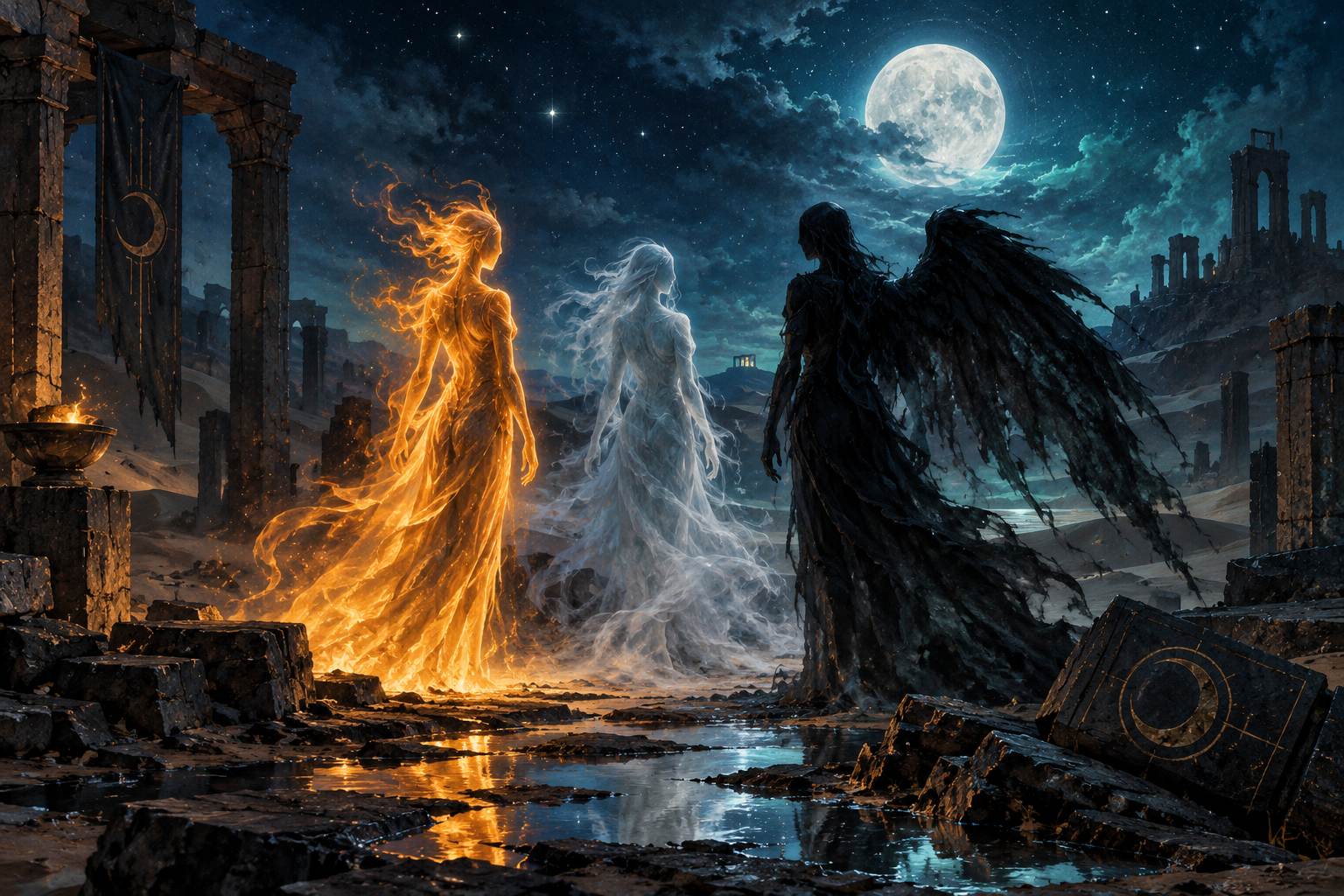
Jinn ghost or demon? Learn how jinn differ from ghosts and demons in origin, nature, scripture and folklore, and why the three are so often confused.
Quick answer: A jinn is not a ghost and not quite a demon. In Islamic belief a jinn is a living, created being made from smokeless fire, with free will and a lifespan of its own, while a ghost is usually understood as the lingering soul of a dead human, and a demon in Christian theology is a fallen angel. The phrase "jinn ghost" mostly reflects how Western readers try to fit an unfamiliar category into familiar ones. The three overlap in stories, but their origins, moral range and relationship to the dead are different.
Related guides: what jinn are, for beginners, the main types of jinn, how demonology defines demons, angels and demons compared, what shaitan means, jinn verses in the Quran.
| Feature | Jinn | Ghost | Demon (Christian/Goetic) |
|---|---|---|---|
| Origin | Created from smokeless fire (Quran 55:15) | Soul or impression of a dead human | Fallen angel or rebellious spirit |
| Alive or dead? | Living beings that are born, eat and die | By definition, the dead | Immortal spirits, never human |
| Moral range | Good, bad and in between (Quran 72:11) | Usually neutral, sad or restless | Almost always evil in theology |
| Free will | Yes, judged like humans | Not usually discussed | Chose rebellion once, now fixed |
| Main sources | Quran, hadith, Arabic folklore, Arabian Nights | European folklore, ghost stories, spiritualism | Bible, Church Fathers, grimoires such as the Goetia |
| Typical story role | Trickster, helper, rival, lover, guardian | Haunting, warning, unfinished business | Tempter, possessor, bound servant of a magician |
Key Takeaways
The clearest way to settle the jinn vs ghosts question is to look at what each word claims about its subject. In Islamic scripture a jinn is a created being, made before humans “from the fire of a scorching wind” (Quran 15:27) and “from a smokeless flame of fire” (Quran 55:15). Jinn are born, form families, eat, marry, grow old and die. They are addressed by revelation and held accountable on the Day of Judgment. Nothing about this description involves death, mourning or the afterlife of a human being.
A ghost, by contrast, is defined by death. In most European, American and East Asian folklore a ghost is the soul, shade or lingering impression of someone who once lived. It haunts a house, a road or a battlefield because something was left unfinished. The ghost is tied to a human biography; the jinn has its own biography. That is why traditional Muslim scholars usually reject the idea that the dead walk among the living and instead explain apparent hauntings as the work of jinn impersonating the dead.
So when a search for “jinn ghost” turns up a shadowy figure in an empty house, two explanations are being folded together. A Western reader sees a ghost; a reader raised on Arabic folklore sees a jinn in a frightening shape. Same scene, different cosmology.
The short answer to “are jinn demons” is: some jinn behave like demons, but the category itself is wider. The Quran describes jinn who listened to the recitation and believed (72:1-2) and jinn who admit “among us are the righteous, and among us are those who are otherwise” (72:11). A tradition in which a whole species is capable of faith cannot be mapped onto the Christian demon, who in classical theology is a fallen angel with no path back. The Islamic figure closest to a demon is the shaitan, a rebellious jinn; Iblis himself “was of the jinn” (Quran 18:50). You can read more about that word in what shaitan means.
Christian demonology developed differently. The New Testament speaks of unclean spirits and of the devil and his angels; later theologians such as Augustine and Aquinas explained demons as angels who fell with Lucifer. Their nature is fixed. They can tempt, deceive and possess, but they are never described as believers, parents or mortals. When grimoire writers of the late Middle Ages and Renaissance compiled lists such as the 72 spirits of the Goetia, they inherited this framework and added ranks, seals and offices.
The overlap is real, though. Both traditions describe spirits that whisper, mislead and sometimes take over a human body. The difference is that Islamic sources treat the jinn as a parallel nation of moral agents, while the Christian demon is a single fallen class. “Jinn demon” is therefore a reasonable label for a shaitan, and a poor label for jinn in general.
Does this touch your own situation? Many readers come to these pages because something in their home, dreams or family feels unexplained. Reading history helps, but it cannot look at your specific case.
Consult the Sheikh Private, confidential, and free to ask.
Ghost belief is ancient and nearly universal, but it rests on an assumption that the Quranic picture of jinn does not share: that a human soul can remain on earth after death. Greek and Roman writers told of shades who demanded proper rites, and medieval Christian Europe imagined souls in purgatory returning to ask for prayers. The familiar English ghost story, with its cold rooms, footsteps and figures at the end of a hall, grew out of that layered inheritance.
In Islamic thought the soul after death is held in the barzakh, an intermediate state, until the resurrection. Most classical scholars concluded that the dead do not return to visit the living. A figure that looks like a dead relative is, in this view, either a dream, a misperception or a jinn wearing a borrowed face. Arabic folklore is full of such shapeshifting: jinn appearing as dogs, snakes, black cats or beautiful strangers, and sometimes as the dead. This is the single most important reason the jinn vs ghosts confusion exists.
It helps to remember that the ghost is a description of what happens to us, while the jinn is a description of someone else. A ghost story is about memory and loss; a jinn story is about neighbors who live beside us unseen, with their own tribes, kings and quarrels.
Each of the three beings has a home tradition, but they travel. A quick breakdown shows where the lines are drawn and where they blur.
The Quran devotes an entire chapter, Surah Al-Jinn (72), to the jinn, and refers to them alongside humans as the two accountable species. Hadith literature adds detail: jinn are said to come in three kinds, some that fly, some that take the form of snakes and dogs, and some that travel and settle. Ghosts in the Western sense are largely absent. For a verse-by-verse survey, see jinn verses in the Quran.
In the Nights the jinn are dramatic characters: the jinni in the bottle, the ifrit who carries a princess across the sky, the marid who serves the ring. They are rarely called demons in the Arabic text, though Victorian translators sometimes used the word. Stories of the returning dead are rare; the fear in the Nights is of living spirits with their own plans.
Here the demon rules. The Goetia lists spirits with titles such as king, duke and president, each with offices and a seal. These beings are not jinn and not ghosts; they are presented as fallen spirits bound by Solomon. The Solomon connection is what links this tradition back to Islamic lore, where Solomon also commands the jinn.
Local traditions add hybrids. The Moroccan Aisha Kandisha is called a jinniya but behaves like a European revenant; the Persian div is a demon in one text and a monstrous giant in another; South Asian stories mix jinn with bhoot, the regional ghost. In these places the three categories mingle freely in everyday speech.
One useful way to hold the three apart is to ask a single question of each: what is its relationship to life and death? Jinn live. They have lifespans far longer than ours by tradition, but they age and die, and they will be judged. Ghosts died. Whatever a ghost is, it presupposes a death that already happened. Demons fell. They neither live in the biological sense nor died; they changed status once, in a rebellion, and remain in that state.
A second question is about variety. The jinn tradition is unusually rich in subtypes, from the sea-going marid and the powerful ifrit to the desert ghul and the personal qareen assigned to each human. Ghost lore has fewer types, all variations on one theme. Demonologies arrange demons by rank and office rather than by kind. If you want the jinn side of that picture, start with the main types of jinn.
A third question is about power over the human will. Ghosts in most stories cannot possess; they frighten, warn or ask. Demons in Christian belief can possess and are expelled by exorcism. Jinn, in Islamic folk belief, can also enter a person, and ruqya, the recitation of Quranic verses, is the traditional response. This shared possession motif is where jinn and demons look most alike to outsiders, and where films tend to blend them.
The first misunderstanding is translation. Early European translators of Arabic texts had no word for jinn, so they reached for “demon,” “genie” or “spirit” depending on context. “Genie” comes from the Latin genius, a guardian spirit, and stuck after Galland’s French Arabian Nights. “Demon” imported Christian assumptions that the Arabic text did not carry. Readers who meet jinn only through these translations inherit the confusion built into the words.
The second is cinema. Horror films regularly present a jinn as a Middle Eastern demon, complete with possession, Latin-style exorcism and an evil nature from the first frame. This fits the Hollywood template but flattens the tradition, which includes Muslim jinn, jinn who help, and jinn who simply want to be left alone. The phrase “jinn ghost” in some film titles and subtitles is pure marketing shorthand.
The third is the assumption that all cultures agree about what happens after death. They do not. If you believe souls can linger, a haunting is a ghost. If you believe souls are kept until the resurrection, a haunting must be something else, and the jinn fill that role.
Interest in jinn has grown in English-speaking countries for several reasons. Horror films and series set in the Middle East, South Asia and the Muslim diaspora have made the jinn a recognizable monster. Video games borrow jinn and ifrit as enemy types. Social media accounts share “true” jinn encounters alongside ghost videos, and the audience naturally asks whether these are the same thing.
There is also a broader fascination with comparative demonology. Readers who know the Goetia or Christian exorcism lore discover that Islamic tradition has a parallel world of spirits and want to see how they line up. A jinn is not simply a demon with an Arabic name, and a ghost is not a jinn that happens to be sad. For the Christian side of the comparison, see angels and demons compared.
When you encounter a story, start by identifying its source tradition. A tale from the Arabian Nights or a hadith collection is describing jinn, even if a translator wrote “demon.” A Victorian ghost story assumes a lingering soul. A grimoire or a Catholic exorcism manual assumes fallen angels. Reading the story inside its own framework prevents most errors.
Next, notice what the being wants. Jinn in folklore want territory, respect, revenge or love, and can be negotiated with. Ghosts want resolution. Demons in theology want corruption. These motives survive even when the vocabulary gets mixed up.
Finally, treat modern retellings as what they are: entertainment built on older material. Djinn Guide describes these beliefs as beliefs and these stories as stories. It does not offer methods for contacting, expelling or binding any spirit, and nothing here should be taken as a claim that jinn, ghosts or demons produce effects in the world.
Still have a question about your own experience? Describe what you are seeing, feeling or dreaming, and when it started. The Sheikh reads every message personally and replies in private.
Drawn to these questions for a reason? Sorting jinn, ghosts and demons into clear categories often brings up quieter, more personal questions. If you would like to reflect on what these traditions stir up for you, a Full Personal Reading with our partner PuraTarot offers a gentle, personal perspective. Join the free Djinn Guide newsletter and, once you confirm, you will unlock a 50% code for your first reading.
Further reading
As an Amazon Associate we earn from qualifying purchases.
No. A jinn is a living created being in Islamic belief, made from smokeless fire, with its own birth, life and death. A ghost is the lingering soul or impression of a dead human. Traditional Islamic scholarship generally holds that the dead do not return, and explains apparent ghosts as jinn taking a familiar form.
Not as a class. The Quran says some jinn are righteous and some are not (72:11). The rebellious jinn are called shayatin, and Iblis is described as one of the jinn (18:50). So a shaitan resembles a demon, but the jinn as a whole include believers, which Christian demons never do.
A demon in Christian theology is a fallen angel, immortal and fixed in evil. A jinn is a separate species with free will that can be good, bad or indifferent, and that is judged like humans. The Goetia's demons are a grimoire tradition that borrows Solomon's name but not the Quranic picture of jinn.
In Arabic and South Asian folklore, yes. Jinn are said to settle in abandoned houses, bathrooms, ruins and deserts, and stories describe noises, moved objects and shadowy figures. The experience resembles a Western haunting, but the explanation differs: a living spirit occupying a space rather than a dead person returning to it.
All three are invisible or shape-changing beings that stories place in contact with humans, and all three appear in possession and haunting narratives. All are also described as capable of fear, speech and deception. The differences lie in origin (fire, death, fall), moral range and the tradition that tells the story.
Disclaimer
This article describes religious beliefs, folklore and literary traditions for educational purposes. Jinn, ghosts and demons are presented as they appear in scripture and stories, not as verified entities, and nothing here is advice on contacting, expelling or protecting against any spirit.
Did this guide help you understand the subject? Rate it and share your honest opinion to help other readers. Every review is checked by our editors before it appears.
There are no reviews yet. Be the first one to write one.


Sheikh Youssef
Tayeb El Merzouki
For inquiries about personalized spiritual work, private rituals, and traditional talismans, connect directly with Sheikh Youssef Tayeb El Merzouki.
Chat on WhatsApp