





Join Djinn Guide: Get 50% Off a Personal Reading
Get new guides to jinn, folklore and occult history. Confirm your subscription to unlock a 50% code for a first personal reading with our partner PuraTarot.
Discover the unseen
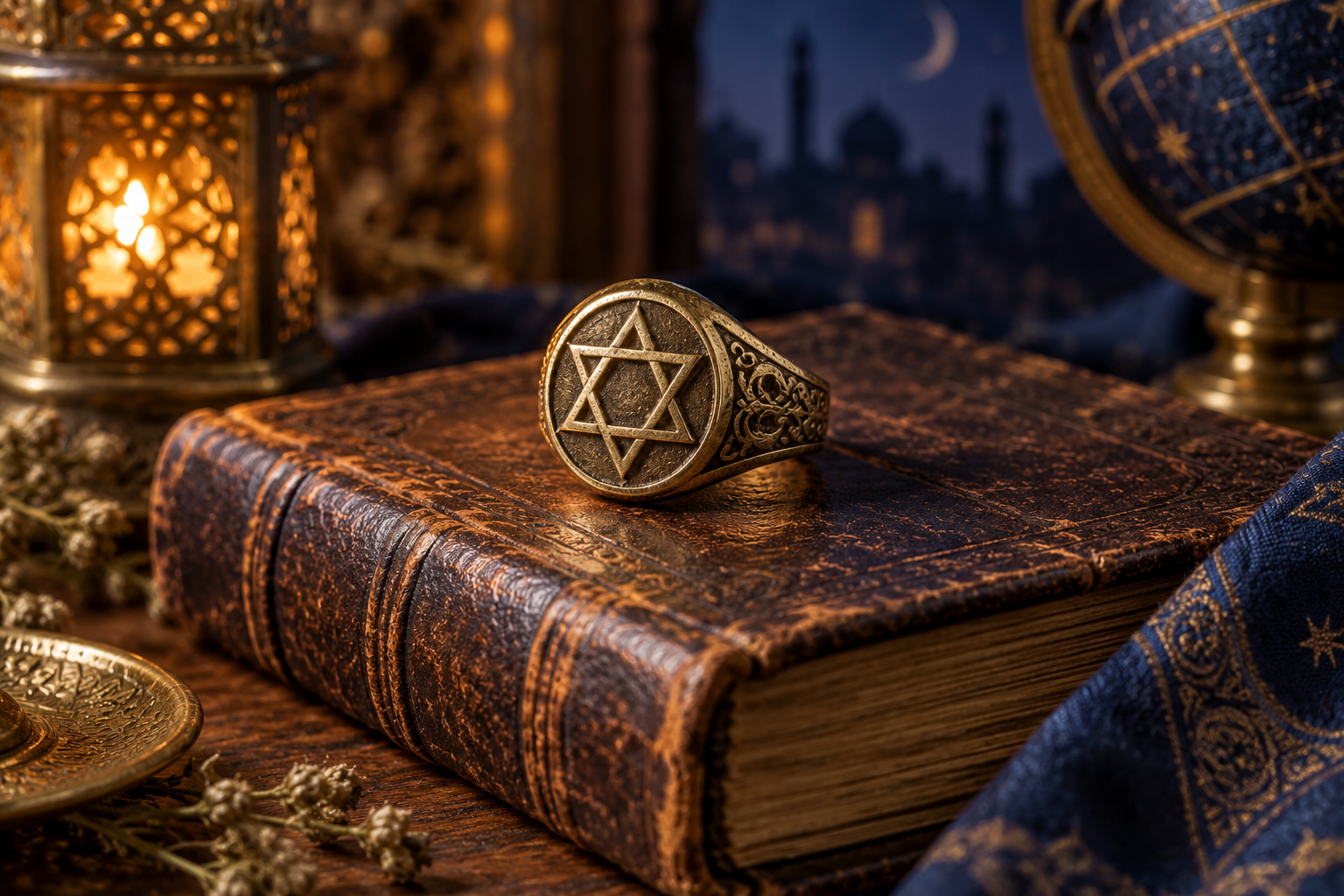
Solomon and the Queen of Sheba explained: the Bible account, Surah An-Naml, the throne of Bilqis, the ifrit's offer, the glass floor and Ethiopian legend.
Quick answer: Solomon and the Queen of Sheba is a story told in three major traditions. In the Hebrew Bible (1 Kings 10), the queen travels to Jerusalem to test Solomon's wisdom with hard questions and leaves impressed. In the Quran (Surah An-Naml 27:20–44), a hoopoe reports her sun-worshipping kingdom, Solomon writes to her, her throne is brought to his court in an instant, and she enters a palace floored with glass before submitting to God. Ethiopian tradition makes her the mother of Solomon's son Menelik.
Related guides: the ifrit in Solomon's court, King Solomon and the jinn, history of the Seal of Solomon, Surah Al-Jinn explained, the Testament of Solomon, kings of the jinn tradition.
| Source | Date and language | Queen's name | Key episodes |
|---|---|---|---|
| 1 Kings 10:1–13; 2 Chronicles 9:1–12 | Hebrew Bible, first millennium BCE | Unnamed | Queen tests Solomon with hard questions; exchange of gifts; she praises his God and returns home |
| Matthew 12:42; Luke 11:31 | Greek New Testament, 1st century CE | Queen of the South | Cited as one who traveled far to hear Solomon's wisdom |
| Surah An-Naml 27:20–44 | Quran, Arabic, 7th century CE | Unnamed (Bilqis in later commentary) | Hoopoe's report; Solomon's letter; throne brought in an instant; glass-floored palace; queen submits to God |
| Tafsir and qisas al-anbiya literature | Arabic, 8th century CE onward | Bilqis | Her lineage, legends about her legs and a jinn mother, marriage traditions |
| Kebra Nagast | Ethiopian Ge'ez, compiled around the 14th century CE | Makeda | Queen bears Solomon's son Menelik I, founder of the Solomonic dynasty |
Key Takeaways
The Queen of Sheba is a ruler who appears in the Hebrew Bible, the New Testament, the Quran, and a wide body of later Jewish, Christian, Islamic, and Ethiopian storytelling. In every version she is a powerful foreign monarch who hears of Solomon’s reputation and travels to meet him. Beyond that shared core, the traditions diverge in tone, detail, and purpose, which is exactly what makes the story of Solomon and the Queen of Sheba such a useful case study in how legends grow.
The earliest written account is 1 Kings 10:1–13, repeated with small changes in 2 Chronicles 9:1–12. The queen is never named. She arrives in Jerusalem with a large retinue, camels carrying spices, gold, and precious stones, and she questions Solomon on everything she has in mind. The text says he answered all of it. She praises his wisdom, his court, and his God, gives him gifts, receives gifts in return, and goes back to her own land.
Sheba itself is usually identified with the kingdom of Saba in southern Arabia, in what is now Yemen, whose capital Marib was famous for its great dam and its trade in frankincense and myrrh. Some ancient and medieval writers, including the historian Josephus, placed her instead in Ethiopia or Egypt. The Ethiopian tradition built on that southern placement and made her its own, calling her Makeda.
The Quran tells the fullest and most dramatic version of king Solomon and queen Sheba in Surah An-Naml (27:20–44), the chapter named for the ants. The episode opens with Solomon reviewing the birds and noticing that the hoopoe is absent. When the bird returns, it reports that it has found a woman ruling a people in Saba, that she has a magnificent throne, and that she and her people prostrate to the sun instead of God.
Solomon tests the report by sending a letter. The queen reads it to her council, which assures her of their military strength but leaves the decision to her. She chooses diplomacy and sends gifts. Solomon rejects them, saying what God has given him is better than what they offer, and warns that he will come with forces they cannot resist. The queen decides to travel to him herself.
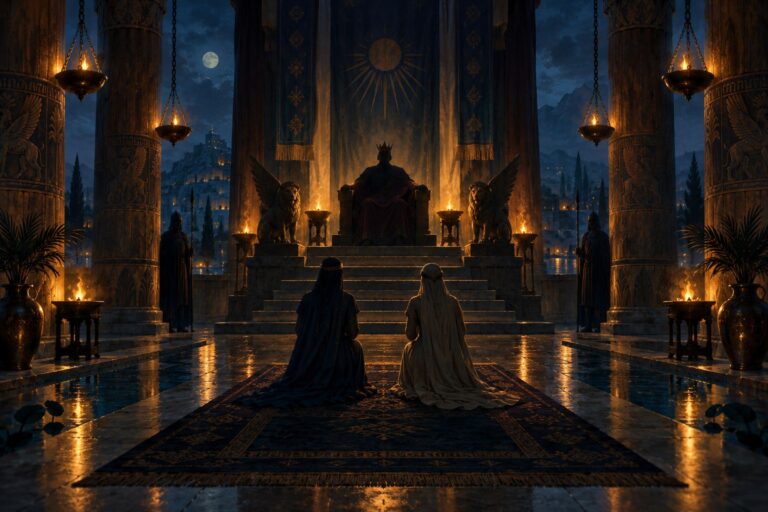
Before she arrives, Solomon asks his assembly who can bring her throne to him. An ifrit of the jinn says he can do it before Solomon rises from his seat. Then one who has knowledge of the Book says he can do it before Solomon’s glance returns to him, and the throne appears (27:38–40). Solomon orders the throne altered and asks her whether it is hers. Her answer, that it is as though it were the same, is read by commentators as a sign of her intelligence and caution.
Finally she is invited into the palace. Its floor is a sarh, a smooth surface of glass or crystal, which she mistakes for water, so she lifts her garment to wade through. Solomon explains what it is. She responds by declaring that she has wronged herself and now submits, with Solomon, to God, the Lord of the worlds (27:44). The story ends on that note of recognition rather than conquest.
Does this touch your own situation? Many readers come to these pages because something in their home, dreams or family feels unexplained. Reading history helps, but it cannot look at your specific case.
Consult the Sheikh Private, confidential, and free to ask.
The throne scene is the part of the story that readers of this site ask about most, because it is one of the few places in the Quran where a jinn speaks. The passage is short, so it is worth reading closely rather than relying on retellings. The ifrit’s offer stresses speed and reliability: he promises to bring the throne before Solomon stands, and adds that he is strong and trustworthy for the task.
Yet Solomon does not use him. The throne is brought instead by someone described only as having knowledge from the Book. The Quran does not name this person. Later commentators proposed various identities, including a scribe or minister of Solomon, and some suggested Solomon himself. The text leaves it open, and the contrast seems to be the point: raw jinn power is real, but knowledge connected to revelation outranks it. We discuss this contrast in detail in our article on the ifrit in Solomon’s court.
The name Bilqis is attached to the queen in tafsir (Quranic commentary) and in the qisas al-anbiya, the stories of the prophets, from roughly the eighth century onward. The Quran never names her. Once named, she gathered legends: that her mother was a jinn, that her legs were hairy or had a deformity which the glass floor was designed to reveal, that Solomon married her, or that he married her to a Yemeni king. These are later additions, and good readers keep them separate from the scriptural text.
Comparing the three major accounts side by side shows how each tradition shaped the same encounter for its own purpose.
In 1 Kings 10 the queen is a peer, not a convert in the formal sense. She comes with hard questions, and the narrative is interested in Solomon’s answers and the splendor of his court. Her praise of Solomon’s God is warm but brief. The passage sits inside a larger description of Solomon’s wealth, trade, and international fame.
Surah An-Naml reframes the meeting as a movement from sun worship to monotheism. The hoopoe, the letter, the council, the throne, and the glass floor all serve that movement. Solomon is a prophet-king whose authority over jinn and birds is a gift from God, not a personal achievement. The queen’s final words are a declaration of faith.
The Kebra Nagast, the Glory of Kings, was compiled in Ge’ez around the fourteenth century. It names the queen Makeda, tells of her journey to Jerusalem, and relates that she bore Solomon a son, Menelik I. Menelik later visits his father and, in the Ethiopian telling, the Ark of the Covenant comes to Ethiopia. This story underpinned the Solomonic dynasty’s claim to descent from Solomon until the twentieth century.
Later Jewish midrash expanded the riddles the queen asked. Christian readers followed Matthew 12:42 and Luke 11:31, where Jesus mentions the Queen of the South who came from the ends of the earth to hear Solomon’s wisdom. Medieval Christian art often painted her as a type of the Church or of the Magi coming to a greater king.
Because the story is retold so often, several claims circulate that the sources do not support. Here are the ones that come up most.
None of these corrections diminish the story. They simply let readers see which layer each detail comes from, which is the first step in reading any legend well.
Few biblical scenes have been painted, carved, and sung as often as this meeting. Medieval cathedral sculpture in France placed the queen beside Solomon as a pair of royal figures. Piero della Francesca painted her meeting Solomon in his fresco cycle in Arezzo in the fifteenth century, treating her as a figure of reverence for the wood of the future cross. Handel’s oratorio Solomon (1749) gave the world the orchestral piece now known as the Arrival of the Queen of Sheba, still played at weddings and ceremonies.
In Islamic manuscript painting, Persian and Ottoman artists loved the scene of Bilqis enthroned, surrounded by jinn, birds, and courtiers, with the hoopoe in attendance. These images were made centuries after the Quran and reflect the expanded legend rather than the bare text. In Ethiopia, painted panels telling the Makeda story in comic-strip rows remain a popular folk art form.
Today people search for the story for many reasons: Bible study, Quran study, curiosity about the throne of Bilqis after watching a documentary, interest in Ethiopian history, or simply the romance of a queen who crossed deserts to test a king. Archaeological work at Marib has kept Saba in the news, though no inscription naming the queen has been found.
If you want to go beyond summaries, read the three primary passages in order of length. Start with 1 Kings 10:1–13, which takes a few minutes. Then read Surah An-Naml 27:15–44 in a reliable translation, noting where the Quran names things and where it leaves them open. Finally, sample the Kebra Nagast in an English translation, remembering that it is a medieval national epic rather than scripture for most readers.
When you encounter the name Bilqis, the hairy legs, the jinn mother, or the marriage, ask which source the detail comes from. Commentators such as al-Tabari and later storytellers recorded many such traditions, often noting that they were reports rather than certainties. Treating those layers as later elaboration, not as the Quran itself, keeps the reading honest.
For the symbolic side of the story, the queen’s recognition of the altered throne and her correction at the glass floor are both about seeing truly. That theme connects to the wider Solomonic material on this site, including the history of the Seal of Solomon and the Quranic chapter devoted entirely to the jinn, Surah Al-Jinn. Read together, they show how Solomon came to stand for a kind of authority grounded in knowledge rather than force.
Still have a question about your own experience? Describe what you are seeing, feeling or dreaming, and when it started. The Sheikh reads every message personally and replies in private.
Thinking about a relationship of your own? The story of Solomon and Sheba is a meeting of two sharp minds, and if a bond in your own life is on your mind, a Relationship Harmony Ritual with our partner PuraTarot offers a gentle, reflective way to focus your intentions for it. Join the free Djinn Guide newsletter and, once you confirm, you will unlock a 50% code for your first reading.
Further reading
As an Amazon Associate we earn from qualifying purchases.
A foreign queen hears of Solomon's wisdom and travels to meet him. In the Bible she tests him with hard questions and exchanges gifts. In the Quran, Solomon learns of her from a hoopoe, writes to her, has her throne brought to his court, and she accepts God after mistaking a glass floor for water. Ethiopian tradition adds that she bore his son Menelik.
No. Surah An-Naml describes her only as a woman ruling a people in Saba. The name Bilqis appears in later Islamic commentary and in the stories of the prophets literature, from around the eighth century onward. The Bible also leaves her unnamed; the name Makeda is Ethiopian.
According to Surah An-Naml 27:38–40, an ifrit of the jinn offered to bring it before Solomon rose from his seat, but one who had knowledge of the Book brought it in the blink of an eye. The Quran does not name this person; commentators proposed a scribe or minister of Solomon.
Most scholars identify Sheba with Saba, an ancient kingdom in southern Arabia centered on Marib in modern Yemen, known for its dam and incense trade. Ethiopian tradition places the queen in Ethiopia, and some ancient writers such as Josephus linked her to Egypt and Ethiopia. Both regions had close trade ties.
Neither the Bible nor the Quran says so. Some later Islamic traditions report that Solomon married Bilqis or gave her in marriage to a Yemeni king, and the Ethiopian Kebra Nagast says she bore Solomon a son, Menelik I. These are later traditions, not part of the scriptural accounts.
Disclaimer
This article describes religious scripture, commentary, and folklore for educational and historical purposes. Beliefs about Solomon, the jinn, and the Queen of Sheba are presented as the traditions hold them, not as endorsed facts, and no outcome of any kind is promised.
Did this guide help you understand the subject? Rate it and share your honest opinion to help other readers. Every review is checked by our editors before it appears.
There are no reviews yet. Be the first one to write one.


Sheikh Youssef
Tayeb El Merzouki
For inquiries about personalized spiritual work, private rituals, and traditional talismans, connect directly with Sheikh Youssef Tayeb El Merzouki.
Chat on WhatsApp