







Join Djinn Guide: Get 50% Off a Personal Reading
Get new guides to jinn, folklore and occult history. Confirm your subscription to unlock a 50% code for a first personal reading with our partner PuraTarot.
Discover the unseen
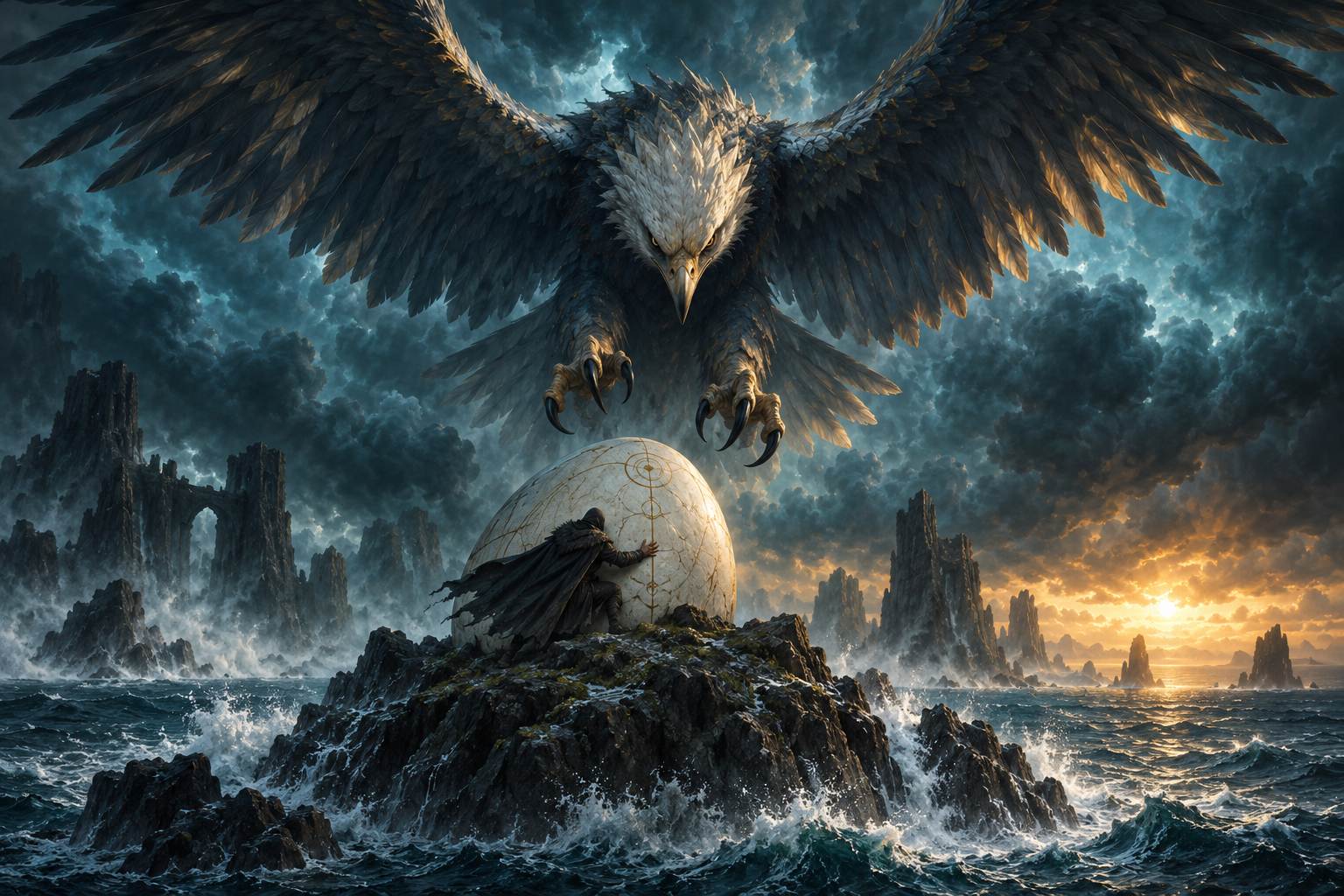
Roc bird explained: the giant rukh of Sinbad's voyages, Marco Polo's Madagascar report, the elephant bird theory, and its cousins from simurgh to Garuda.
Quick answer: The roc bird, or rukh in Arabic, is a legendary bird of prey so enormous that it feeds elephants to its chicks and darkens the sky when it flies. It is best known from Sinbad's second and fifth voyages in the Arabian Nights, where a roc carries the sailor to a valley of diamonds and later destroys his ship. Medieval travelers such as Marco Polo reported it near Madagascar, and some scholars connect it to the island's extinct elephant bird.
Related guides: Sinbad the Sailor's seven voyages, history of the 1001 Nights, jinn in the Arabian Nights, jinn and spirits in Persian mythology, Scheherazade's frame story, jinn stories across cultures.
| Bird | Tradition | Size and traits | Role in stories |
|---|---|---|---|
| Roc (rukh) | Arabic, Persian; Arabian Nights | Wings that darken the sky; carries elephants; eggs like domes | Transports Sinbad; destroys ships when its egg is broken |
| Simurgh | Persian; Shahnameh | Vast benevolent bird, often with dog or peacock features | Raises the hero Zal; heals and advises |
| Anqa | Arabic | Long-necked, often linked with the simurgh and phoenix | Proverbial for something that exists only in name |
| Garuda | Hindu and Buddhist | Eagle-like, golden, enemy of serpents | Mount of Vishnu; symbol of speed and strength |
| Ziz | Jewish rabbinic lore | Wingspan that blocks the sun | Ruler of birds; counterpart of Leviathan and Behemoth |
| Thunderbird | Native American | Creates thunder with its wings | Powerful spirit of storms |
| Elephant bird (Aepyornis) | Real, Madagascar, extinct | About 3 m tall, flightless, eggs up to 1 m around | Possible real-world seed of the roc legend |
Key Takeaways
The roc bird is a creature of medieval Arabic and Persian storytelling: a bird of prey so large that ordinary scale breaks down around it. In the Arabian Nights its egg looks like the white dome of a building, its wings blot out the sun as it approaches, and its talons can lift an elephant into the air. The Arabic name is rukhkh, usually written rukh in English, and the European form “roc” entered through French and Italian travel accounts.
The roc is not a god or a spirit. In the stories it behaves like an animal, nesting, hunting and defending its young, and that is part of its appeal. Where the jinn of the same tales think and scheme, the roc simply is, an immovable fact of nature that human travelers must survive. Sailors tie themselves to its leg, pirates steal its eggs, and the bird reacts as any raptor would, on an impossible scale.
Travelers took it seriously. From the thirteenth to the fifteenth century, Marco Polo, Ibn Battuta and the Arab geographers all reported the rukh as something sailors in the Indian Ocean had seen or heard about. That blend of story and report is why the roc sits between mythology and natural history in a way that few legendary animals do.
The roc’s most famous appearance is in the tale of Sinbad the Sailor’s seven voyages. On the second voyage, Sinbad is accidentally abandoned on an island and finds a gleaming white dome with no door. It is a roc’s egg. When the parent bird lands, he unwinds his turban, ties himself to its leg, and is carried at dawn to a mountain valley floored with diamonds and patrolled by giant serpents. Merchants, he learns, throw meat into the valley so that eagles will carry diamond-studded chunks to their nests; Sinbad ties himself to a piece of meat and escapes the same way.
The fifth voyage turns the roc from rescuer to avenger. Sinbad’s shipmates find another egg, break it open and cook the chick inside, ignoring his warning. Two rocs return, see what has happened, and each lifts a boulder in its claws. The first stone misses; the second shatters the ship. Sinbad alone survives, clinging to wreckage. The two episodes together give the roc its character: indifferent to humans, catastrophic when provoked.
A separate story in Burton’s translation, about the merchant Abd al-Rahman of the Maghreb, describes sailors who eat a roc chick and find their beards turning black again, a brief fantasy of rejuvenation. The roc tales are among the oldest layers of the Sinbad cycle, which itself was added to the Nights relatively late; the history of the 1001 Nights explains how those layers were assembled.
Does this touch your own situation? Many readers come to these pages because something in their home, dreams or family feels unexplained. Reading history helps, but it cannot look at your specific case.
Consult the Sheikh Private, confidential, and free to ask.
Marco Polo, dictating his travels around 1300, described an island he called Madagascar where a bird known as the rukh appeared at certain seasons. He said it resembled an eagle but was incomparably larger, that it could seize an elephant and drop it from a height to kill it, and that its wing feathers measured many paces. He reported that the Great Khan sent envoys to investigate and that they returned with a feather, which modern readers suspect was a frond of the raffia palm.
Polo’s “Madagascar” probably conflated the island with Mogadishu on the Somali coast, but the association stuck. Ibn Battuta, traveling in the fourteenth century, wrote that in the China Sea his companions saw what looked like a mountain rise from the water and, in terror, said it was the rukh. The thing turned out to be something else, but the fact that experienced sailors expected a giant bird tells us how widespread the belief was.
Arab encyclopedists such as al-Qazwini included the rukh among the wonders of creation, and Persian miniatures of the Mongol and Timurid periods painted it carrying elephants in its talons. By the time the Nights were translated into French in the early eighteenth century, European readers already knew the roc from these travel books.
The strongest real-world candidate is Madagascar’s elephant bird, Aepyornis, a flightless giant that stood around three meters tall and laid eggs roughly a meter in circumference, the largest eggs of any known animal. The birds survived into the second millennium CE, and their eggshells, whole or in fragments, were traded along the East African coast. An Arab merchant holding an Aepyornis egg could easily believe in a bird big enough to carry an elephant.
Other explanations have been proposed, and they are not mutually exclusive.
Most scholars settle on a combination: an old mythic image of the giant bird, reinforced by real objects and real animals glimpsed on the fringes of the Indian Ocean trade. The roc, on this view, is the Nights’ name for a story that nature kept confirming just enough to keep alive.
Giant birds are everywhere in world mythology, and the roc has clear relatives. The Persian simurgh, who in the Shahnameh raises the abandoned infant Zal on a mountaintop and later heals his son Rustam, is older than the roc and far more benevolent. Islamic-era writers sometimes used simurgh and rukh interchangeably, and Persian painters gave the roc the simurgh’s long, flame-like tail. Our survey of jinn stories across cultures looks at the same borrowing from the other side.
The Arabic anqa is a bird of proverb, something so rare it exists only in name, and medieval lexicons often identify it with the simurgh and the Greek phoenix. Farther east, Garuda, the eagle-mount of Vishnu, is a sworn enemy of serpents, a detail that may echo in the diamond valley guarded by snakes beneath the roc’s mountain. In Jewish rabbinic lore the Ziz is the king of birds, so large that its outstretched wings hide the sun, a counterpart to Leviathan in the sea and Behemoth on land.
What distinguishes the roc from all of these is its lack of personality. The simurgh speaks and gives counsel; Garuda has a biography; the Ziz is an eschatological symbol. The roc never says a word. It is nature at its largest, which makes it the perfect obstacle for a merchant hero whose only tools are wit and a length of turban cloth.
The first confusion is between the roc and the phoenix. Both are giant Eastern birds in Western imagination, but the phoenix is about death and rebirth, while the roc is about size and distance. The Nights never mention the roc burning or regenerating; the rejuvenation motif in the Abd al-Rahman story belongs to eating the chick, not to the bird itself.
The second is the idea that the roc has two heads. That image comes from Ray Harryhausen’s 1958 film The 7th Voyage of Sinbad, whose stop-motion roc was given two heads for visual effect. No Arabic source describes a two-headed rukh. Similarly, the giant birds that carry heroes across seas in later European fantasy are borrowings, not parallels.
The third is treating the roc as a jinn. The Nights are full of jinn, ifrits and marids, and readers sometimes assume every wonder in the book is a spirit. The roc belongs to a different category, the marvelous animal, alongside the giant serpents of the diamond valley and the fish-island of the first voyage. The distinction matters because jinn in these tales make bargains, while animals cannot be reasoned with. The site’s guide to jinn in the Arabian Nights covers the spirits proper.
The roc survived the transition from manuscript to screen better than most Nights creatures because it is easy to draw and hard to forget. Harryhausen’s two-headed version set the template for a generation of monster films, and the Sinbad cartoons and live-action adaptations that followed almost always include an egg, a valley and a giant shadow passing overhead.
Tabletop and video games adopted it early. Dungeons & Dragons has listed the roc as a monster since the 1970s, and card games and fantasy strategy titles use the name for any oversized bird. In these settings the roc is usually a hazard of mountain travel with no connection to the Indian Ocean, Madagascar or Sinbad, which is why many searchers meet the name first and the story second.
Interest also comes from natural history. Documentaries and museum displays about the elephant bird regularly mention the roc, and the question “was the roc real” is one of the most common ways people arrive at the legend. The answer, as the sections above show, is no and almost: the bird is imaginary, but the egg that inspired it may well have been real.
Begin with the Sinbad tales in a complete translation. Burton’s version is public domain and lively but Victorian; Husain Haddawy’s translation of the Nights is clearer, though Sinbad appears only in his second volume because the cycle was a later addition. Read the second and fifth voyages back to back and notice how the roc’s role flips from carrier to destroyer.
Then read Marco Polo’s chapter on “Madagascar” and the relevant passage of Ibn Battuta. Both are short and widely available. Comparing them with the Nights shows how a traveler’s rumor and a storyteller’s set piece fed each other over several centuries.
Finally, treat the elephant-bird theory as a reasonable hypothesis rather than a proven fact. It explains the eggs and the East African setting; it does not explain the Persian simurgh or the universal appeal of the giant bird. The roc, like most good legends, has more than one parent, and the pleasure of reading about it lies in watching those parents meet.
Still have a question about your own experience? Describe what you are seeing, feeling or dreaming, and when it started. The Sheikh reads every message personally and replies in private.
Has a dream or sign stayed with you? Great birds like the Roc have carried travelers’ hopes and fears for centuries, and our partner PuraTarot offers a Custom Spiritual Session for readers who want a personal perspective on a dream, a sign or a decision of their own. Join the free Djinn Guide newsletter and, once you confirm, you will unlock a 50% code for your first reading.
Further reading
As an Amazon Associate we earn from qualifying purchases.
A roc, or rukh, is a legendary giant bird of Arabic and Persian folklore, large enough to carry an elephant in its talons and to darken the sky in flight. It appears in the Arabian Nights, most famously in Sinbad's second and fifth voyages, and in medieval travel accounts by Marco Polo and Ibn Battuta.
No. The roc is a mythical creature. Many scholars think the legend was reinforced by Madagascar's extinct elephant bird, a flightless giant whose meter-round eggs reached Arab traders, and by exaggerated reports of large eagles. The image of the enormous bird also draws on older Persian and Indian mythology.
On his second voyage Sinbad ties himself to a roc's leg and is carried to a valley of diamonds. On his fifth voyage his shipmates break a roc egg and kill the chick; the parent rocs drop boulders on the ship and sink it. The bird is both his means of escape and the cause of his ruin.
The simurgh is a benevolent, wise bird of Persian mythology that speaks, raises heroes and heals in the Shahnameh. The roc is a wild animal of enormous size that never speaks. Islamic-era writers sometimes used the names interchangeably, and Persian painters gave the roc the simurgh's long tail feathers.
He did not claim to see it himself. Polo reported that people on an island he called Madagascar described a bird called the rukh that could lift an elephant, and that the Great Khan's envoys brought back a feather. The feather was probably a raffia palm frond, and his island may have been Mogadishu.
Disclaimer
This article treats the roc as a creature of folklore and literary history. Stories are described as stories, and the natural-history explanations offered are scholarly hypotheses rather than settled facts.
Did this guide help you understand the subject? Rate it and share your honest opinion to help other readers. Every review is checked by our editors before it appears.
There are no reviews yet. Be the first one to write one.


Sheikh Youssef
Tayeb El Merzouki
For inquiries about personalized spiritual work, private rituals, and traditional talismans, connect directly with Sheikh Youssef Tayeb El Merzouki.
Chat on WhatsApp