





Join Djinn Guide: Get 50% Off a Personal Reading
Get new guides to jinn, folklore and occult history. Confirm your subscription to unlock a 50% code for a first personal reading with our partner PuraTarot.
Discover the unseen
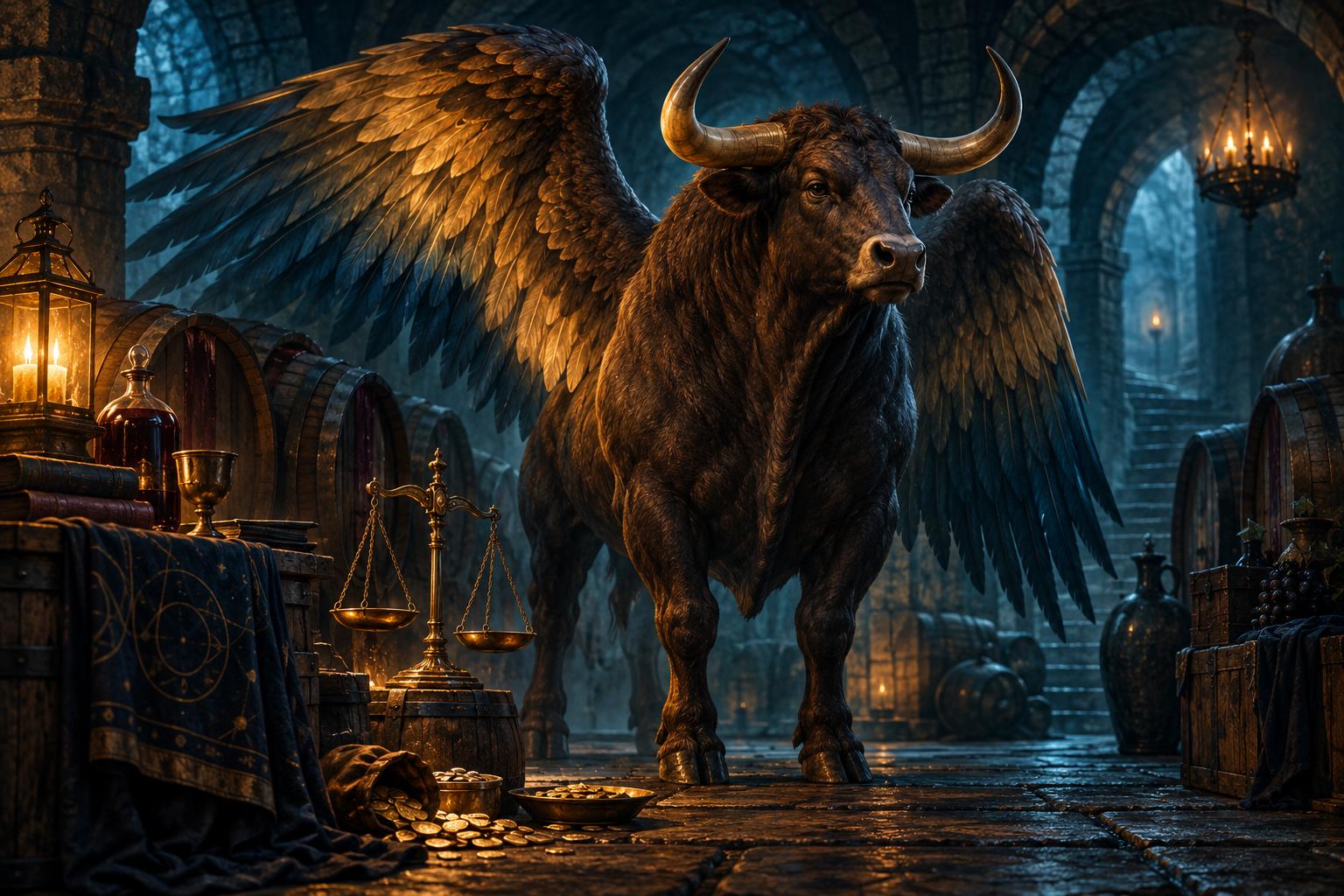
Zagan demon profile: the 61st Ars Goetia spirit, a king and president shown as a bull with griffin's wings. Rank, legions, sigil, offices and sources.
Quick answer: The Zagan demon is the sixty-first spirit of the Ars Goetia, holding the double rank of king and president. The Lemegeton says he first appears as a bull with griffin's wings and then takes human form. His offices are to make people witty, to turn wine into water and water into wine, to turn blood into wine, to change any metal into coin of that metal, and to make fools wise. He commands thirty-three legions. Weyer's 1577 catalog lists the same profile under the name Zagan.
Related guides: the complete list of 72 Goetia demons, Goetia ranks from king to knight, Ars Goetia names, offices and sigils, Bael and Paimon, the Goetia kings, Valac, the winged child president, Marbas, the lion president.
| Spirit | Number & rank | Appearance | Main offices | Legions |
|---|---|---|---|---|
| Zagan | 61, King and President | A bull with griffin's wings, then a man | Wit, transmuting wine, water, blood and metals, making fools wise | 33 |
| Marbas | 5, President | A great lion, then a man | Secrets, diseases, mechanical arts, shape-changing | 36 |
| Valac | 62, President | A winged boy on a two-headed dragon | Hidden treasure, finding serpents | 30 or 38 |
| Haagenti | 48, President | A bull with griffin's wings, then a man | Wisdom, turning metals into gold, wine into water | 33 |
Key Takeaways
Zagan, also spelled Zagam, is the sixty-first of the seventy-two spirits in the Ars Goetia, the first book of the Lesser Key of Solomon. In the Mathers and Crowley edition of 1904 the entry describes him as “a Great King and President” who “appeareth at first in the Form of a Bull with Gryphon’s Wings; but after a while he putteth on Human Shape.” The text says he makes men witty, turns wine into water and water into wine, turns blood into wine, can change any metal into the coin of that metal, and can make even fools wise. He is said to govern thirty-three legions of spirits.
Holding two ranks is rare in the catalog. Most spirits are a king, a duke, a marquis or so on; a handful, including Zagan, Gaap and Haagenti, are listed with a second title. The grimoire never explains what the double rank means in practice. Modern commentators sometimes read it as a sign that two separate entries were merged, or that the spirit was thought to answer to more than one planetary power. For how the ranks fit together, see our guide to the demon hierarchy of the Goetia.
Like most Goetia spirits, Zagan has no life outside the grimoires. He does not appear in scripture, in classical mythology or in medieval demonologies before Weyer. His entire profile is a short paragraph that was copied, translated and lightly edited over three centuries, and that is what this article examines.
The first printed appearance of Zagan is in Johann Weyer’s Pseudomonarchia Daemonum of 1577, the catalog of sixty-nine spirits he attached to his De Praestigiis Daemonum. Weyer, a physician who argued that accused witches were deluded rather than guilty, published the list to discredit the magicians who used it. His entry reads that Zagan is a great king and president who comes forth like a bull with griffin’s wings, and when he takes human shape he makes men witty, turns wine into water and blood into wine, also water into wine, turns all metals into the coin of the realm, and makes fools wise. Weyer gives him thirty-three legions.
Reginald Scot’s Discoverie of Witchcraft (1584) carried this text into English with little change. The Ars Goetia, assembled in the seventeenth century, reorganized Weyer’s spirits, added four more and attached a seal to each. Zagan’s description survived the process almost intact; the only visible edit is the phrase “coin of that metal” in place of Weyer’s “coin of the realm,” a small shift from a kingdom’s currency to the metal’s own.
What stands out when the sources are laid side by side is the stability of the entry. Rank, form, offices and legions all match across Weyer, Scot and the Goetia. For a spirit as obscure as Zagan, that consistency is itself evidence that the compilers were copying from a shared source rather than inventing freely.
Does this touch your own situation? Many readers come to these pages because something in their home, dreams or family feels unexplained. Reading history helps, but it cannot look at your specific case.
Consult the Sheikh Private, confidential, and free to ask.
The seal given to Zagan in the Mathers edition is a wide, roughly symmetrical figure. A horizontal baseline runs across the bottom, and from it rise several vertical and diagonal strokes that end in small circles or short crossbars. Above the center a curved element arches like a bow or a crescent, and a pair of outward-sweeping lines on either side suggest, to some viewers, the spread wings of the bull the text describes. As with all the Goetia seals, this resemblance is in the eye of the reader; the glyph is abstract.
The Ars Goetia treats these seals as the spirits’ signatures, to be worn by the operator so that the spirit will obey. Their origins are unclear. Joseph Peterson’s critical edition, drawn from the British Library manuscripts, shows small differences from Mathers in Zagan’s seal, particularly in the number and placement of the terminal circles. These variations are copyist’s drift rather than meaningful alternatives.
This site presents the Zagan sigil as a historical design and does not provide instructions for its use. The broader history of these characters, from Solomonic manuscripts to modern practice, is explained in our article on what a sigil is.
Zagan’s offices are unusually coherent. Nearly all of them concern changing one thing into another.
Turning water into wine is the first miracle of the Gospel of John, and reversing it, wine into water, is a pointed inversion. Adding blood into wine deepens the pattern; the Eucharist turns wine into blood, and Zagan reverses that too. Whether the compilers intended blasphemy or simply listed liquid transformations is unknown, but a sixteenth-century reader would have caught the echo.
The promise to turn any metal into the coin of that metal is a counterfeiter’s dream. Coining was a capital offense across early modern Europe, and the office suggests the practical, often criminal hopes that attached to grimoire magic. It also places Zagan near alchemy, the art of transmuting metals, which was respectable in a way that coining was not.
Making men witty and fools wise is a mental transformation to match the physical ones. Several Goetia spirits teach sciences or languages; Zagan instead changes the mind’s quality. The office mirrors the president rank, which the tradition links with Mercury, the planet of intellect.
A bull with griffin’s wings combines earthly strength with a creature of the air. Winged bulls are ancient Near Eastern images, as in the Assyrian lamassu, though the Goetia’s compilers more likely drew on heraldry and bestiaries than on archaeology. The form is shared exactly with Haagenti, discussed below.
Jacques Collin de Plancy’s Dictionnaire Infernal, first issued in 1818, includes an entry for Zagan (Zagam in some French editions) that repeats the Weyer profile: a king and president, a bull with griffin’s wings, a transformer of wine, water, blood and metal, a maker of wit and wisdom, with thirty-three legions. For the 1863 edition Louis Le Breton produced sixty-nine engravings, and Zagan was among the spirits he drew. His image shows a heavy bull’s body with large feathered wings, a somewhat human cast to the face and a crown or raised brow to mark the royal rank.
That engraving has done more for Zagan’s modern recognition than any text. It appears in countless reproductions, on posters and in books of demon imagery, and it is the model for most contemporary illustrations. Readers should remember that Le Breton worked from the same brief paragraph as everyone else; his bull is an artist’s reading, not a traditional portrait.
Later occult systems added attributions. Crowley’s 1904 edition assigns Zagan a night-demon position in the zodiacal scheme, and twentieth-century books of correspondences give him colors, planets and days. These are modern constructions layered on the grimoire. For how catalogs like Weyer’s and de Plancy’s were built and used, see our overview of what demonology is.
Readers who move through the Goetia in order notice that Zagan, spirit 61, closely resembles Haagenti, spirit 48. Both are presidents; both appear as a bull with griffin’s wings before taking human shape; both make men wise, turn water into wine and wine into water, and change metals into gold or coin; both command thirty-three legions. The main differences are that Zagan is also a king, works with blood as well as wine, and makes fools wise, while Haagenti turns all metals into gold specifically.
Such overlaps occur elsewhere in the catalog. Bael and Paimon are both kings with human-and-animal forms; several spirits teach the same sciences. The usual explanation is that the list grew by accretion from multiple earlier sources, and that near-duplicates were kept rather than merged. Weyer already has both Zagan and Haagenti, so the doubling predates the Goetia.
For the reader this matters in one way: a description that seems to be about Zagan may in fact be about Haagenti, and vice versa. Checking the number and the extra details, kingship and blood for Zagan, gold for Haagenti, keeps the two apart. The comparison table above sets Zagan beside Haagenti, Marbas and Valac so the distinctions are visible at a glance.
Zagan is a minor figure compared with Asmodeus, Belial or Paimon, but the winged bull has given him a foothold in media that draw on the Goetia. He appears as a summonable or collectible demon in several Japanese games and gacha titles built around the seventy-two spirits, usually depicted close to Le Breton’s engraving. The name has been used for characters in manga and light novels with Goetia themes and for the occasional metal band or album.
Online occult communities discuss Zagan mainly in connection with alchemy and with the phrase “makes fools wise,” which some modern writers treat as a patron office for learning. Such readings go beyond the text, which is a list of claims rather than a personality. The grimoire gives no voice, mood or history to Zagan; everything of that kind is contemporary invention.
His relatively low profile is itself informative. Spirits with vivid engravings and striking offices tend to be adopted by fiction; those without stay obscure. Zagan sits in between, recognizable by his image but rarely given a story. That leaves readers free to approach the sources without a famous fictional version in the way, which is not true of Valac after The Nun or Paimon after Hereditary.
The entire primary tradition on Zagan fits on one page: Weyer’s Latin entry of 1577, Scot’s English version of 1584, the seventeenth-century Goetia manuscripts, the Mathers and Crowley printing of 1904, and Peterson’s critical edition of 2001. De Plancy’s Dictionnaire adds a French summary and Le Breton’s engraving. Anything beyond these is interpretation.
When evaluating a modern source, check three things. First, whether it gives the double rank of king and president; dropping one is a sign of careless copying. Second, whether it keeps the thirty-three legions and the full set of transformations, including blood into wine, which some writers omit. Third, whether it confuses Zagan with Haagenti. A source that passes all three is at least reading the grimoire.
This site describes the Goetia as a historical document and does not offer ritual instructions or claims about results. For Zagan’s position in the full roster, see the 72 demons of Solomon, and for how the names, offices and seals were organized, our guide to the Ars Goetia.
Still have a question about your own experience? Describe what you are seeing, feeling or dreaming, and when it started. The Sheikh reads every message personally and replies in private.
Want a personal perspective? Zagan is remembered as a spirit of transformation, turning one thing into another, a theme many readers recognize in their own lives. A Full Personal Reading from our partner PuraTarot offers a personal, reflective look at the changes you are facing. Join the free Djinn Guide newsletter and, once you confirm, you will unlock a 50% code for your first reading.
Further reading
As an Amazon Associate we earn from qualifying purchases.
Zagan is the sixty-first spirit of the Ars Goetia, a king and president who appears as a bull with griffin's wings and then as a man. The Lemegeton says he makes people witty, turns wine into water and water into wine, blood into wine, metal into coin, and fools wise, commanding thirty-three legions.
The grimoire describes Zagan as a bull with griffin's wings who later takes human form. Louis Le Breton's 1863 engraving for the Dictionnaire Infernal shows a heavy winged bull with a crowned, partly human face, and most modern images follow that drawing. The same form is given to Haagenti, spirit 48.
Zagan holds two ranks, king and president, one of only a few Goetia spirits with a double title. He is said to rule thirty-three legions. These details are the same in Weyer's Pseudomonarchia Daemonum (1577), Scot's translation (1584) and the Mathers edition of the Goetia (1904).
They are near duplicates. Both are presidents shaped like winged bulls with thirty-three legions and powers over wine, water and metals. Zagan is also a king, turns blood into wine and makes fools wise, while Haagenti specifically turns metals into gold. Both appear in Weyer, so the doubling is older than the Goetia.
According to the Lemegeton, Zagan makes men witty, turns wine into water, water into wine, and blood into wine, changes any metal into coin of that metal, and can make fools wise. These are claims recorded in a historical text; this site does not present them as real effects or provide any instructions.
Disclaimer
This article describes Zagan as he appears in historical grimoires and demonologies for educational and cultural interest. The beliefs summarized are not endorsed, no ritual instructions are given, and no claim is made that any spirit, seal or practice produces results.
Did this guide help you understand the subject? Rate it and share your honest opinion to help other readers. Every review is checked by our editors before it appears.
There are no reviews yet. Be the first one to write one.


Sheikh Youssef
Tayeb El Merzouki
For inquiries about personalized spiritual work, private rituals, and traditional talismans, connect directly with Sheikh Youssef Tayeb El Merzouki.
Chat on WhatsApp