





Join Djinn Guide: Get 50% Off a Personal Reading
Get new guides to jinn, folklore and occult history. Confirm your subscription to unlock a 50% code for a first personal reading with our partner PuraTarot.
Discover the unseen
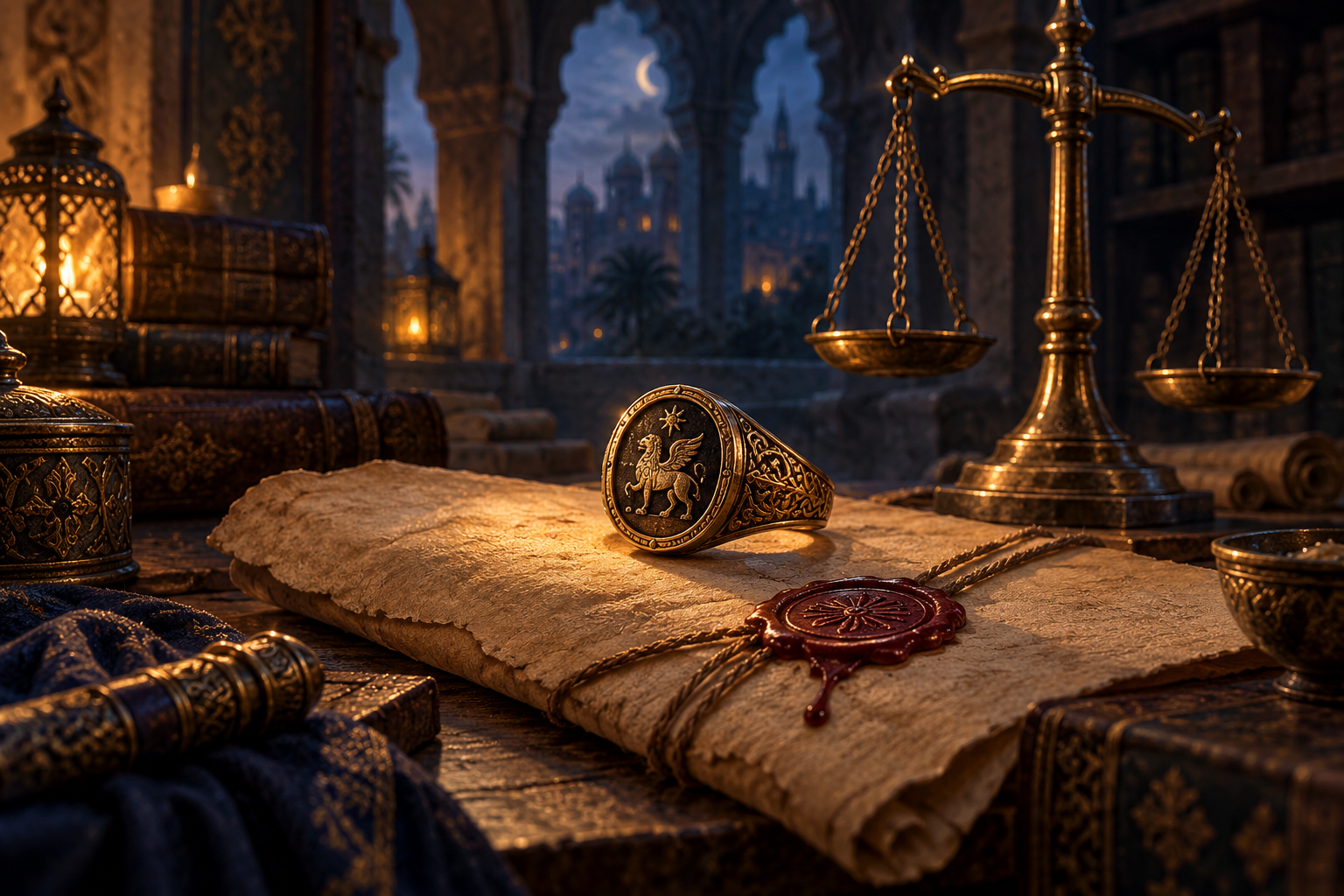
The Ring of Solomon in the Testament of Solomon: how the ring was given, which demons it bound, why its power failed, and how later traditions reused it.
Quick answer: The Ring of Solomon is the signet ring that, according to the Testament of Solomon, the archangel Michael brought to King Solomon from God so he could bind demons and force them to help build the Temple. Its power rested on the divine seal engraved on it, not on Solomon himself. The Greek text, written between roughly the first and fifth centuries CE, is the earliest full account of the ring and the source for most later legends, including those in Islamic folklore and European grimoires.
Related guides: Testament of Solomon full summary, Seal of Solomon history and meaning, King Solomon and the demons, Asmodeus in the Testament of Solomon, Beelzebub, prince of demons, the seal in the Arabian Nights.
| Source | Period | How the ring is obtained | What the ring does |
|---|---|---|---|
| Hebrew Bible (1 Kings) | c. 6th century BCE | No ring mentioned | Not applicable; Solomon's wisdom is a gift from God |
| Josephus, Antiquities 8 | 1st century CE | No ring; a ring with a root is used by an exorcist named Eleazar | Draws a demon out through a possessed man's nostrils |
| Testament of Solomon | c. 1st to 5th century CE | Archangel Michael delivers it from God after Solomon prays | Binds demons, compels them to reveal names and weaknesses, sets them to work |
| Islamic Quran commentary and folklore | 8th century CE onward | Granted by God; stolen by the jinni Sakhr in one tale | Rules jinn, wind and animals; its loss means loss of kingship |
| Lesser Key of Solomon (Lemegeton) | 17th century CE | Prepared by the operator following the book | Claimed protection from a spirit's harmful breath |
| Arabian Nights | Medieval, printed 18th to 19th century | Not shown; its seal stamps the bottles that hold jinn | Keeps rebellious jinn imprisoned |
Key Takeaways
In the Testament of Solomon, the ring is a gift with a purpose. The narrative opens with the construction of the Temple in Jerusalem. Solomon notices that his favored master workman’s young son is wasting away, and the boy explains that each evening a demon comes, takes half his wages and food, and sucks his right thumb. Solomon goes to the Temple and prays. In answer, the archangel Michael arrives carrying a small ring engraved with a seal and tells the king that with it he will bind all the demons, male and female, and use them to build the Temple.
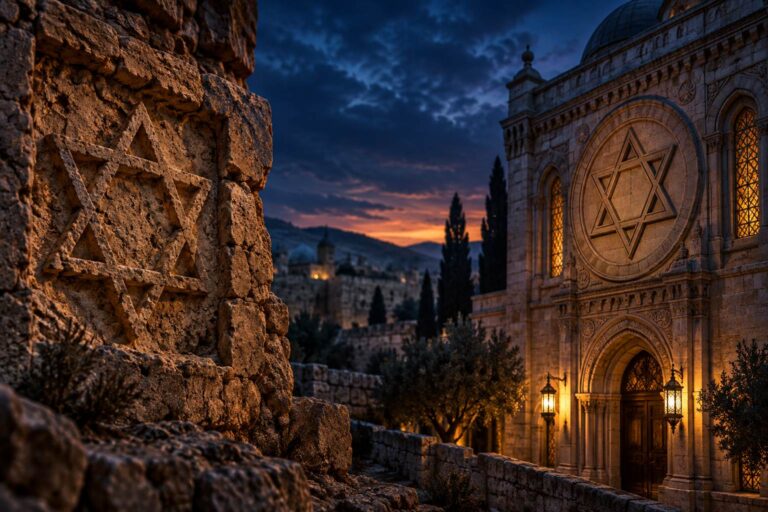
Two details define the ring’s authority from the start. First, the seal, not the metal, carries the power; the text repeatedly refers to the seal of the ring and in some manuscripts describes its engraving as a pentalpha, a five-pointed star. Second, Solomon does not use the ring himself at first. He gives it to the boy, who throws it at the demon’s chest and commands him in the king’s name. The ring works for whoever wields it under Solomon’s authority, which becomes important later in the story.
The demon caught that night is Ornias. Brought before the king, he gives his name, admits what he has been doing, and reveals that he lives in the constellation Aquarius and can be thwarted by the archangel Ouriel. Solomon sets him to cutting stone. This pattern, binding, interrogation, revelation of a counter-angel and assignment of labor, repeats for every spirit in the book. For the whole narrative, see our guide to the Testament of Solomon.
The Testament of Solomon survives in Greek manuscripts, the earliest fragments from around the fifth or sixth century and the main copies from the medieval period. Scholars generally place the composition between the first and fifth centuries CE, with many favoring a date around the third century. The text is pseudepigraphal, meaning it is written in Solomon’s voice but was composed long after his lifetime, probably in a Greek-speaking environment with Jewish and early Christian elements.
The first modern English translation was published by F. C. Conybeare in 1898, and the standard critical edition was prepared by Chester Charlton McCown in 1922. McCown identified several recensions, showing that scribes expanded and rearranged the material over time. Some demon lists and astrological passages belong to later layers, so readers should expect variation between translations.
None of this diminishes the text’s importance. It is the bridge between the biblical Solomon, famous for wisdom, and the medieval Solomon, famous for commanding spirits. Josephus, writing in the first century CE, already reports that Solomon composed incantations and that a Jewish exorcist named Eleazar used a ring containing a root to draw a demon out of a possessed man before the emperor Vespasian. The Testament gives that reputation a story and a ring.
Does this touch your own situation? Many readers come to these pages because something in their home, dreams or family feels unexplained. Reading history helps, but it cannot look at your specific case.
Consult the Sheikh Private, confidential, and free to ask.
The middle of the Testament is a procession of spirits, each compelled by the ring to appear and answer. The sequence gives a sense of how the authors imagined demonic variety and the limits of the ring’s power.
The thumb-sucking demon from the opening. He can take the shape of a woman, a lion, or a winged being. Solomon later sends him with the ring to fetch the prince of demons.
Called the prince of demons, he is brought by Ornias and bound. He explains that he was once a high angel and that he works through the demons under him. He is set to cut marble. Our profile of Beelzebub traces the name from Philistine deity to this text.
A female spirit with a beautiful body and the legs of a mule, who lives in caves and cliffs and leads men astray. She is set to spin hemp for ropes.
Hostile and proud, he breaks marriages and spreads madness, and is thwarted by the archangel Raphael and by the smoke of a burning fish’s liver and gall, an echo of the Book of Tobit. Solomon sets him to kneading clay. See our article on Asmodeus.
The parade continues with Lix Tetrax, who raises whirlwinds; the seven spirits of the heavenly bodies; the female demon Obyzouth, who harms newborns; the dog-shaped Rabdos; a lion-shaped spirit; a three-headed dragon; and the thirty-six decans, each tied to a disease. Each reveals the angelic name that defeats it, and the ring compels the confession.
The Testament does not end in triumph. After the Temple is complete, Solomon falls in love with a Shunammite (or, in some manuscripts, Jebusite) woman. Her people’s priests refuse to allow the marriage unless he worships their gods, and Solomon, resisting at first, finally sacrifices locusts to Moloch and Raphan. At that moment, the text says, the spirit of God departs from him and his wisdom fails. The demons he had bound are no longer under his command.
The moral of the ending explains the whole theology of the ring. The power was never Solomon’s property. It was a delegation from God, conditional on the king’s fidelity, and the engraved seal was its outward sign. The ring is still in his hand when he loses the ability to use it. This is why the text calls itself a testament: it is written as the aging king’s warning to readers not to repeat his fall.
Readers familiar with the Hebrew Bible will recognize the source. 1 Kings 11 reports that Solomon’s foreign wives led him to build shrines to Chemosh, Molech and other deities, and that God consequently promised to divide the kingdom. The Testament retells that passage with the ring as the measure of what was lost.
Islamic tradition developed its own version of the ring without the Testament. The Quran describes Solomon’s command over jinn, wind and animals (Surah Saba 34:12 to 13; Surah An-Naml 27:16 to 17) but names no ring. The ring enters through commentary on Surah Sad 38:34, where a body is said to have been placed on his throne. Commentators told of a jinni, often named Sakhr, who obtained the ring, took Solomon’s likeness and ruled in his place for forty days while the true king wandered as a beggar, until the ring was found inside a fish.
The story has the same logic as the Testament: the ring confers kingship, so whoever holds it can impersonate the king, and its loss strips him of authority until repentance. Early Muslim scholars themselves debated whether the tale was authentic, and many later commentators rejected it as borrowed from non-Islamic sources. Our article on King Solomon and the demons covers the Quranic material and the commentary tradition.
In the Arabian Nights the ring is offstage but its seal is everywhere. Bottles and vessels stamped with Solomon’s seal hold imprisoned jinn for centuries, and the Fisherman and the Jinni turns on the fact that even a rebellious spirit cannot break that seal.
European manuals of ceremonial magic took the ring from the legend and turned it into equipment. The Lesser Key of Solomon, compiled in the seventeenth century from older material, includes a ring the operator is to wear as protection, specifically against the fiery breath of the spirit Amaymon, together with a hexagram and pentagram of Solomon and the Secret Seal said to have closed the brass vessel of the seventy-two spirits.
The shift is significant. In the Testament the ring is unique and given once by heaven to one righteous king. In the grimoires it becomes a reproducible object any trained operator can prepare, and its authority is grounded in the correctness of the procedure rather than in the character of the user. This reflects the general transformation of Solomonic legend into technical magic during the late medieval and early modern period.
Djinn Guide describes these books as historical documents only and does not provide instructions for their use.
The most common error is to assume the ring is biblical. It is not; the Bible attributes Solomon’s achievements to wisdom and never mentions a magic ring. A second error is to merge the palmistry term with the legend. In hand reading, the “ring of Solomon” is a small curved line beneath the index finger, a nineteenth- and twentieth-century usage unrelated to the ancient text.
A third misunderstanding concerns the engraving. Some sources state flatly that the ring bore a hexagram, others a pentagram; the Testament’s manuscripts vary, and medieval Islamic and Jewish art used both. A fourth is that the ring made Solomon invulnerable. The Testament shows the opposite: the ring worked only while he remained faithful.
Searches for the ring of Solomon come from people reading about the Temple, from fans of games and fiction where the ring is a plot device, from students of the Goetia and from people hoping to buy a protective ring. For all of them, the Testament of Solomon offers the same insight: the ring is a story about delegated authority and its loss, not about a self-powered artifact.
That framing makes the text easier to read. Each demon’s confession is a miniature lesson about illness, misfortune and the angelic order that limits them; the ending is a lesson about the king. Modern retellings that present the ring as a weapon or a treasure strip out exactly the part the original authors cared about.
To compare sources, read the Testament first, then the relevant Quranic verses with a commentary, then the Fisherman and the Jinni. Keep a note of which elements each adds: Michael, Ornias and the labor of demons from the Testament; Sakhr and the fish from Islamic commentary; sealed bottles from the Nights. The ring of King Solomon is best understood as the sum of those layers, each reported here as tradition rather than as fact.
Still have a question about your own experience? Describe what you are seeing, feeling or dreaming, and when it started. The Sheikh reads every message personally and replies in private.
Drawn to these stories for a reason? Legends of Solomon’s ring are about authority and wisdom, themes many readers recognize in their own lives. A Full Personal Reading with our partner PuraTarot offers a calm space to reflect on your own question. Join the free Djinn Guide newsletter and, once you confirm, you will unlock a 50% code for your first reading.
Further reading
As an Amazon Associate we earn from qualifying purchases.
It is a signet ring engraved with a divine seal that the archangel Michael delivers to Solomon after he prays for help against a demon tormenting a young workman. With it Solomon binds demons, compels them to reveal their names and weaknesses, and sets them to work building the Temple in Jerusalem.
In the Testament of Solomon the ring comes from God and is delivered by the archangel Michael. Islamic commentary likewise treats the ring as a divine gift tied to Solomon's kingship. The Bible does not mention a ring at all, so every account of its origin comes from post-biblical literature.
The Testament lists many, beginning with Ornias, then Beelzeboul, Onoskelis, Asmodeus, Lix Tetrax, the seven spirits of the heavenly bodies, Obyzouth, the dog-shaped Rabdos, a lion-shaped spirit, a three-headed dragon and the thirty-six decans. Each is forced to name the angel that can defeat it and is assigned labor on the Temple.
In the Testament, Solomon keeps the ring but loses its authority when he sacrifices to foreign gods for the sake of a woman he loves; the spirit of God departs and the demons are freed. In Islamic folklore, a jinni named Sakhr steals the ring and rules in Solomon's place until it is recovered from a fish.
They are closely linked. The seal is the emblem engraved on the ring, usually drawn as a six-pointed or five-pointed star, and the ring is the object that carries it. In most sources the power is attributed to the seal, which is why the same design appears on amulets, bottles and manuscripts without the ring.
Disclaimer
This article describes an ancient pseudepigraphal text and later legends for historical and educational purposes. Beliefs about demons, jinn and the ring are presented as beliefs held within their traditions, and no ritual instructions or claims of effect are offered.
Did this guide help you understand the subject? Rate it and share your honest opinion to help other readers. Every review is checked by our editors before it appears.
There are no reviews yet. Be the first one to write one.


Sheikh Youssef
Tayeb El Merzouki
For inquiries about personalized spiritual work, private rituals, and traditional talismans, connect directly with Sheikh Youssef Tayeb El Merzouki.
Chat on WhatsApp