






Join Djinn Guide: Get 50% Off a Personal Reading
Get new guides to jinn, folklore and occult history. Confirm your subscription to unlock a 50% code for a first personal reading with our partner PuraTarot.
Discover the unseen
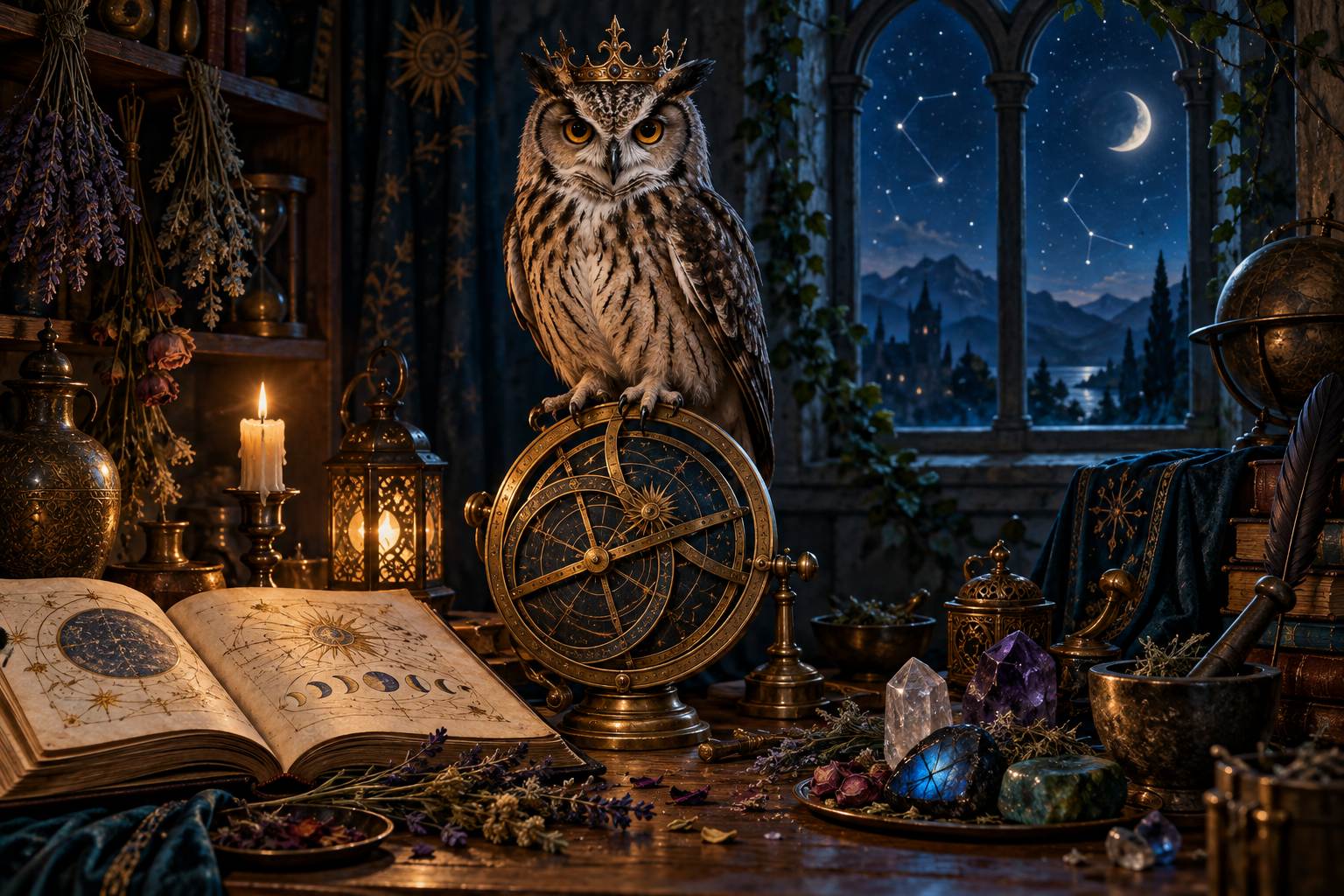
Stolas demon explained: the Goetia's 36th spirit, a Great Prince who teaches astronomy and herbs. See why he is drawn as an owl and what the old books say.
Quick answer: The Stolas demon is the thirty-sixth spirit listed in the Ars Goetia, the first book of the Lesser Key of Solomon. The text calls him a Great Prince who commands twenty-six legions, first appears as a large raven and then takes human shape, and teaches astronomy, the virtues of herbs, and the properties of precious stones. The familiar owl image comes from a nineteenth-century French illustration, not from the grimoire itself.
Related guides: Ars Goetia names, offices and seals, Goetia ranks and demon hierarchy, full list of the 72 demons, Buer, the healer president, the five books of the Lesser Key, what a sigil actually is.
| Attribute | Pseudomonarchia Daemonum (Weyer, 1577) | Ars Goetia (Lemegeton, 17th c.) | Dictionnaire Infernal (Collin de Plancy, 1863 ed.) |
|---|---|---|---|
| Name form | Stolas | Stolas (also Stolos) | Stolas |
| Rank | Great Prince | Great Prince | Grand Prince |
| Legions | 26 | 26 | 26 |
| Appearance | Night raven, then a man | Mighty raven, then a man | Crowned owl with long legs |
| Teaches | Astronomy, herbs, precious stones | Astronomy, virtues of herbs and stones | Astronomy, properties of plants |
| Position in list | Listed among the spirits of the hierarchy | Number 36 of 72 | Entry in alphabetical dictionary |
Key Takeaways
Stolas is one of the seventy-two spirits catalogued in the Ars Goetia, the first of the five books that make up the Lemegeton, better known as the Lesser Key of Solomon. In the standard ordering he holds position thirty-six, roughly the midpoint of the list. The text gives him the rank of Great Prince, places twenty-six legions of spirits under his command, and assigns him a short list of offices, all of them concerned with knowledge rather than force.
The description is brief. In the Mathers and Crowley edition of 1904, Stolas is said to appear first in the shape of a mighty raven and afterward in the image of a man. He teaches the art of astronomy, the virtues of herbs, and the properties of precious stones. That is nearly the whole entry. There is no story attached to him, no tale of a magician who met him, and no account of a temper or a trick, which is more than can be said for some of his neighbors in the catalogue.
Because the entry is so compact, almost everything people now associate with Stolas, including the owl, the crown, and the aristocratic personality, was added later by illustrators and modern writers. Understanding the figure means separating three layers: the early modern grimoire text, the nineteenth-century picture, and the twenty-first-century fiction.
The earliest printed appearance of Stolas is in Johann Weyer’s Pseudomonarchia Daemonum (1577), an appendix to his larger work De praestigiis daemonum. Weyer, a physician and a skeptic about witch trials, published the catalogue partly to expose what he considered the foolishness of ceremonial magic. His list of sixty-nine spirits includes Stolas as a great prince who appears in the form of a night raven and teaches astronomy and the virtues of herbs and precious stones. Reginald Scot translated the list into English in The Discoverie of Witchcraft (1584), carrying the entry to English readers almost unchanged.
The Ars Goetia proper is a seventeenth-century English compilation that reworks Weyer’s material, adds a few spirits to reach seventy-two, attaches a seal to each, and arranges them with ranks and legion counts. Scholars generally date the surviving manuscripts to the mid-1600s. Stolas keeps his offices and his raven form in this version, and the ordering that puts him at number thirty-six is the one most modern editions follow.
Does this touch your own situation? Many readers come to these pages because something in their home, dreams or family feels unexplained. Reading history helps, but it cannot look at your specific case.
Consult the Sheikh Private, confidential, and free to ask.
The Goetia sorts its spirits into a courtly hierarchy borrowed from European nobility: kings, dukes, princes, marquises, counts or earls, knights, and presidents. Stolas is a prince, one of a small group that includes Vassago, Sitri, Ipos, Gaap, Orobas, and Seere. The hierarchy of Goetia ranks matters in the logic of the text because each rank is linked to a planet and, in some traditions, to the metal of the seal and the hour of the day thought proper for the office.
Twenty-six legions is a modest command by the standards of the list. Kings such as Bael and Paimon are given sixty-six and two hundred legions respectively, while a few minor spirits have as few as ten. The legion counts are symbolic rather than literal; they signal relative standing within the imagined court rather than describing an army.
The first office is teaching the art of astronomy. In the early modern period that word covered what we would now split into astronomy and astrology: the positions of the planets and the meanings read into them. A spirit who teaches astronomy is, in grimoire logic, a tutor in the timing of operations.
The second office is knowledge of the virtues of herbs. Herbals were among the most practical books of the age, and several Goetic spirits (Buer, Foras, Marbas) are also credited with botanical or medical knowledge.
The third office is the properties of precious stones, a subject treated in medieval lapidaries that assigned protective or healing qualities to gems. Together, the three offices make Stolas a figure of natural philosophy rather than of war, lust, or wealth.
Ask most people to picture Stolas and they will describe an owl, often crowned, often standing on long thin legs. None of that appears in Weyer or in the Lemegeton, where he is a raven, and specifically a night raven in Weyer’s Latin (nycticorax). The owl image comes from the 1863 edition of Jacques Collin de Plancy’s Dictionnaire Infernal, illustrated by the French artist Louis Le Breton. Le Breton drew Stolas as a solemn owl with a crown and the legs of a wading bird, and the picture was so striking that it displaced the text.
There is a reasonable path from raven to owl. The Latin word nycticorax literally means night raven, but in classical and medieval usage it was often applied to night birds in general, including owls and the night heron. An illustrator working from a French summary of a Latin source could easily have understood a nocturnal, wise-looking bird and reached for the owl, which already carried associations with learning and the night sky. The long legs may reflect the heron reading of the same word.
The lesson for readers is a general one that applies across the names, offices, and seals of the Goetia: the pictures people share online are nineteenth-century art, produced two centuries after the texts, and they should be treated as interpretation rather than as a description of what the grimoires say.
Stolas has no counterpart in the Hebrew Bible, the Quran, or the Greek Testament of Solomon. Unlike Asmodeus, Beelzebub, or Belial, whose names reach back into Jewish and Christian scripture, Stolas belongs to the layer of names that first surface in sixteenth-century European manuscripts. Scholars have proposed origins in garbled classical or Hebrew words, but nothing is settled, and the honest answer is that we do not know where the name came from.
That makes him a useful contrast with the jinn of Islamic tradition. The Quran describes jinn as a created community with free will, some believing and some not, living alongside humans and judged like them. Stolas, by contrast, is a bureaucratic entry in a court, defined by rank, number, and function, with no inner life at all. The Goetia’s spirits are tools in a system; jinn are persons in a cosmology.
The first and most common error is treating the owl as the original form. It is not. The second is assuming Stolas has a biblical pedigree because he sits in a book attributed to King Solomon. He does not; the attribution is a literary convention, and the name is first attested in the 1500s.
For most of the twentieth century Stolas was an obscure entry known mainly to collectors of grimoires. That changed with popular media. The animated web series Helluva Boss, first released in 2019, made a character named Stolas, an owl-headed prince of Hell with an interest in the stars, one of its leads. The design draws directly on Le Breton’s owl and on the astronomy office, then builds an elaborate personality, family, and romance around it. Search interest in the name rose sharply as the series grew, and most people arriving at the keyword today are curious about the connection between the cartoon and the old book.
Video games had already used the name. Entries in the Shin Megami Tensei and Persona series include a Stolas modelled on the owl illustration, and the same artwork has circulated for years on tarot-style oracle decks and poster prints. In each case the modern work takes the picture and the one-line description, then invents everything else.
Fiction has always borrowed from demonologies, and the Goetia itself repurposed older material. But the sympathetic, aristocratic Stolas of recent fiction is a creation of the 2010s and 2020s, not a reading of Weyer or the Lemegeton.
If you want to go beyond summaries, three texts cover almost everything. Weyer’s Pseudomonarchia Daemonum (1577) gives the earliest entry; Scot’s Discoverie of Witchcraft (1584) gives it in Elizabethan English; and a critical edition of the Lemegeton, such as Joseph H. Peterson’s 2001 edition based on British Library manuscripts, gives the Goetic text with the seal. The Mathers and Crowley Goetia (1904) is the version most often reproduced online, but it is an edited text with its own additions.
Read the entry in context rather than in isolation. Note the rank, the legion count, and the offices, then compare them with the spirits immediately before and after in the list. The complete list of the 72 demons makes this easy. Notice how many spirits share the teaching of sciences or herbs, which shows that the compilers were drawing on a stock vocabulary of offices rather than describing distinct personalities.
Finally, keep the layers separate. The text describes a raven; the 1863 picture shows an owl; modern fiction shows a character. Each is interesting in its own right, and none of them is evidence about the others. This site discusses these materials as history and literature. It does not provide instructions for evocation or any other ritual practice, and nothing here should be read as a claim that the spirits described in the grimoires produce any effect.
Still have a question about your own experience? Describe what you are seeing, feeling or dreaming, and when it started. The Sheikh reads every message personally and replies in private.
Curious how this applies to your own life? Stolas is remembered as a teacher of stars, plants and stones, a reminder of how long people have looked to nature for meaning. If you have a question about your own path, a Full Personal Reading from our partner PuraTarot offers a personal, reflective perspective. Join the free Djinn Guide newsletter and, once you confirm, you will unlock a 50% code for your first reading.
Further reading
As an Amazon Associate we earn from qualifying purchases.
In the Ars Goetia, Stolas is a Great Prince who teaches astronomy, the virtues of herbs, and the properties of precious stones. He commands twenty-six legions and appears first as a raven, then as a man. His offices are scholarly, which is why he is often described as one of the knowledge-giving spirits of the Lesser Key of Solomon.
The grimoire texts, including Weyer's Pseudomonarchia Daemonum and the Lemegeton, describe Stolas as a raven or night raven. The owl comes from Louis Le Breton's illustration in the 1863 edition of Collin de Plancy's Dictionnaire Infernal. The owl image became so popular that it is now the standard way the spirit is pictured, despite the texts.
Stolas is number thirty-six in the standard ordering of the seventy-two spirits of the Ars Goetia. Marchosias, number thirty-five, comes just before him, and Phenex, number thirty-seven, comes just after. Numbering can shift slightly between manuscripts, but thirty-six is the figure used in most modern editions of the Lesser Key of Solomon.
No. Stolas does not appear in the Hebrew Bible, the New Testament, the Quran, or the Greek Testament of Solomon. The name is first attested in sixteenth-century European sources, specifically Johann Weyer's 1577 catalogue. The association with Solomon comes only from the title of the Lemegeton, which was attributed to the king by its compilers.
Most current interest comes from the animated series Helluva Boss, which features an owl-headed Prince Stolas as a main character, and from video games such as the Shin Megami Tensei series. These works draw on the nineteenth-century owl illustration and the astronomy office, then add personalities and stories that are not found in any historical grimoire.
Disclaimer
This article describes Stolas as he appears in early modern European grimoires and later art and fiction. The material is presented for historical and cultural understanding; beliefs about spirits are described, not endorsed, and no ritual instructions or outcome claims are offered.
Did this guide help you understand the subject? Rate it and share your honest opinion to help other readers. Every review is checked by our editors before it appears.
There are no reviews yet. Be the first one to write one.


Sheikh Youssef
Tayeb El Merzouki
For inquiries about personalized spiritual work, private rituals, and traditional talismans, connect directly with Sheikh Youssef Tayeb El Merzouki.
Chat on WhatsApp