






Join Djinn Guide: Get 50% Off a Personal Reading
Get new guides to jinn, folklore and occult history. Confirm your subscription to unlock a 50% code for a first personal reading with our partner PuraTarot.
Discover the unseen
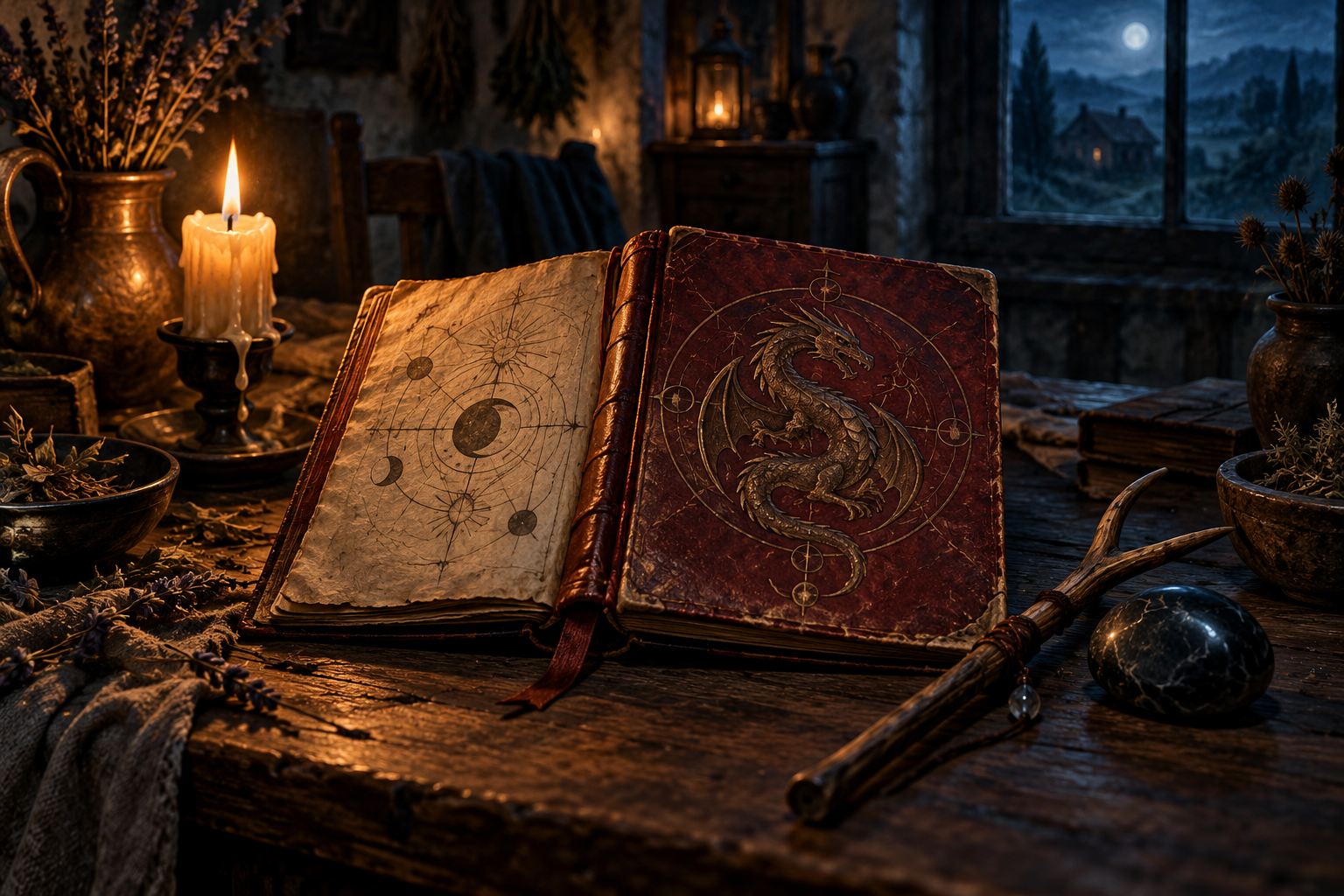
Grand Grimoire explained: the French black book called the Red Dragon, its false 1522 date, the pact with Lucifuge Rofocale, its hell ranks and history.
Quick answer: The Grand Grimoire is a French black-magic chapbook, also published as Le Dragon Rouge (The Red Dragon), that claims to date from 1522 but first appears in print in the late eighteenth century. It is notorious for describing a pact with Lucifuge Rofocale, the "prime minister" of Lucifer, and for a hierarchy of infernal officers that reshuffles names from the Goetia. Historians treat it as a product of the cheap French grimoire trade, not of Renaissance Italy.
Related guides: grimoire meaning and the famous grimoires, the 72 demons of the Goetia, Astaroth, grand duke of hell, Beelzebub in demonology, the Heptameron grimoire, manuscript versus printed Goetia.
| Office in the Grand Grimoire | Spirit | Subordinates named | Goetia equivalent |
|---|---|---|---|
| Emperor | Lucifer | All | Not in the Goetia |
| Prince | Beelzebub | All | Not in the Goetia |
| Grand Duke | Astaroth | All | Duke Astaroth, no. 29 |
| Prime Minister | Lucifuge Rofocale | Bael, Agares, Marbas | Not in the Goetia; subordinates are nos. 1, 2, 5 |
| Grand General | Satanachia | Pruslas, Aamon, Barbatos | Not in the Goetia; Aamon and Barbatos are nos. 7, 8 |
| General | Agaliarept | Buer, Gusoyn, Botis | Not in the Goetia; subordinates are nos. 10, 11, 17 |
| Lieutenant General | Fleurety | Bathin, Pursan, Abigar | Not in the Goetia; Bathin and Purson are nos. 18, 20 |
| Brigadier | Sargatanas | Loray, Valefar, Forau | Not in the Goetia; Leraje, Valefar, Foras are nos. 14, 6, 31 |
| Field Marshal | Nebiros | Ayperos, Naberus, Glasyalabolas | Not in the Goetia; Ipos, Naberius, Glasya-Labolas are nos. 22, 24, 25 |
Key Takeaways
The Grand Grimoire is a short French book of ceremonial and folk magic that promises its reader the power to compel the spirits of hell, chiefly through a pact with Lucifuge Rofocale. Its title page claims that it was written in 1522 by one “Antonio Venitiana del Rabina” from the papers of King Solomon, a boast no historian accepts. The earliest surviving printings belong to the late eighteenth century, when cheap pamphlets of this kind sold widely through the French peddler trade known as the Bibliothèque bleue.
The same text was reissued in 1822 under the title Le Dragon Rouge, the Red Dragon, with minor additions. That edition became the version most often reprinted, and the two names now refer to one book. A sister text, the Grimorium Verum, shares material with it and makes a similar false claim of a 1517 date.
In the family of famous grimoires, the Grand Grimoire sits at the dark end. The Key of Solomon and the Heptameron frame their rituals as pious appeals to God; the Grand Grimoire openly describes bargaining with a devil. That is the source of its reputation and of most of the searches that bring people to it today.
The book’s own account of itself is fiction. No manuscript from 1522 exists, the Italian author is unknown to any record, and the French prose is of the eighteenth century. Scholars of the grimoire trade, notably Owen Davies in his history of grimoires, place its composition in France sometime after 1750, within a market that also produced the Grimoire of Pope Honorius, the Petit Albert and the Grimorium Verum. These were sold alongside almanacs and saints’ lives by traveling booksellers, and they borrowed from one another freely.
The 1822 Dragon Rouge edition added a frontispiece of a red dragon, a short section on “the secret of the black hen,” and a few recipes. Nineteenth-century French publishers kept it in print in Paris and Lyon, and the title became a byword for forbidden knowledge. In 1898 and again in 1911 Arthur Edward Waite translated and dissected it in The Book of Ceremonial Magic, calling it the most fantastic of the black grimoires while deploring its contents.
Across the Atlantic the Red Dragon found a second life. French colonial networks carried it to Haiti and Louisiana, where it was absorbed into Vodou and hoodoo traditions and treated as a powerful, dangerous object. In Haiti the name Dragon Rouge still carries weight, and the grimoire’s demons appear in some Haitian spirit lists. This Caribbean afterlife is one of the few places where the book shaped living practice rather than armchair demonology.
Does this touch your own situation? Many readers come to these pages because something in their home, dreams or family feels unexplained. Reading history helps, but it cannot look at your specific case.
Consult the Sheikh Private, confidential, and free to ask.
The first part of the Grand Grimoire centers on Lucifuge Rofocale, a spirit found nowhere before this text. His name is a mock-Latin construction meaning “one who flees the light,” and “Rofocale” is widely read as a scramble of “Focalor,” a duke of the Goetia. The book introduces him as Lucifer’s prime minister, the official with whom an operator must deal, since Lucifer himself is too great to be approached directly.
The narrative describes the operator preparing a wand called the blasting rod, a bloodstone and a circle, then calling Lucifuge over several attempts. The spirit at first refuses, then offers wealth in exchange for the operator’s soul after twenty years. The clever operator, the book says, tricks him into granting treasure in exchange for a token payment and a promise to reward him later. The pact is presented as a contract with loopholes, a very French legal joke dressed as diabolism.
This site does not reproduce those procedures or offer instruction in them. What matters historically is the structure: a hierarchy with a bureaucrat at the top, a negotiation rather than a worship, and a payoff measured in buried gold. The pact story reflects the concerns of its eighteenth-century rural readers, who wanted treasure and feared the price.
The second part of the book lays out the government of hell with the precision of a court almanac. It is the feature most quoted by later writers, so it is worth setting out in full.
Every one of the eighteen subordinate spirits is a Goetia name, sometimes mangled. Bael, Agares and Marbas are the first, second and fifth spirits of the Lemegeton; Aamon and Barbatos are the seventh and eighth; Buer, Gusion and Botis the tenth, eleventh and seventeenth. Loray is Leraje, Forau is Foras, Ayperos is Ipos, Naberus is Naberius. The compiler evidently worked from a copy of Weyer’s Pseudomonarchia Daemonum or a Goetia derived from it, selected eighteen names, and put them under six invented commanders. Readers who want the original list can consult the 72 demons of the Goetia.
The contrast with the Lesser Key of Solomon is instructive. The Goetia gives 72 spirits, each with a rank, a seal, a number of legions and a list of offices, and it frames the whole enterprise as a Solomonic art of constraint under divine names. The Grand Grimoire gives 27 spirits, no seals for most of them, and a single master narrative about a pact. It is a story with a spirit list attached, where the Goetia is a catalog with a method attached.
The Grimorium Verum, its closest relative, shares the names Lucifer, Beelzebub and Astaroth at the top and adds its own crowd of subordinates, including Clauneck and Frimost. The Grimoire of Pope Honorius uses a Christian liturgical frame to call the spirits of the days. The Book of Abramelin, by contrast, is a long devotional program whose demons are made to serve only after the operator has gained an angelic guardian, a world away from the Red Dragon’s quick bargain.
Seen in this company, the Grand Grimoire is the most commercial of the group. Its promises are concrete, its demands are few, and its hierarchy flatters the reader with the sense of dealing with high officials. That is why it has remained in print while more learned grimoires gathered dust, and why its names keep surfacing in demon lists that never cite their source.
The first mistake is believing the 1522 date. It appears on nearly every reprint and on most websites, but it is part of the book’s fiction, in the same way the Lemegeton claims King Solomon and the Heptameron claims Pietro d’Abano. The text is a product of the eighteenth century.
The second is confusing it with the Grimorium Verum or with the Red Dragon as a separate work. The Red Dragon is the Grand Grimoire under an 1822 title. The Grimorium Verum is a different text with overlapping spirits. Online descriptions often blend the three into one “ancient book of black magic,” and then attribute to it recipes and demons that belong to the others.
The third is the belief that reading the book is itself dangerous, or that owning a copy brings misfortune. That reputation was useful to peddlers, who could charge more for a forbidden object, and to later occultists who liked to be seen holding one. Waite ridiculed the contents as absurd even while warning against them. A reader today can approach the Grand Grimoire as a historical document, as thousands of library patrons do, without any of the consequences its own preface promises.
Searches for “grand grimoire pdf” are common, and the reason is simple: the book is public domain, short, and available in French and English scans from libraries and archive sites. The English versions usually derive from Waite’s partial translation or from twentieth-century occult reprints, and they vary in completeness. Different downloads often show different chapter orders and spellings, reflecting the chaotic printing history rather than any lost original.
The Red Dragon title has been borrowed by novels, metal bands, role-playing games and at least one Hollywood thriller, usually as shorthand for the ultimate forbidden book. Lucifuge Rofocale appears as a character in comics and video games, and the hierarchy of six officers is reproduced in demonology websites that rarely mention where it came from. In Haiti and the Francophone Caribbean the book has a more serious presence as an object within living religious traditions.
Interest also comes from the history of reading. The Grand Grimoire is one of the best-documented examples of how magical texts moved from manuscript to cheap print to mass culture, and historians of the book use it as a case study. That makes it unusual among grimoires: notorious as magic, respectable as evidence.
Start with a reliable edition rather than a random PDF. Waite’s Book of Ceremonial Magic summarizes and quotes it with commentary; modern scholarly reprints of the French text exist for readers who can follow eighteenth-century prose. Note which version you have, since the Red Dragon’s additions are often presented as part of the original.
Then read it alongside its sources. Keep a list of the Goetia open and match the eighteen subordinates; the misspellings tell you what kind of copy the compiler used. Compare the pact narrative with the Faust chapbooks of the sixteenth and seventeenth centuries, which supplied the template of a scholar bargaining with a devil’s intermediary. Compare the treasure-hunting motifs with French folk magic of the same period, in which buried gold guarded by spirits is a constant concern.
Finally, place it in the wider map of demonology. The Grand Grimoire’s officers are inventions, but the names beneath them are old, and the three spirits at the top connect it to centuries of Christian demon lore, including Beelzebub. Read that way, the Red Dragon stops being a scary curiosity and becomes what it is: a late, popular, derivative but revealing chapter in the long history of books about spirits.
Still have a question about your own experience? Describe what you are seeing, feeling or dreaming, and when it started. The Sheikh reads every message personally and replies in private.
Want a personal perspective? Grimoires like this one were written for people hoping for wealth, love or power, and if you have a real question about your own path, our partner PuraTarot offers a Full Personal Reading for calm, honest reflection. Join the free Djinn Guide newsletter and, once you confirm, you will unlock a 50% code for your first reading.
Further reading
As an Amazon Associate we earn from qualifying purchases.
The Grand Grimoire is a French book of black magic, also printed as Le Dragon Rouge, that describes a pact with the demon Lucifuge Rofocale and a hierarchy of infernal officers. It claims to date from 1522 but first appears in print in the late eighteenth century as part of the cheap French grimoire trade.
Yes. Le Dragon Rouge is the title of an 1822 edition of the Grand Grimoire with a few added recipes and a dragon frontispiece. The two names now refer to the same text. The Grimorium Verum is a different, related grimoire that shares some spirit names but has its own content.
Lucifuge Rofocale is the spirit the Grand Grimoire names as prime minister of hell under Lucifer, and the one with whom its pact is made. The name means roughly "he who flees the light," and Rofocale is often read as an anagram of Focalor, a Goetia duke. He appears in no source before this book.
Historians date it to eighteenth-century France, probably after 1750, despite its title-page claim of 1522. No earlier manuscript exists, the supposed author Antonio Venitiana del Rabina is unknown, and the French prose matches other chapbooks of the period such as the Grimoire of Pope Honorius.
No. The Lesser Key, or Lemegeton, is an English compilation of five books including the Ars Goetia with its 72 spirits. The Grand Grimoire is a separate French text that borrows eighteen Goetia names, often misspelled, and places them under invented officers such as Satanachia and Nebiros.
Disclaimer
This article describes the Grand Grimoire as a historical document in the European grimoire tradition. It explains the book's contents for educational purposes, does not endorse its claims, and provides no ritual or pact instructions.
Did this guide help you understand the subject? Rate it and share your honest opinion to help other readers. Every review is checked by our editors before it appears.
There are no reviews yet. Be the first one to write one.


Sheikh Youssef
Tayeb El Merzouki
For inquiries about personalized spiritual work, private rituals, and traditional talismans, connect directly with Sheikh Youssef Tayeb El Merzouki.
Chat on WhatsApp