







Join Djinn Guide: Get 50% Off a Personal Reading
Get new guides to jinn, folklore and occult history. Confirm your subscription to unlock a 50% code for a first personal reading with our partner PuraTarot.
Discover the unseen
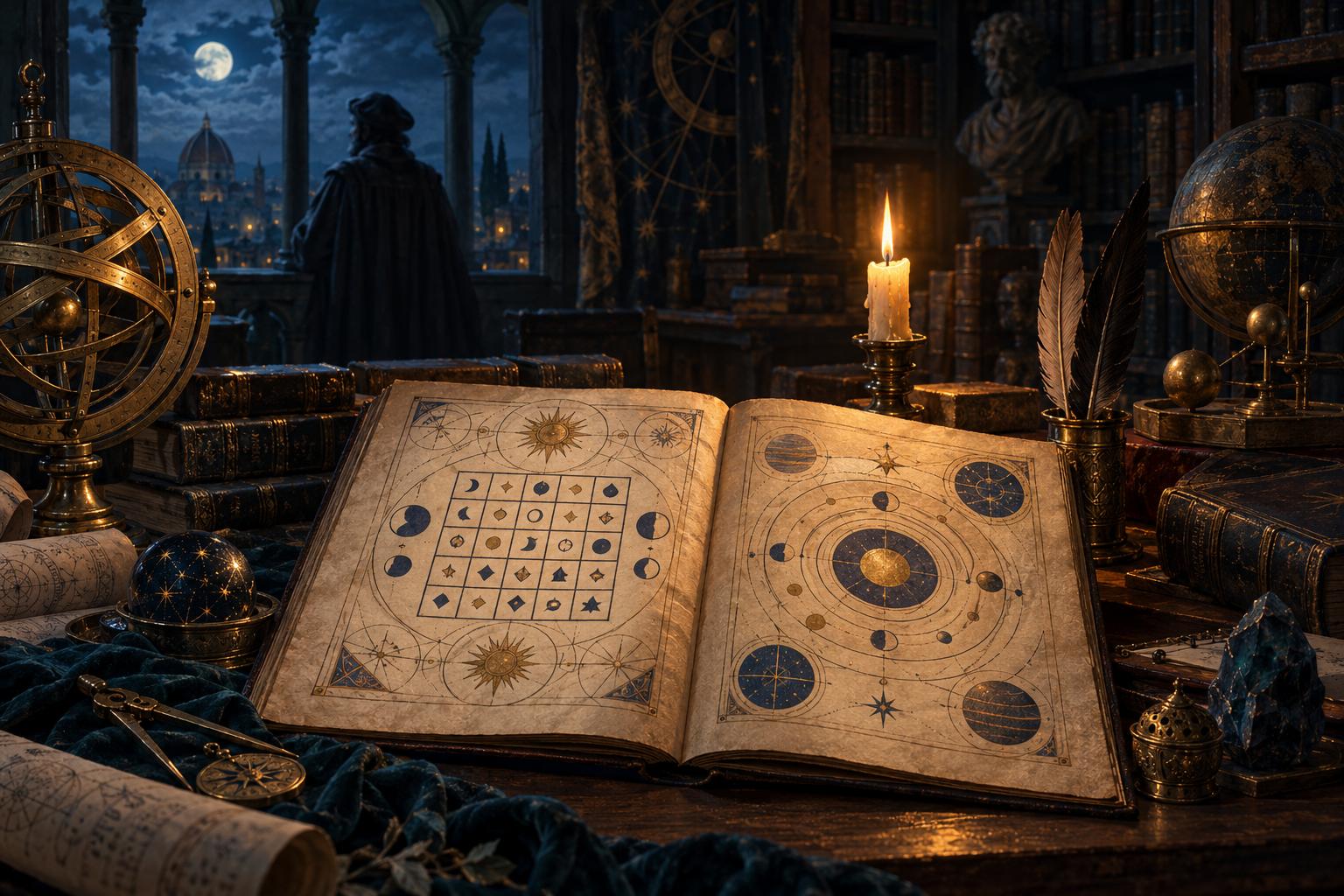
Agrippa's Three Books of Occult Philosophy explained: who Cornelius Agrippa was, what each book covers, the 1533 edition, the fake Fourth Book, its legacy.
Quick answer: Agrippa's Three Books of Occult Philosophy (De occulta philosophia libri tres) is the most influential summary of Renaissance magic, written by Heinrich Cornelius Agrippa von Nettesheim, drafted around 1510 and printed in full in 1533. Book One covers natural magic, Book Two celestial and mathematical magic, and Book Three ceremonial or religious magic. Nearly every later Western occult system, from the planetary magic squares to the Golden Dawn, borrows from it.
Related guides: grimoire meaning and famous grimoires, planetary magic squares and seals, John Dee and his library, what Kabbalah is, Hermeticism explained, the Picatrix and astral magic.
| Book | Realm | Main subjects | Key sources Agrippa draws on |
|---|---|---|---|
| Book One | Natural (elemental) world | Four elements, occult virtues of stones, plants and animals, sympathies, fascination, the senses, the passions | Pliny, Albertus Magnus, Ficino, Picatrix |
| Book Two | Celestial (mathematical) world | Number symbolism, the planetary magic squares (kameas), planetary seals and intelligences, astrological images, harmony and music | Pythagorean and Platonic number lore, Ficino, Arabic astrology |
| Book Three | Intellectual (divine) world | Names of God, angelic hierarchies, Hebrew letters and Kabbalah, Shem HaMephorash, religion, prophecy, the soul | Reuchlin, Pico della Mirandola, Pseudo-Dionysius, Trithemius |
| 'Fourth Book' (spurious) | Ceremonial practice | Spirit evocation, consecrations, characters of spirits | Anonymous, printed 1559; Agrippa did not write it |
Key Takeaways
De occulta philosophia libri tres, usually called in English the Three Books of Occult Philosophy, is a systematic encyclopedia of magic written in Latin by Heinrich Cornelius Agrippa von Nettesheim. Agrippa sent a first draft to the abbot Johannes Trithemius in 1510; a version of Book One was printed in 1531, and the complete three-volume work appeared at Cologne in 1533, two years before the author’s death. The title uses ‘occult’ in its older sense of ‘hidden’: the concealed powers and correspondences believed to run through nature.
The work’s structure follows a three-world cosmology that Agrippa inherited from Neoplatonism and from Marsilio Ficino. Everything exists in three layers: the elemental world of matter, the celestial world of stars and numbers, and the intellectual world of angels and God. Each book addresses one layer and the kind of magic appropriate to it, from the natural virtues of stones and herbs to the names of God and the angelic choirs.
Agrippa’s achievement was not originality but synthesis. He gathered Hermetic philosophy, Pythagorean number lore, Arabic astrological magic, Christian Kabbalah and classical natural history into one organized reference. Later grimoires borrow its tables wholesale, which is why it belongs at the start of any list of grimoire meaning and famous grimoires, even though it is a work of philosophy rather than a handbook of rituals.
Agrippa was born in Cologne in 1486 into a family of minor nobility, and took the surname ‘von Nettesheim’ from a village nearby. He studied at the University of Cologne, then led a restless career across Europe as a soldier, lecturer, physician, lawyer and court secretary. He lectured on Reuchlin’s Kabbalistic De verbo mirifico at Dôle in 1509, served Emperor Maximilian in Italy, and later worked for Margaret of Austria and for Louise of Savoy, mother of Francis I of France.
Two episodes reveal his temperament. In 1519, as legal advocate in Metz, he defended a peasant woman accused of witchcraft, arguing that the Inquisitor’s reasoning was absurd; he won her release and lost his position. In 1530 he published De incertitudine et vanitate scientiarum (On the Uncertainty and Vanity of the Sciences), a sweeping skeptical attack on all human learning, including magic, which has puzzled readers ever since, since he printed the Occult Philosophy only three years later.
Scholars read this apparent contradiction in different ways. Some think the skeptical book was a protective screen; others see a genuine crisis of faith; still others argue that Agrippa distinguished a false, demonic magic he rejected from a true, religious magic he still valued. He died at Grenoble in 1535. Within decades legend made him a sorcerer with a black dog familiar, a reputation Goethe later borrowed for Faust.
Does this touch your own situation? Many readers come to these pages because something in their home, dreams or family feels unexplained. Reading history helps, but it cannot look at your specific case.
Consult the Sheikh Private, confidential, and free to ask.
The three books can be read as a ladder from matter to spirit.
Book One treats the elemental world. Agrippa explains the four elements and their qualities, then catalogues the ‘occult virtues’ of things: why the magnet attracts iron, why certain stones were believed to cure or protect, how plants and animals correspond to planets. He discusses sympathy and antipathy, the power of the imagination and the passions, fascination (the evil eye), and the senses. Much of this is natural history from Pliny and Albertus Magnus, reframed as the foundation of magic.
Book Two is mathematical. Agrippa holds that number is the bridge between matter and spirit, and devotes chapters to the symbolism of each number from one to twelve. The most copied section is chapter 22, which presents the seven planetary magic squares, or kameas, from the three-by-three square of Saturn to the nine-by-nine square of the Moon, with the seals and the names of the planetary intelligences and spirits derived from them. He also covers astrological images, the fixed stars, harmony, music and the soul of the world. These squares are examined in our guide to planetary magic squares and seals.
Book Three turns to the divine world. Here Agrippa draws on Pico della Mirandola and Reuchlin to present a Christianized Kabbalah: the ten names of God, the sephiroth, the angelic orders of Pseudo-Dionysius, the 72 names of the Shem HaMephorash, Hebrew letter numerology, and the celestial alphabets. He writes about religion, prayer, prophecy, the nature of the soul and the conditions a magician must meet. The tone is devout, insisting that true magic is inseparable from piety.
Agrippa was a reader before he was a writer, and the Occult Philosophy is partly a map of what a learned European could access around 1510. The Hermetic texts, translated by Ficino in 1463, supply the vision of a cosmos bound by hidden sympathies. Ficino’s own De vita provides the theory of attracting planetary influence through images, music and diet. From Arabic sources, above all the Picatrix, come the astrological talismans and the idea of drawing down celestial virtue into matter.
The Kabbalistic material comes through Christian intermediaries. Pico’s 900 theses of 1486 had declared that no science proved Christ’s divinity better than magic and Kabbalah; Reuchlin’s De arte cabalistica (1517) gave Latin readers the sephiroth and the divine names. Agrippa cites both, and his teacher Trithemius contributed cryptographic and angelic lore. Pliny, Ptolemy, Iamblichus and Proclus supply natural history and Neoplatonic theory; Pseudo-Dionysius provides the nine angelic choirs.
What Agrippa added was organization and confidence. By presenting all of this as a single ‘occult philosophy’ he gave magic the shape of a discipline with principles, branches and a curriculum. That framing is as influential as any individual table. For the Jewish mystical background that Agrippa reworked, see what Kabbalah is.
The 1533 Cologne edition is the authoritative text, though a 1531 printing of Book One at Antwerp and Paris preceded it. In 1559 a printer in Marburg issued a Fourth Book of Occult Philosophy under Agrippa’s name, bundled with the Heptameron attributed to Peter of Abano and other short magical texts. Agrippa’s own pupil Johann Weyer denounced the Fourth Book as a forgery, and scholars agree it is not his. Unlike the genuine three books, it gives practical ceremonial material: how spirits of each planet are said to appear, the forms of seals, consecrations and the construction of a book of spirits. It has nonetheless been read as part of the set for four centuries.
English readers received the work in 1651, when ‘J.F.’ (usually identified as John French) translated the Three Books, followed by Robert Turner’s 1655 translation of the Fourth Book and the Heptameron. These seventeenth-century versions circulated among English astrologers and cunning folk and were the texts that Francis Barrett plundered for The Magus in 1801. The standard modern edition is Donald Tyson’s annotated 1993 edition of the 1651 translation, published by Llewellyn, which corrects tables and identifies sources; the Latin critical edition by Vittoria Perrone Compagni appeared in 1992.
The diagrams, especially the magic squares and Hebrew tables, contain copying errors in many printings; Tyson’s notes document the corrections.
The first error is to treat the Three Books as a spellbook. The genuine work contains almost no step-by-step rituals; it explains a worldview and supplies tables of correspondence. The practical procedures that later readers associate with Agrippa come mostly from the spurious Fourth Book, the Heptameron and later grimoires that cited him for authority.
A second error is to assume Agrippa was an atheist or a Satanist. His Book Three is explicitly Christian, and his letters show a reform-minded, sometimes anticlerical, but believing scholar. The black-dog legend and the tales of his demonic pacts belong to the posthumous folklore collected by writers such as Paolo Giovio and reworked by Goethe and Mary Shelley, whose Victor Frankenstein reads Agrippa as a boy.
A third is to think his magic squares are his invention. The squares were known in Arabic and Byzantine mathematics centuries earlier and reached Europe through Spain and Italy; Agrippa’s contribution was to fix the planetary assignments and seals in print. Finally, ‘occult philosophy’ is not the modern ‘occult’ of secret societies; for Agrippa the phrase meant a philosophy of hidden natural and divine causes.
The Three Books became the reference work for every serious student of magic who came after. John Dee owned and annotated a copy, and his planetary and angelic work assumes Agrippa’s framework; our profile of John Dee and his library traces that debt. Bruno, Fludd and the Rosicrucian writers used him as a quarry. Marlowe’s Faustus vows to be ‘as cunning as Agrippa was’, showing the name was a byword by 1590.
In the nineteenth century Eliphas Lévi and then the Hermetic Order of the Golden Dawn rebuilt their correspondence systems directly on Books Two and Three, taking the planetary squares, the Hebrew letter attributions, the angelic names and the Shem HaMephorash. Through the Golden Dawn these tables passed into Aleister Crowley’s 777, into Wicca and into the modern practice of sigil-making, where Agrippa’s planetary seals and the method of tracing names on magic squares are still the standard models.
For readers interested in jinn, Solomon and the Goetia, Agrippa is the hinge between medieval Arabic and Hebrew learning and the English grimoire tradition. The Solomonic texts assume a reader who knows what planetary hours, angelic names and seals are; Agrippa is where such a reader learned them.
Begin with Tyson’s annotated edition, which keeps the 1651 English while explaining every reference. Read Book One quickly for its worldview, slow down in Book Two for the number chapters and the squares, and treat Book Three as a Christian Kabbalistic treatise rather than a manual. Tracing a single table back to Ficino or Reuchlin teaches more about Renaissance magic than any summary can.
Compare the genuine books with the Fourth Book and the Heptameron so that the difference between philosophy and practice is clear, and compare Agrippa’s planetary seals with those in later grimoires to see how copying changed them. Read the 1530 Vanity of the Sciences alongside, if only in extracts, to meet the skeptical Agrippa who doubted everything he had compiled.
This site describes these works as history. It does not provide ritual instructions and does not claim that any table, square or name produces an effect. Agrippa himself ended his career unsure of that question, and his uncertainty is as much a part of his legacy as his tables.
Still have a question about your own experience? Describe what you are seeing, feeling or dreaming, and when it started. The Sheikh reads every message personally and replies in private.
Drawn to these ideas for a reason? Agrippa saw the world as a web of hidden correspondences, an idea many readers still find worth reflecting on in their own lives. A Full Personal Reading from our partner PuraTarot offers a personal look at the questions shaping your path. Join the free Djinn Guide newsletter and, once you confirm, you will unlock a 50% code for your first reading.
Further reading
As an Amazon Associate we earn from qualifying purchases.
It is a Renaissance encyclopedia of magic organized by three worlds. Book One covers natural magic and the hidden virtues of things, Book Two celestial magic, numbers and the planetary squares, and Book Three divine or ceremonial magic, including Kabbalah and angelic names. It explains a worldview rather than giving rituals.
Agrippa drafted the work around 1510 and sent it to Trithemius. Book One was printed in 1531 at Antwerp and Paris, and the complete three books appeared at Cologne in 1533. The first English translation by 'J.F.' came in 1651, and Donald Tyson's annotated edition of that translation appeared in 1993.
No. The Fourth Book was printed at Marburg in 1559, twenty-four years after Agrippa's death, and his pupil Johann Weyer denounced it as a forgery. Scholars agree. It contains practical ceremonial material absent from the genuine books, and it was often bound with the Heptameron attributed to Peter of Abano.
Heinrich Cornelius Agrippa von Nettesheim (1486–1535) was a German scholar, physician, lawyer and soldier who served several European courts. He defended an accused witch at Metz in 1519, wrote a skeptical attack on all learning in 1530, and published the Three Books of Occult Philosophy in 1533. Later legend made him a sorcerer.
The Golden Dawn built its correspondence tables, planetary squares, Hebrew letter attributions and angelic names largely on Agrippa's Books Two and Three, and passed them to Crowley, Wicca and modern sigil practice. His synthesis of Hermeticism, Kabbalah and astrology is the shared foundation of most Western esoteric systems.
Disclaimer
This article treats Agrippa's work as a subject of intellectual and cultural history. The beliefs it describes are reported, not endorsed, and nothing here is offered as ritual instruction or as a claim that any practice produces results.
Did this guide help you understand the subject? Rate it and share your honest opinion to help other readers. Every review is checked by our editors before it appears.
There are no reviews yet. Be the first one to write one.


Sheikh Youssef
Tayeb El Merzouki
For inquiries about personalized spiritual work, private rituals, and traditional talismans, connect directly with Sheikh Youssef Tayeb El Merzouki.
Chat on WhatsApp