






Join Djinn Guide: Get 50% Off a Personal Reading
Get new guides to jinn, folklore and occult history. Confirm your subscription to unlock a 50% code for a first personal reading with our partner PuraTarot.
Discover the unseen
Jinn in Persian mythology explained: how the div and peri of Zoroastrian lore and the Shahnameh met the Arabic jinn after Islam, from Rostam to Solomon.
Quick answer: Jinn in Persian mythology are a blend of two traditions. Before Islam, Persian lore had its own spirit beings: the div, a demon descended from the Avestan daeva, and the peri or pari, a once-sinister being later remembered as a beautiful winged creature. After the seventh century the Arabic concept of the jinn arrived with the Quran, and Persian writers folded div and peri into it. Ferdowsi's Shahnameh, finished around 1010 CE, preserves the older demons in the battles of Rostam and the reign of Jamshid.
Related guides: jinn folklore across cultures, the main types of jinn, Solomon's authority over the jinn, the seven kings of the jinn, who Iblis is in Islamic tradition, the history of the 1001 Nights.
| Being | Origin | Character | Appearance in tradition | Key sources |
|---|---|---|---|---|
| Div (dēw) | Avestan daeva, false gods turned demons | Hostile, brutish, sometimes cunning | Giant, horned, often with animal features; the White Div of Mazandaran | Avesta, Bundahishn, Shahnameh |
| Peri (pari) | Avestan pairika, a seductive sorceress spirit | Ambiguous, later benevolent | Beautiful, winged, luminous; imprisoned in cages by divs in later tales | Avesta, Persian romances, Hamzanama |
| Jinn | Arabic, pre-Islamic Arabia and the Quran | Morally varied, Muslim or unbelieving | Invisible by default; smokeless fire; many shapes | Quran 72, 55:15; Persian tafsir and epic |
| Al / Aal | Iranian and Caucasian folk belief | Malevolent toward mothers and newborns | Hag-like, with features that vary by region | Oral folklore, folk charms |
Key Takeaways
Jinn in Persian mythology are not a single species but a layered tradition. The word jinn is Arabic, and it reached Iran with Islam in the seventh century CE. Before that, Persian speakers already had a rich vocabulary of unseen beings rooted in Zoroastrian scripture and in older Iranian folk belief. The two most important were the div, a class of demons, and the peri, a class of beautiful but originally dangerous spirits.
When the Quran’s jinn entered Persian thought, writers did not discard the older beings. Instead they mapped them onto the new category. Persian translators of the Quran and commentators often rendered jinn as div or treated the two as overlapping. Poets kept the div as an epic villain and the peri as an image of unearthly beauty. A medieval Persian reader could meet a div in Ferdowsi, a jinn in a sermon, and a peri in a love poem, and feel that all three belonged to the same hidden world.
This article follows that layering: the pre-Islamic div and peri, the Shahnameh, the absorption of the Arabic jinn, and how these beings differ from the Arabic classes described in our guide to the types of jinn.
The div (Middle Persian dēw, Avestan daēva) has one of the clearest histories of any demon. In the oldest Indo-Iranian religion the daevas were gods, cognate with the Sanskrit devas who remained gods in India. Zoroaster, whose Gathas are usually dated to the second millennium BCE, rejected the daevas as false deities, and in later Zoroastrian texts they became outright demons serving Angra Mainyu, the destructive spirit known in Middle Persian as Ahriman.
Zoroastrian literature such as the Bundahishn and the Vendidad populates the world with named divs responsible for specific evils: Aeshma for wrath, Az for greed, Nasu for the pollution of corpses. The name Aeshma is widely thought to survive in Asmodeus, the demon of the Book of Tobit and later of the Testament of Solomon, which gives Persian demonology a direct line into the Solomonic tradition discussed on this site.
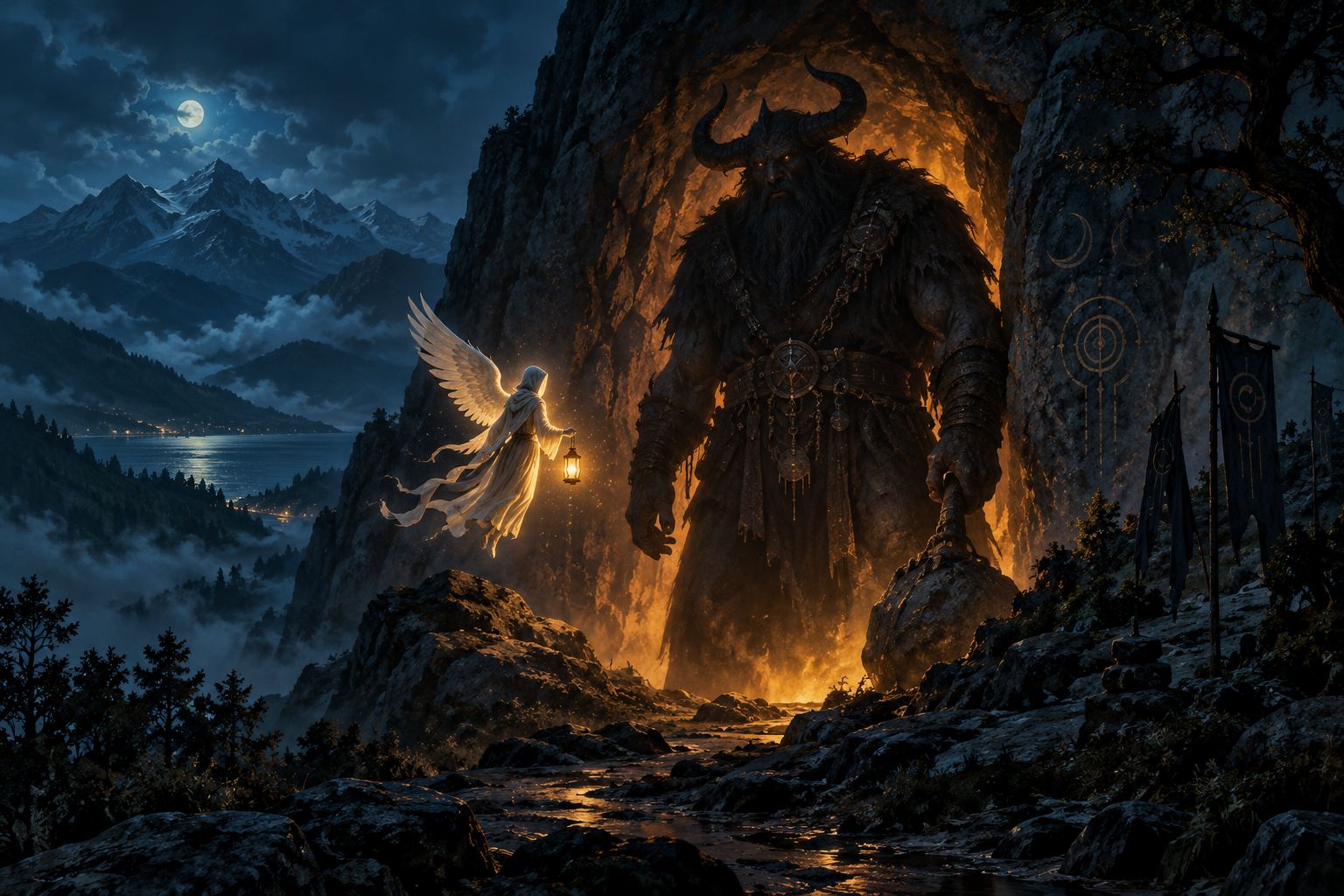
By the time Persian was written in Arabic script, the div had become the standard word for a monstrous, usually stupid but physically overwhelming demon. Divs in later folklore are giants with horns, tusks or animal heads, living in mountains and wastelands, hostile to humans and especially to heroes. They are also, in several tales, keepers of knowledge: the Shahnameh says the divs taught King Tahmuras the art of writing after he bound them. That double nature, brute force and hidden learning, recurs in jinn traditions across the Islamic world.
Does this touch your own situation? Many readers come to these pages because something in their home, dreams or family feels unexplained. Reading history helps, but it cannot look at your specific case.
Consult the Sheikh Private, confidential, and free to ask.
The peri or pari has the opposite trajectory. In the Avesta the pairika is a malign female being, a sorceress or seductress allied with the daevas, who disrupts the natural order and tempts the righteous. Zoroastrian priests classed pairikas among the enemies of Ahura Mazda alongside the divs.
Over centuries the image softened. In medieval Persian poetry and romance the peri became a radiant, often winged being of great beauty, neither angel nor demon, who could fall in love with humans and be captured by divs. A standard motif has a peri imprisoned in a cage or well by a div until a hero frees her. The peris were sometimes said to be made of fire, which encouraged Persian writers to identify them with jinn, who in the Quran are made of smokeless fire. Peri came to mean roughly what fairy means in English, and in the nineteenth century the word entered English through Thomas Moore’s poem Lalla Rookh.
In Islamic-era Persian cosmology the peri and the div are often paired as the two faces of the jinn: the beautiful believers and the ugly unbelievers. This is not Quranic, but it gave Persian audiences a way to hold onto both older beings while accepting the new framework.
Ferdowsi’s Shahnameh, the Book of Kings, completed around 1010 CE, is the great storehouse of Persian demon lore. It draws on pre-Islamic sources and keeps the divs as central antagonists.
The early king Jamshid commands the divs and uses them as laborers, builders and craftsmen. Tradition holds that they taught humanity the arts of building and even carried the king through the air on a throne. Persian and later Arabic writers noticed the parallel with Solomon, whose jinn built and dived for him, and some identified the two kings or made Jamshid a Persian Solomon. Our profile of Solomon and the jinn covers the Islamic side of that comparison.
The tyrant Zahhak is corrupted by Ahriman in human disguise, who kisses his shoulders; two serpents grow from them and must be fed human brains daily. Zahhak is not called a div, but he becomes a demonic king, and his story shows Ahriman working through deception rather than brute force.
The hero Rostam’s Seven Labors end in Mazandaran, the land of the divs, where he kills the Div-e Sepid, the White Div, and uses its blood to cure the blinded king Kay Kavus. The White Div is the archetypal Persian demon: enormous, cave-dwelling, horned and savage.
Later in the epic Rostam fights Akvan Div, a trickster who lifts the sleeping hero on a slab of earth and offers to drop him on mountain or sea. Rostam chooses wrongly on purpose, since divs do the opposite of what is asked, and survives. Akvan shows the div as cunning rather than merely strong.
With the Arab conquest of the Sasanian Empire in the seventh century, Persian religious life was reorganized around the Quran, which speaks of jinn in many places and devotes Surah 72 to them. Persian scholars wrote major works of Quranic commentary, and in rendering jinn for a Persian audience they reached for existing words. Div and peri were the obvious candidates. Early Persian translations of the Quran commonly use div for shaitan and sometimes for jinn, and later dictionaries treat div and jinn as near synonyms.
Persian storytelling went further and gave the jinn of Islamic legend a Persian cast. The stories of Solomon’s command over the jinn were elaborated in Persian with divs as the laborers; the jinn kings of later folk Islam acquired Persian names and courts; and the Persian romance tradition, including the Hamzanama, sends its heroes into the land of the peris and divs in a setting that owes as much to Mazandaran as to Arabia. The Takht-e Soleyman, Throne of Solomon, a Sasanian fire-temple site in northwestern Iran, shows the fusion in stone: an ancient Zoroastrian sanctuary renamed for the jinn-ruling king of the Quran.
Meanwhile the Arabic word jinn itself became ordinary Persian vocabulary, spelled jenn, and the ghul, ifrit and marid of Arabic lore crossed into Persian tales, especially through Persian versions of the stories that fed the 1001 Nights, whose frame story is itself of Persian origin.
The two traditions overlap but keep distinct emphases. The Arabic jinn of the Quran and hadith are a parallel community to humans: born, dying, marrying, accountable to God, some Muslim and some not. They are invisible by default and take shapes at will. Arabic folklore adds classes such as the marid, ifrit, ghul, sila and qareen.
Persian divs are physical in a way the Quranic jinn are not. They have bodies, horns, blood that can be used as medicine; they can be wrestled and beheaded. They are almost always evil, descended as they are from the rejected gods of Zoroastrianism, and the moral ambiguity the Quran grants the jinn is rarely extended to them. The peri carries the ambiguity instead, as a being who may help or harm but is above all beautiful.
A second difference is cosmology. Arabic tradition locates jinn in deserts, ruins and bathhouses, scattered through human space. Persian tradition gives the divs a homeland, Mazandaran, and the peris a distant realm often called Paristan. The hero travels to them rather than stumbling on them. Finally, Persian tradition keeps a stronger memory of demons as teachers: Tahmuras learns writing from the divs, Jamshid builds with them. The Arabic jinn teach too, but more often as whisperers to poets than as masters of craft.
A few points trip up readers who come to Persian material from the Arabic or Western side.
Persian mythology gives the jinn a second genealogy. Reading it alongside the Arabic sources shows that the Islamic world’s spirit lore was never a single system but a conversation between traditions. The Quran supplied a theology of jinn; Persia supplied centuries of demon stories, a geography for them, and two beings, the div and the peri, that proved too vivid to abandon.
For readers of the Arabian Nights and the Solomon legends, this background explains features that otherwise seem arbitrary: why some jinn are hideous giants and others radiant beauties, why demons so often build palaces or guard hidden knowledge, why the frame story of Scheherazade has Persian names. For readers interested in Zoroastrianism, it shows how an entire pantheon could be reclassified as demons and then survive, renamed, within another religion.
The sources are accessible. Dick Davis’s translation of the Shahnameh is the standard English version, and the Bundahishn and Vendidad exist in older scholarly translations. This site describes these beliefs as beliefs and these stories as stories, without endorsing any claim about the beings themselves.
Still have a question about your own experience? Describe what you are seeing, feeling or dreaming, and when it started. The Sheikh reads every message personally and replies in private.
Drawn to these stories for a reason? The divs and peris of the Shahnameh have fascinated readers for a thousand years, often because they mirror very human struggles. A Full Personal Reading from our partner PuraTarot offers a personal, reflective look at the questions in your own story. Join the free Djinn Guide newsletter and, once you confirm, you will unlock a 50% code for your first reading.
Further reading
As an Amazon Associate we earn from qualifying purchases.
Persian tradition uses two older words alongside the Arabic jinn: div (or dev) for a monstrous, hostile demon descended from the Zoroastrian daeva, and peri (pari) for a beautiful, often winged spirit. After Islam, Persian writers used div and jinn almost interchangeably, and the Arabic word itself became Persian as jenn.
A div is a demon of Iranian tradition, descended from the Avestan daeva, the gods rejected by Zoroaster and reclassified as servants of Ahriman. In the Shahnameh divs are giant, horned, cave-dwelling enemies of heroes like Rostam, though some, like Akvan Div, are cunning, and others taught humans writing and building.
Not originally. The peri comes from the Avestan pairika, a seductive sorceress spirit. In later Persian literature peris became beautiful, often winged beings, and because they were sometimes said to be made of fire, Islamic-era writers grouped them with the jinn as its benevolent or beautiful branch opposite the divs.
The Div-e Sepid, or White Div, is the ruler of the demons of Mazandaran in Ferdowsi's Shahnameh. Rostam kills him in the last of his Seven Labors and uses his blood to restore the sight of King Kay Kavus and his army. He is the most famous individual demon in Persian epic.
Persian writers often equated Solomon's jinn with divs and told the Islamic Solomon stories with Persian demons as his laborers. They also noted the parallel with the Persian king Jamshid, who commanded the divs as builders, and some identified the two. The Takht-e Soleyman site in Iran reflects this fusion.
Disclaimer
This article surveys Persian and Islamic traditions about jinn, divs and peris as mythology, folklore and literary history. The beliefs described are presented as beliefs, not endorsed, and nothing here makes claims about the existence or behavior of spirits.
Did this guide help you understand the subject? Rate it and share your honest opinion to help other readers. Every review is checked by our editors before it appears.
There are no reviews yet. Be the first one to write one.


Sheikh Youssef
Tayeb El Merzouki
For inquiries about personalized spiritual work, private rituals, and traditional talismans, connect directly with Sheikh Youssef Tayeb El Merzouki.
Chat on WhatsApp