







Join Djinn Guide: Get 50% Off a Personal Reading
Get new guides to jinn, folklore and occult history. Confirm your subscription to unlock a 50% code for a first personal reading with our partner PuraTarot.
Discover the unseen
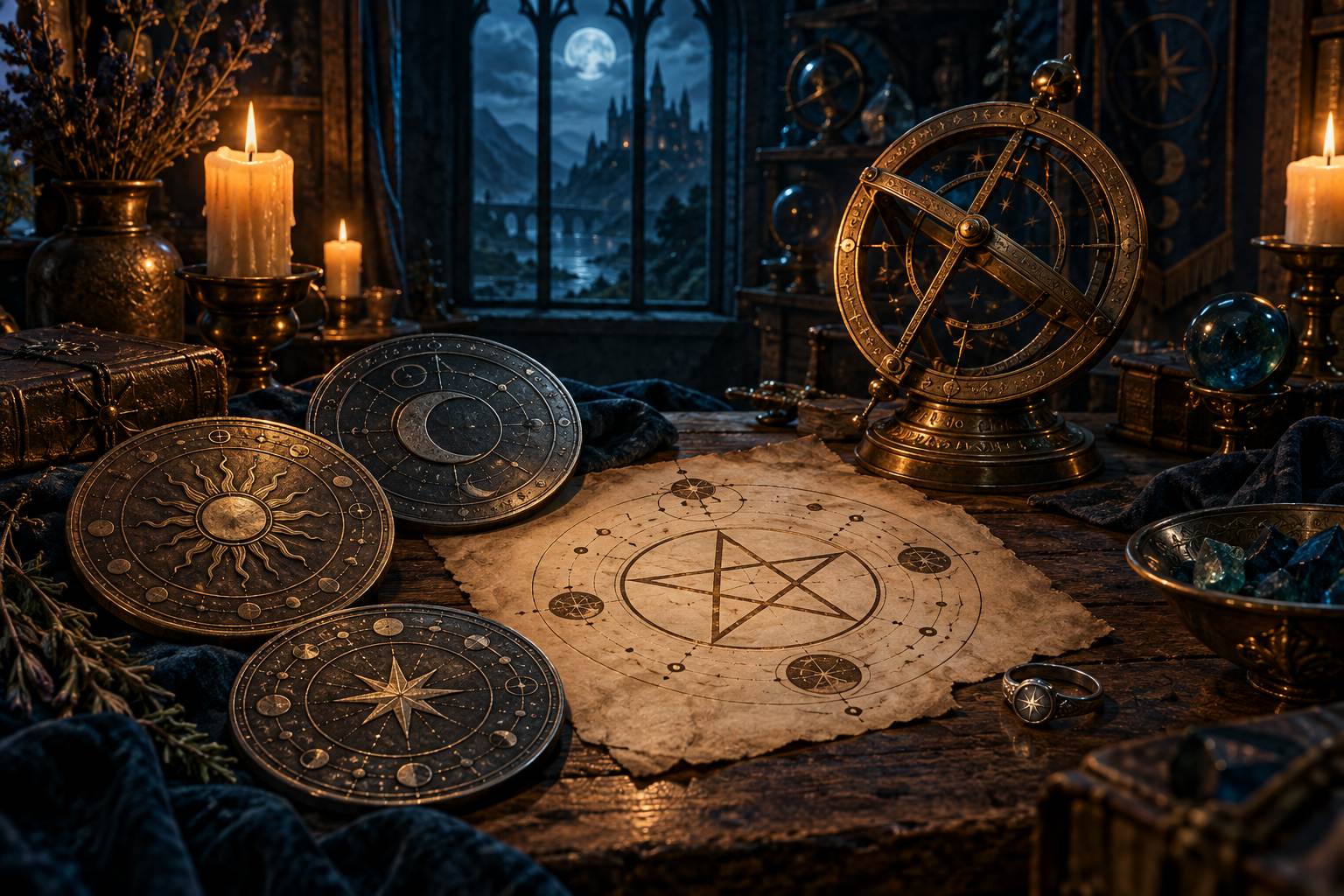
Talisman meaning explained: what a talisman is, where the word comes from, how it differs from an amulet, and its main types from pentacles to seals.
Quick answer: A talisman is an object that people believed was made or consecrated to carry a specific power, usually by inscribing it with symbols, names or astrological signs at a chosen time. The word comes from Arabic tilasm, which in turn comes from Greek telesma, a thing completed or consecrated. Unlike an amulet, which mainly protects, a talisman was thought to attract a particular benefit such as health, favor or success. Talismans appear in Greek, Islamic, Jewish and European magical traditions.
Related guides: amulet vs talisman: the difference, the Picatrix and astrological talismans, planetary magic squares and seals, pentacles of the Greater Key of Solomon, history of the Seal of Solomon, occult symbols and their meanings.
| Type | Tradition and period | Typical material | Stated purpose in the sources |
|---|---|---|---|
| Astrological image talisman | Hellenistic, Arabic (Picatrix), Renaissance | Engraved stone or metal | Draw down the influence of a planet or fixed star |
| Planetary square (kamea) | Arabic and Latin magic, Agrippa 1533 | Metal plate matched to the planet | Concentrate the virtue of a planet |
| Solomonic pentacle | Key of Solomon manuscripts, 15th to 18th century | Parchment or metal, inscribed with names | Specific aims, from protection to favor |
| Talismanic shirt | Ottoman, Safavid, Mughal courts | Linen covered with Quranic verses | Protection and victory in battle |
| Written charm or scroll | Jewish, Ethiopian, Islamic folk practice | Paper, parchment, metal case | Healing, protection, blessing of a house |
Key Takeaways
In its simplest definition, a talisman is an object made to carry a power. The emphasis is on made. A stone found on a beach and kept for luck is a charm; the same stone engraved with a planetary sign on a Thursday morning and wrapped in the right color of silk is a talisman, at least according to the handbooks that taught such things. The purpose was usually to attract a benefit: health, eloquence, the favor of a patron, success in trade, safety on a journey. The process of making and consecrating was what turned an ordinary object into a talisman.
The word’s history matches that idea. English borrowed talisman from French in the 1630s, and French took it from Arabic tilasm (plural tilasmat). The Arabic word itself came from Greek telesma, meaning something completed, a payment, or a rite of consecration, from the verb telein, to complete or initiate. In late antique Greek the word was already used for consecrated statues and engraved objects believed to protect cities. So the core sense of a talisman, an object completed by a rite, is at least fifteen hundred years old.
Modern dictionaries also give the looser sense: anything thought to bring luck or protect its owner. We separate talisman from amulet below only because the older texts did.
Writers on magic from the Renaissance onward drew a line between amulets and talismans that is useful even if it was never watertight. An amulet is apotropaic: it wards off harm, and its power usually comes from its material or its natural association. A piece of coral, a hand-shaped pendant, a blue bead against the evil eye, a verse of scripture in a case: all of these protect simply by being present. A talisman is active and specific. It is constructed for a purpose, inscribed with signs and names, and often timed to an astrological moment that was thought to charge it.
The distinction matters because it reflects two different theories of how objects were believed to work. Amulet lore is older and more widespread; it belongs to folk religion in almost every culture. Talisman lore depends on a learned system, usually astrology, in which the maker must know which planet governs which aim and when its influence is strongest. That is why talismans are associated with books and scholars while amulets are associated with markets and grandmothers. Our dedicated comparison of amulet vs talisman goes through the materials and the history in detail.
In everyday usage the two words have collapsed into one, and a protective talisman is a normal phrase.
Does this touch your own situation? Many readers come to these pages because something in their home, dreams or family feels unexplained. Reading history helps, but it cannot look at your specific case.
Consult the Sheikh Private, confidential, and free to ask.
The oldest objects we would call talismans come from the ancient Near East and Egypt, where inscribed scarabs, cylinder seals and metal plaques carried divine names and images. The Greek magical papyri from Roman Egypt describe engraved gems and lamellae, thin sheets of gold or silver inscribed with names and signs, and these survive in museum collections by the hundred. Late antique cities were said to be protected by consecrated statues, the telesmata that gave the word its name.
The learned tradition passed into Arabic in the ninth and tenth centuries. The most influential handbook, the Ghayat al-Hakim, known in Latin as the Picatrix, lays out the theory of astrological images at length: the maker chooses a material and a moment, engraves an image fitting the planet or star, and the object becomes a vessel for that celestial force. Arabic treatises on magic squares and on the properties of stones fed the same tradition.
Latin Europe received these texts through Spain and Italy from the twelfth century. By the fifteenth century the Key of Solomon manuscripts were circulating with their pentacles, and in 1533 Cornelius Agrippa’s Three Books of Occult Philosophy gave readers a systematic account of planetary squares, seals and the virtues of materials. Agrippa’s book became the standard reference for talisman-making in Europe for three centuries, and most of what later occultists wrote on the subject descends from it.
The sources describe several distinct families of talisman. The forms differ, but the underlying claim is the same in each case: a correctly made object carries a chosen influence.
These are the classic talismans of the Picatrix and the Renaissance. A figure representing a planet, a zodiac sign, a decan or a fixed star was engraved on a stone or metal plate under the right sky. Marsilio Ficino discussed them cautiously in the 1480s, and they appear in Agrippa’s second book.
Each of the seven classical planets was assigned a magic square whose rows, columns and diagonals sum to the same number, together with a seal and the sigils of its spirit and intelligence. These were engraved on the planet’s metal, gold for the Sun, silver for the Moon, and so on. See our guide to planetary magic squares and seals.
The Key of Solomon contains dozens of circular designs filled with Hebrew names, scriptural verses and geometric figures, each assigned a purpose and a planet. They were to be drawn on parchment or metal and consecrated in a ceremony.
In the Islamic world, talismanic shirts covered in Quranic verses, divine names and squares were made for rulers and soldiers; fine examples from Ottoman, Safavid and Mughal courts survive. Ethiopian prayer scrolls and Jewish written charms belong to the same family of textual talismans.
The legendary ring of Solomon, engraved with a seal that gave the king authority over spirits, is the ancestor of this type. Our article on the history of the Seal of Solomon traces that story.
Each of the three Abrahamic traditions produced talismans and also argued about them. In the Islamic world, scholars distinguished between objects inscribed with Quranic text, which many jurists allowed as a form of seeking protection through God’s words, and objects relying on astrological images or unknown names, which were widely condemned. The practice flourished anyway. Court workshops made talismanic shirts, bowls inscribed with verses were used for healing, and the science of letters, which assigned numerical values to the Arabic alphabet, supplied the squares and formulas found on countless objects.
Jewish tradition is rich in written charms, the kameot, which carry divine names, angelic names and scriptural verses. Later Kabbalistic texts supplied new names and diagrams, and some Solomonic pentacles borrow directly from this material, which is why the Key of Solomon is full of Hebrew.
Christian Europe inherited the Greek and Arabic learned tradition, and the Church condemned it repeatedly while clerics continued to copy the books. Medieval writers such as Thomas Aquinas allowed that stones and herbs had natural virtues but rejected images and characters as implying a pact with demons. That argument, between natural and demonic magic, runs through every discussion of talismans from the thirteenth century to the eighteenth and is one reason the subject became entangled with demonology and the Solomonic grimoires.
Because the word is used so loosely, a few points deserve clearing up. First, a talisman is not the same as a lucky charm in the historical sources; the charm is kept, the talisman is made. Second, the Seal of Solomon and the pentagram are symbols, not talismans in themselves; they become part of a talisman when drawn on an object for a purpose. Third, most “ancient” talismans sold today are modern designs that mix symbols from unrelated traditions, and their makers’ claims about age and origin should be read with care.
Fourth, the historical texts never present talismans as working by themselves. The Picatrix and Agrippa both insist on the state of the maker, the timing, the materials and the prayers, which is why the procedures are so long. Fifth, no study has shown a talisman to have any effect beyond the confidence or comfort it gives its owner, and this site makes no claim otherwise. We describe the tradition; we do not provide instructions for making or consecrating objects.
Interest in talismans has several modern sources. Jewelry and fashion use the word for pendants and bracelets, often with vague references to protection or energy. Video games and fantasy fiction treat talismans as items with fixed effects, which has made the term familiar to a generation that has never seen a grimoire. The revival of interest in astrology has brought astrological talismans back as a topic, and small workshops now produce planetary pendants timed to elections in the manner described by Agrippa.
There is also a scholarly revival. Museum exhibitions of Islamic talismanic objects, editions of the Picatrix in English, and studies of Greek magical gems have made the history more accessible than it has ever been. Readers who come to the subject from the Solomonic side can follow the thread from the pentacles of the Greater Key of Solomon back to their Jewish and Arabic sources.
Whatever the route, the question behind most searches is the same: what did people think these objects did, and why? That question rewards reading as history rather than as a catalogue of powers.
A reader who wants to go further should start with three kinds of text. Primary sources are the handbooks: the Picatrix, Agrippa’s Three Books, the Key of Solomon. They are prescriptive, telling you what should be done, not descriptive of what was common. Museum catalogues are the second kind: they show the real objects, which are often cruder and more eclectic than the books suggest. Modern scholarship is the third, and it supplies the dating, the manuscript history and the social context the other two lack.
When comparing sources, watch for three things. Note the date, because a nineteenth-century occult author quoting Agrippa is not independent evidence of medieval practice. Note the tradition, because an Ottoman shirt and a Florentine gem rest on related but different theories. And note the gap between the text and the object: the elaborate timing rules in the books are almost never visible on surviving talismans, which suggests that most makers worked more simply than the authors prescribed.
Finally, keep the vocabulary straight. Amulet, talisman, charm, pentacle, seal and sigil overlap but are not synonyms, and the guide to occult symbols and their meanings on this site will help you tell them apart when the sources blur them.
Still have a question about your own experience? Describe what you are seeing, feeling or dreaming, and when it started. The Sheikh reads every message personally and replies in private.
Have a question of your own? Many readers arrive at this page because a symbol, an inherited object or a recurring sign has caught their attention, and they want to understand what it means for them. For that kind of personal question, our partner PuraTarot offers a Custom Spiritual Session, a reflective reading built around the question you bring. Join the free Djinn Guide newsletter and, once you confirm, you will unlock a 50% code for your first reading.
Further reading
As an Amazon Associate we earn from qualifying purchases.
A talisman is an object believed to carry a specific power because it was made or consecrated for that purpose, typically by inscribing it with symbols, names or astrological signs. The word comes from Arabic tilasm and Greek telesma, a consecrated thing. In loose modern usage it means any object thought to bring luck or protection.
An amulet protects passively through its material or association, such as a blue bead or a verse in a case. A talisman is made for an active, specific purpose, often timed to a planetary hour and inscribed with signs. The distinction comes from Renaissance writers; in everyday speech the two words are used interchangeably.
A protective talisman is an inscribed object meant to guard its owner, such as a Solomonic pentacle for safety on journeys or an Ottoman shirt covered in Quranic verses. Strictly speaking, protection is the job of an amulet, but the phrase is common and the historical sources themselves often use the two terms loosely.
English took talisman from French in the 1630s. French borrowed it from Arabic tilasm, which came from Greek telesma, meaning a completed or consecrated thing, from the verb telein. In late antiquity telesma already referred to consecrated statues and engraved objects believed to protect cities.
There is no evidence that talismans produce any effect beyond the reassurance or confidence they give their owners. Historians study them as records of belief, craftsmanship and the transmission of ideas between cultures. This site describes the tradition for educational purposes and does not claim that any object has supernatural power.
Disclaimer
This article treats talismans as objects of cultural and historical interest. The beliefs described belong to the traditions that produced them and are not endorsed here, and no claim is made that any talisman produces a result.
Did this guide help you understand the subject? Rate it and share your honest opinion to help other readers. Every review is checked by our editors before it appears.
There are no reviews yet. Be the first one to write one.


Sheikh Youssef
Tayeb El Merzouki
For inquiries about personalized spiritual work, private rituals, and traditional talismans, connect directly with Sheikh Youssef Tayeb El Merzouki.
Chat on WhatsApp


