





Join Djinn Guide: Get 50% Off a Personal Reading
Get new guides to jinn, folklore and occult history. Confirm your subscription to unlock a 50% code for a first personal reading with our partner PuraTarot.
Discover the unseen
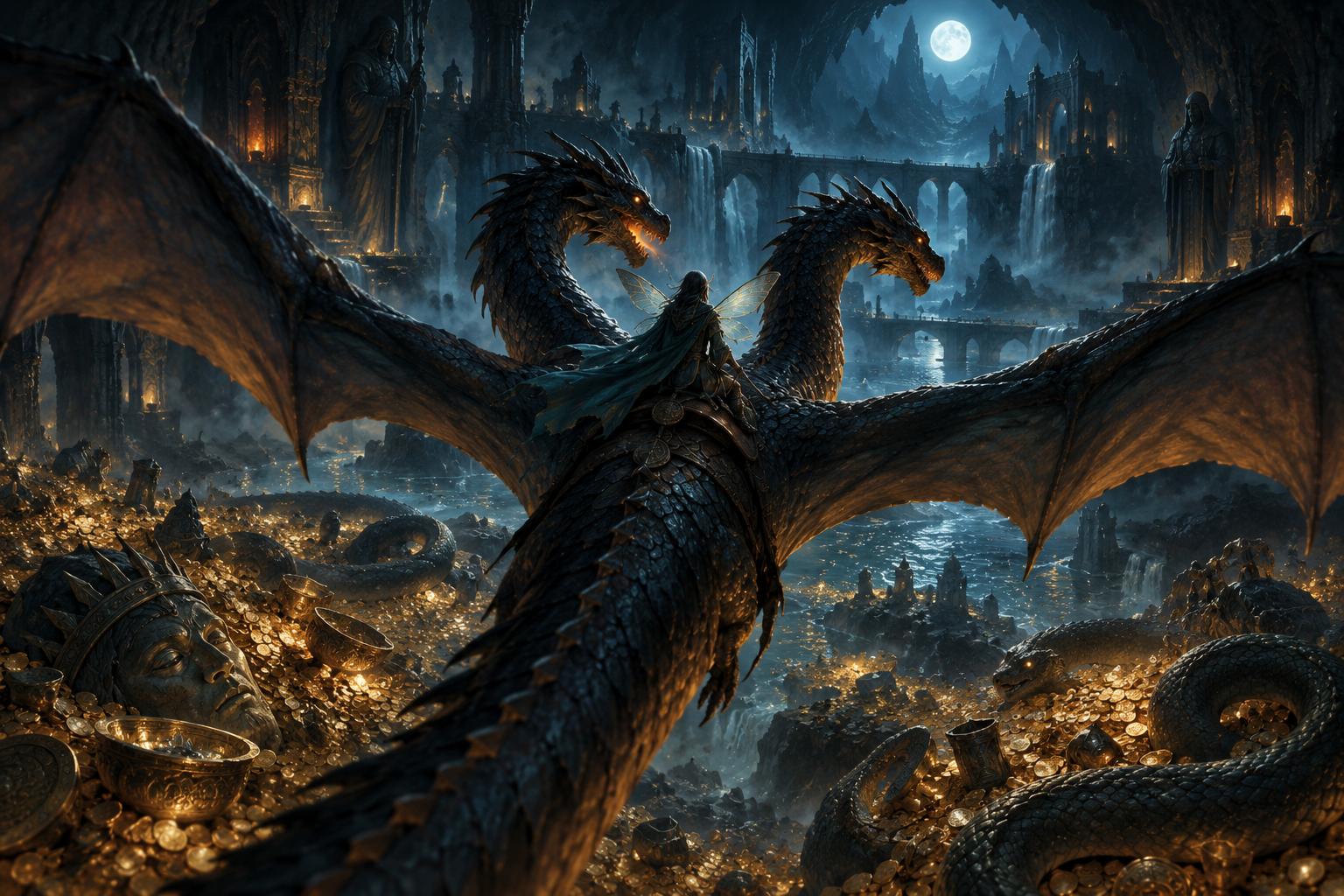
Valac demon profile: the 62nd Ars Goetia spirit, a president shown as a winged child on a two-headed dragon. Rank, legions, sigil, sources and The Nun.
Quick answer: The Valac demon, also spelled Valak, Volac or Ualac, is the sixty-second spirit of the Ars Goetia. The Lemegeton describes him as a great and mighty president who appears as a small boy with angel's wings riding a two-headed dragon. His offices are to reveal hidden treasure and to tell where serpents may be found, bringing them harmlessly to the operator. Weyer gives him thirty legions; the Mathers edition gives thirty-eight. The horror film The Nun borrowed only his name.
Related guides: all 72 demons of Solomon listed, the ranks of the Goetia explained, how Goetia names, offices and seals work, Marbas, the lion president, Zagan, king and president, Vassago, finder of lost things.
| Spirit | Number & rank | Appearance | Main offices | Legions |
|---|---|---|---|---|
| Valac | 62, President | A boy with angel's wings on a two-headed dragon | Hidden treasure, finding and bringing serpents | 30 (Weyer) / 38 (Mathers) |
| Vassago | 3, Prince | Not described; said to resemble Agares | Past and future, lost or hidden things | 26 |
| Marbas | 5, President | A great lion, then a man | Secrets, diseases, mechanical arts | 36 |
| Zagan | 61, King and President | A bull with griffin's wings, then a man | Wit, transmuting liquids and metals | 33 |
Key Takeaways
Valac is the sixty-second of the seventy-two spirits listed in the Ars Goetia, the first section of the Lesser Key of Solomon. The Mathers and Crowley edition of 1904 gives his name as Volac, with the variants Valak and Valu, and describes him as “a President Mighty and Great” who “appeareth like a Child with Angel’s Wings, riding on a Two-headed Dragon.” His office is “to give True Answers of Hidden Treasures, and to tell where Serpents may be seen,” and he is said to bring these serpents to the operator “without any Force or Strength.”
Two things make Valac unusual within the catalog. The first is his form. Most Goetia spirits appear as soldiers, beasts or monstrous hybrids; a winged child is closer to a Renaissance putto than a demon. The second is his narrow brief. Where spirits like Marbas or Buer have four or five offices, Valac has only two, and both are practical rather than intellectual: finding buried wealth and locating snakes.
His rank of president places him in the group of spirits that the grimoire tradition associates with Mercury and with knowledge. The number of legions attached to him differs between sources, as explained below. For how presidents relate to kings, dukes and marquises, see our guide to the Goetia ranks and hierarchy.
The earliest printed description of Valac comes from Johann Weyer’s Pseudomonarchia Daemonum, published in 1577 as an appendix to his De Praestigiis Daemonum. Weyer, a Dutch physician who opposed witch persecution, printed the catalog of spirits to show how absurd he considered ritual magic. His entry, under the name Volac, calls him a great president who comes forth with angel’s wings like a boy, riding a two-headed dragon. He answers perfectly about hidden treasure and where serpents may be seen, which he delivers into the hands of the conjurer “void of any force or strength.” Weyer gives him thirty legions.
Reginald Scot’s English translation in The Discoverie of Witchcraft (1584) reproduces this almost word for word, and it is Scot’s phrasing that the later Goetia echoes. In Weyer’s ordering Valac is likewise one of the later spirits, though the numbering shifts slightly because the Goetia adds four spirits absent from Weyer.
The legion discrepancy is a small but telling example of how the tradition changed between the sixteenth and seventeenth centuries. Weyer and Scot say thirty. The Goetia manuscripts copied in the 1600s, and the Mathers edition drawn from them, say thirty-eight. Nobody knows whether this was a deliberate revision or a copyist’s slip. Modern writers quote one or the other without noticing the gap, so it is worth knowing both.
Does this touch your own situation? Many readers come to these pages because something in their home, dreams or family feels unexplained. Reading history helps, but it cannot look at your specific case.
Consult the Sheikh Private, confidential, and free to ask.
The seal assigned to Valac in the Mathers edition is a compact figure dominated by a horizontal bar with short strokes rising and falling from it, resembling a stylized row of battlements or a key’s teeth. Small circles mark the ends of several lines. One longer line descends from the bar and ends in a hooked or looped terminal, and a shorter curved element sits above. Like the other sixty-two seals it is abstract; nothing in it depicts a child, a dragon or a serpent.
The Goetia calls these figures the spirits’ “Seals” or “Characters” and says each spirit is bound to obey the operator who bears his seal. Where the designs came from is uncertain. Some resemble the cipher-like characters in the Key of Solomon and in earlier Solomonic manuscripts; others look like deliberately invented glyphs. Joseph Peterson’s critical edition, based on the British Library manuscripts, shows minor variations from Mathers in line placement and in the number of circles.
This site describes the Valac sigil as a historical artifact. The background to these signs, from Solomonic seals to modern sigil art, is covered in our article on what a sigil means. No instructions for using any seal are given here.
Each element of Valac’s profile connects to older ideas about spirits and the earth.
Treasure-finding was one of the most common reasons early modern people consulted magical books, and several Goetia spirits share the office. Buried wealth was imagined as guarded by spirits, which is why a demon who could point to it was so attractive. Valac shares this role with Vassago, Marbas and others.
The link between snakes and treasure is ancient. In European and Near Eastern folklore, serpents guard hoards, and dragons are the great serpents of legend. A spirit who reveals both treasure and serpents is really offering a single thing: safe access to what lies hidden underground. The promise to deliver serpents “without force or strength” means the snakes arrive tame, which again reads as a promise of safety.
Dragons appear as mounts for several Goetia spirits, including Bune, who is a three-headed dragon himself. A two-headed mount is probably meant to look exotic and powerful rather than to carry a specific meaning, though some modern commentators read the two heads as the dual office.
Angel-winged children were everywhere in sixteenth-century art. Giving a demon this form may be a deliberate inversion, a reminder that spirits can wear innocent shapes. The Goetia does not explain it; the image is simply inherited from Weyer.
Jacques Collin de Plancy’s Dictionnaire Infernal, published in 1818 and reissued in 1863 with sixty-nine engravings by Louis Le Breton, includes a brief entry for Volac or Valac that repeats Weyer’s description: a great president, a winged child on a two-headed dragon, treasure and serpents, thirty legions. Valac is not among the spirits Le Breton illustrated, so the Dictionnaire gave him no lasting image the way it did for Bael, Buer or Stolas.
Nineteenth- and twentieth-century occult writers mostly left Valac alone. The Golden Dawn and Crowley folded all seventy-two spirits into tables of zodiacal decans and planetary hours, and in Crowley’s 1904 edition Valac is assigned a night-demon attribution, but nothing new was written about him. He remained a minor name in a long list.
That changed in the twenty-first century for reasons that have nothing to do with demonology, as the next section explains. For the wider picture of how these catalogs were assembled and read, see our overview of what demonology is.
Most people who search for Valac today are looking for Valak, the pale demonic nun from the Conjuring film series. The character first appeared in The Conjuring 2 (2016) and then headlined The Nun (2018) and The Nun II (2023). The films present Valak as an ancient demon who takes the form of a nun to mock the faith of its victims and is associated with a Romanian abbey.
None of this comes from the Goetia. The filmmakers have said they chose the name from a list of demons and built the character around a nun image the director had in mind. The historical Valac is a treasure-finding winged child with a snake specialty, not a profaner of convents, and the grimoires say nothing about possession, abbeys or sacred imagery in connection with him.
The borrowing illustrates a pattern. Once a name enters a popular franchise, the fictional version overwrites the historical one in search results and in casual knowledge. The same happened to Paimon after the film Hereditary. Readers who want the original Valac should treat the films as entertainment and go back to Weyer and the Lemegeton, where the entry is four sentences long.
Because the film has crowded out the sources, a few corrections are useful.
Valac is a good example of how little material lies behind a famous demonic name. The entire primary tradition consists of Weyer’s Latin paragraph of 1577, Scot’s English rendering of 1584, the seventeenth-century Goetia manuscripts, and the printed Mathers and Crowley edition of 1904. The Dictionnaire Infernal adds nothing but a French summary. Everything else, including the film, is modern invention or modern interpretation.
When reading a modern description, check it against those sources. If it describes Valac as a nun, a possessing spirit, or a demon of chaos, it is drawing on the Conjuring franchise. If it gives a long personal history or a set of personality traits, it is drawing on contemporary occult writing rather than on anything historical. If it says thirty or thirty-eight legions, it is at least looking at the right books.
This site describes the Goetia as a historical document and does not provide or endorse ritual instructions. For Valac’s place in the full catalog, see the 72 demons of Solomon, and for an explanation of how the names, offices and seals were organized, our guide to the Ars Goetia.
Still have a question about your own experience? Describe what you are seeing, feeling or dreaming, and when it started. The Sheikh reads every message personally and replies in private.
Curious how this applies to your own life? Valac’s legend is about uncovering what lies hidden, a theme that resonates with anyone sorting through an unclear situation. A Full Personal Reading from our partner PuraTarot offers a personal, reflective look at your own questions. Join the free Djinn Guide newsletter and, once you confirm, you will unlock a 50% code for your first reading.
Further reading
As an Amazon Associate we earn from qualifying purchases.
Valac is the sixty-second spirit of the Ars Goetia, a president who appears as a child with angel's wings riding a two-headed dragon. The grimoire says he reveals hidden treasure and tells where serpents can be found, bringing them harmlessly to the operator. The entry comes from Weyer's 1577 catalog and the later Lesser Key of Solomon.
Only the name is borrowed. The Goetia's Valac is a treasure-finding winged child with no connection to nuns, convents or possession. The Conjuring films created the nun character independently and attached the name to it. No historical source describes Valac in the way the films do.
It depends on the source. Johann Weyer's Pseudomonarchia Daemonum of 1577 and Reginald Scot's translation give thirty legions, while the seventeenth-century Goetia manuscripts and the 1904 Mathers edition give thirty-eight. Both numbers are cited in modern books, often without noting the difference.
The Lemegeton describes Valac as a small boy with angel's wings riding on a dragon with two heads. No further details are given, and the Dictionnaire Infernal did not illustrate him, so modern images vary widely. The description is identical in Weyer, Scot and the Goetia.
All three refer to the same spirit. Weyer and Scot write Volac, the Mathers edition gives Volac with Valak and Valu as variants, and Valac is the most common spelling online today. Ualac also appears in some manuscripts. There is no single authoritative form.
Disclaimer
This article describes Valac as he appears in historical grimoires, demonologies and popular culture for educational purposes. The beliefs summarized are not endorsed, no ritual instructions are provided, and no claim is made that any spirit or seal produces results.
Did this guide help you understand the subject? Rate it and share your honest opinion to help other readers. Every review is checked by our editors before it appears.
There are no reviews yet. Be the first one to write one.


Sheikh Youssef
Tayeb El Merzouki
For inquiries about personalized spiritual work, private rituals, and traditional talismans, connect directly with Sheikh Youssef Tayeb El Merzouki.
Chat on WhatsApp