






Join Djinn Guide: Get 50% Off a Personal Reading
Get new guides to jinn, folklore and occult history. Confirm your subscription to unlock a 50% code for a first personal reading with our partner PuraTarot.
Discover the unseen
Shedim explained: the spirits of Jewish tradition named in the Bible and Talmud, their king Ashmedai, and how they compare with the jinn of Islamic belief.
Quick answer: Shedim (singular shed) are spirits in Jewish tradition, named twice in the Hebrew Bible and described at length in the Talmud as beings that share some traits with angels and some with humans: they fly and know hidden things, but they also eat, reproduce and die. Their king is Ashmedai, the Asmodeus of later lore. Because they form a created, mortal community with mixed character, shedim are the closest Jewish parallel to the jinn of Islamic belief.
Related guides: jinn in Islamic sources, Asmodeus across traditions, Lilith in Jewish lore, the Testament of Solomon, jinn folklore across cultures, what demonology is.
| Feature | Shedim (Jewish tradition) | Jinn (Islamic tradition) |
|---|---|---|
| Scriptural basis | Deuteronomy 32:17; Psalm 106:37 | Many Quranic passages; Surah Al-Jinn (72) in full |
| Origin | Various: created at twilight of the sixth day, offspring of Adam's wanderings, or spirits left without bodies | Created from smokeless fire before humans (Quran 15:27; 55:15) |
| Nature | Three angelic traits, three human traits (Hagigah 16a) | A community with free will, eating, marrying, dying, judged |
| Moral status | Mostly harmful; some neutral or helpful; some 'Jewish' shedim in later lore | Believers and unbelievers; good and bad |
| Ruler | Ashmedai, king of the shedim | No single king in the Quran; folklore names several jinn kings |
| Relation to Solomon | Solomon captures Ashmedai to build the Temple (Gittin 68) | Jinn labor for Solomon (Quran 34:12–13; 27:38–40) |
| Visibility | Invisible unless special means are used | Normally unseen by humans (Quran 7:27) |
Key Takeaways
Shedim (Hebrew shedim, singular shed) is the most common Hebrew term for the spirit beings that Jewish tradition places somewhere between angels and humans. The word is usually translated “demons,” but that rendering imports Christian ideas of fallen angels serving Satan that do not fit the Jewish material well. Shedim are better understood as a category of invisible, often harmful, but mortal and sometimes approachable beings who populate the world alongside people.
The etymology points east. Most scholars connect shed with the Akkadian shedu, a protective spirit in Mesopotamian religion often represented as a winged bull guarding palace gates. In Hebrew the term shifted from protector to something more ambiguous, probably because the Israelite writers were describing the gods and spirits of their neighbors and not their own guardian figures. The Bible uses the word only twice, and both times with disapproval.
In later Jewish usage shedim became the general term, alongside mazzikin (“harmers”) and ruchot (“spirits”), for the beings discussed in rabbinic literature, folklore and Kabbalah. When people today ask about jinn in Judaism, shedim are the answer: the Jewish category that most closely resembles the jinn of Islamic sources.
The biblical evidence is small. Deuteronomy 32:17, in the Song of Moses, accuses Israel of sacrificing “to shedim, not God, to gods they had not known.” Psalm 106:37 repeats the charge in harsher form: the people “sacrificed their sons and daughters to shedim.” In both passages the word describes the objects of forbidden worship, and the texts are more interested in condemning the practice than in explaining what shedim are.
Other biblical passages mention beings that later tradition grouped with the shedim without using the word. Azazel in Leviticus 16 receives the scapegoat in the wilderness. Isaiah 34:14 lists the lilit among the creatures of a ruined land, the seed of the later Lilith legend. The se’irim, “hairy ones” or goat-spirits, appear in Leviticus 17:7 and Isaiah 13:21. None of these passages develops a theory of spirits.
That reticence changed in the Second Temple period. Books such as 1 Enoch and Jubilees, which did not enter the Hebrew canon, tell how angels descended, married human women, and fathered giants whose disembodied spirits became the demons that trouble humanity. The Dead Sea Scrolls include hymns and exorcistic psalms against such spirits. By the first century CE, Jewish readers took for granted a populated spirit world that the Bible itself had barely sketched.
Does this touch your own situation? Many readers come to these pages because something in their home, dreams or family feels unexplained. Reading history helps, but it cannot look at your specific case.
Consult the Sheikh Private, confidential, and free to ask.
The Babylonian Talmud, compiled in the fifth and sixth centuries CE, contains the richest classical material on shedim. The most quoted passage is Hagigah 16a, which says that shedim resemble the ministering angels in three ways and human beings in three ways.
They have wings, they fly from one end of the world to the other, and they know what is going to happen, though the Talmud clarifies that they overhear it from behind the heavenly curtain rather than knowing it on their own.
They eat and drink, they reproduce, and they die. This mortal, bodily aspect is what most sharply distinguishes shedim from the Christian idea of an immortal fallen angel.
Other passages add detail. Berakhot 6a says shedim are everywhere and that if the eye could see them no one could endure the sight. Pesachim 110–112 warns about spirits attached to pairs of things, to certain trees, and to the night, and gives folk remedies. Shedim are drawn to ruins, latrines, deserts and water.
Gittin 68a–b tells the famous story of King Solomon capturing Ashmedai, king of the shedim, in order to learn how to cut the stones of the Temple without iron tools. Ashmedai reveals the secret of the shamir worm, is kept in chains, and later tricks Solomon into handing over the royal ring, after which the demon rules in Solomon’s place while the king wanders as a beggar. This is the Jewish root of the Solomon-and-demons legend that fills the Testament of Solomon and the later grimoires.
Unlike Christian theology, which settled on a single story of angelic rebellion, Jewish tradition offers several origins for the shedim and never chose between them. The Mishnah (Avot 5:6) lists things created at twilight on the eve of the first Sabbath, and some versions include the mazzikin, implying that the spirits were made during creation but left unfinished when the Sabbath began, which explains why they have no bodies of their own.
A second tradition, found in the Talmud (Eruvin 18b) and expanded in midrash, says that during the 130 years after the expulsion from Eden, Adam separated from Eve and fathered spirits, shedim and liliths. A third, drawn from Enochic literature, makes demons the spirits of the giants born from angels and women. Medieval writers added that shedim could be born from human sin or from the mixing of categories that the Torah forbids.
Kabbalistic texts, especially the Zohar (thirteenth century), organized these beings into a shadow hierarchy called the “other side,” the sitra ahra, ruled by Samael and his consort Lilith. The Zohar also speaks of “Jewish shedim” who accept the Torah and are less harmful, a notion that later folklore developed into tales of demon communities with rabbis and courts of law.
Jewish and Islamic spirit beliefs developed side by side in the same regions, in Babylonia, Arabia, North Africa and Spain, and they share much. Both describe a created class of beings, invisible to ordinary sight, who eat, marry, bear children and die. Both allow that some of these beings are pious and some wicked, in contrast with the uniformly evil demons of Christian doctrine. Both attach them to deserts, ruins, bathhouses and night. Both tell stories of King Solomon commanding them, and both name a spirit-king: Ashmedai in the Talmud, and various jinn kings in Islamic folklore.
The differences are also real. The Quran gives the jinn a defined origin, smokeless fire, and a defined relationship to revelation: Surah Al-Jinn (72) records a group of jinn hearing the Quran and believing. Jewish sources are far less systematic, preserving multiple contradictory origins and treating the subject as folklore rather than doctrine. The jinn are part of Islamic creed; belief in shedim was never a required article of Jewish faith, and major authorities rejected it outright.
Transmission went both ways. The Jewish Ashmedai became the Asmodeus of Christian demonology and, through Arabic, a figure in Islamic tales of Solomon. The Islamic image of the jinn king and his court colored later Jewish folklore from Muslim lands. The article on Asmodeus across traditions traces one of these journeys in detail.
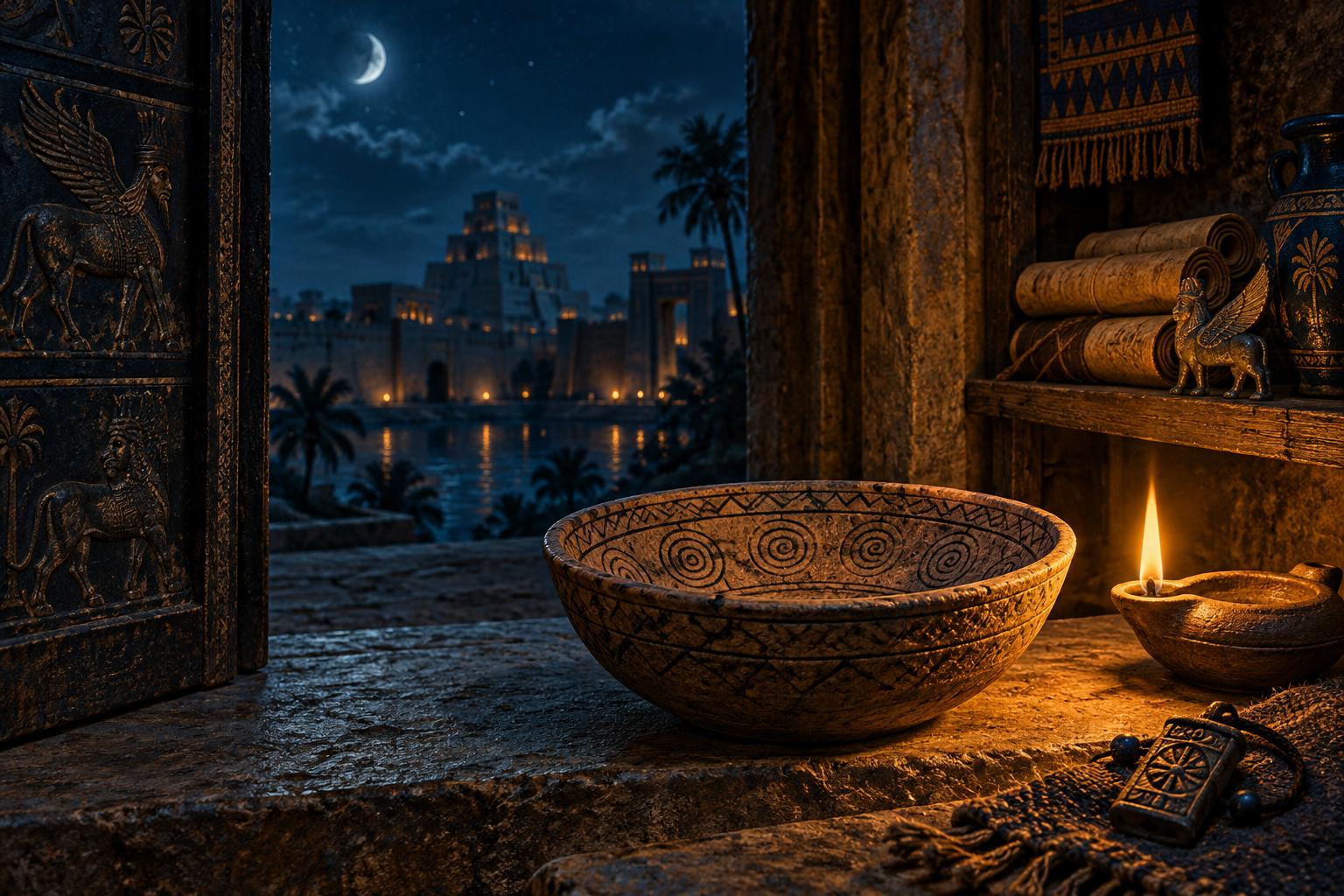
The most vivid physical evidence for belief in shedim comes from the Jewish Aramaic incantation bowls found in Iraq and Iran, dating from roughly the fifth to the seventh centuries CE. These are ordinary clay bowls inscribed in spiral text with spells to protect a household from named spirits, including Lilith, and often decorated with a crude bound figure at the center. They were buried upside down under thresholds and in corners. Hundreds survive, written by and for Jews, Mandaeans and Christians, and they show that the Talmud’s talk of shedim reflected a living popular practice.
Later Jewish communities continued to produce amulets, kame’ot, inscribed with divine names, angel names and verses against spirits, especially to protect mothers and newborns. The use of the name of Lilith and the three angels Senoy, Sansenoy and Semangelof on childbirth amulets is attested from the medieval period into modern times.
It is worth stressing that mainstream rabbinic authorities disagreed about all this. Maimonides, in the twelfth century, denied the existence of shedim altogether and treated belief in them as a foolish superstition, and later rationalists followed him. Other authorities accepted the Talmudic material at face value. Jewish tradition has never required belief in shedim, and the practices described here are presented as history, not as recommendations.
Several ideas about shedim circulate online that the sources do not support.
Interest in shedim has grown with the broader curiosity about jinn and demonology. Readers of fantasy fiction, students comparing Abrahamic religions, and people exploring Jewish folklore all arrive at the term. Shedim also appear in novels, television series and games, usually in forms that owe more to Christian demonology than to the Talmud.
For those who want the real material, the Talmudic passages are available in English in the Steinsaltz and Soncino translations, and the incantation bowls are published with translations in scholarly collections. Gittin 68 and Hagigah 16a are the natural starting points. Read them as rabbinic literature, which mixes law, story and folk wisdom without separating them, and resist the urge to build a single system out of texts that never intended one. Comparing them with the parallel material on jinn folklore across cultures shows how much the two traditions shared and how differently they organized it.
This site treats shedim as a subject of religious and cultural history. The beliefs described here are presented as beliefs held by particular communities at particular times, not as claims about the world, and nothing in this article offers protective, ritual or spiritual instructions of any kind.
Still have a question about your own experience? Describe what you are seeing, feeling or dreaming, and when it started. The Sheikh reads every message personally and replies in private.
Drawn to these stories for a reason? Stories of shedim, like stories of jinn, often reflect very human questions about the unseen and the uncertain. A Full Personal Reading from our partner PuraTarot offers a calm, personal reflection on whatever question is on your mind. Join the free Djinn Guide newsletter and, once you confirm, you will unlock a 50% code for your first reading.
Further reading
As an Amazon Associate we earn from qualifying purchases.
Shedim are spirit beings in Jewish tradition, mentioned twice in the Hebrew Bible and discussed extensively in the Talmud. They are described as sharing three traits with angels, including flight and knowledge of the future, and three with humans, including eating, reproducing and dying. They are mostly seen as harmful but are not fallen angels, and belief in them was never obligatory.
Shedim is the plural of the Hebrew shed, usually translated "demon" or "spirit." Scholars connect it to the Akkadian shedu, a protective guardian spirit in Mesopotamian religion. In the Hebrew Bible the word refers to the spirits or gods to whom foreign nations sacrificed, and in later rabbinic literature it became the general term for invisible, often harmful beings.
Ashmedai is the king of the shedim in the Babylonian Talmud (Gittin 68a–b), where King Solomon captures him to learn how to cut the Temple stones and is later tricked by him into losing his throne. He is the same figure as Asmodeus in the Book of Tobit and in later Christian demonology, and the name may derive from the Persian demon Aeshma.
They are parallel rather than identical. Both are created, invisible, mortal beings that eat, marry and die, and both can be good or bad. But jinn have a fixed origin in the Quran, smokeless fire, and a defined place in Islamic creed, while Jewish sources give shedim several conflicting origins and treat them as folklore that major authorities such as Maimonides rejected.
Views vary. Traditional sources in the Talmud and Kabbalah take shedim seriously, and some observant communities retain protective customs. Rationalist authorities since Maimonides have denied their existence, and most modern Jewish movements treat the material as folklore and literature rather than doctrine. Belief in shedim has never been a required article of Jewish faith.
Disclaimer
This article describes shedim as they appear in Jewish scripture, rabbinic literature, Kabbalah and folklore, and compares them with Islamic beliefs about jinn. These beliefs are presented for historical and cultural understanding, not endorsed, and no protective or ritual instructions are offered.
Did this guide help you understand the subject? Rate it and share your honest opinion to help other readers. Every review is checked by our editors before it appears.
There are no reviews yet. Be the first one to write one.


Sheikh Youssef
Tayeb El Merzouki
For inquiries about personalized spiritual work, private rituals, and traditional talismans, connect directly with Sheikh Youssef Tayeb El Merzouki.
Chat on WhatsApp