




Join Djinn Guide: Get 50% Off a Personal Reading
Get new guides to jinn, folklore and occult history. Confirm your subscription to unlock a 50% code for a first personal reading with our partner PuraTarot.
Discover the unseen
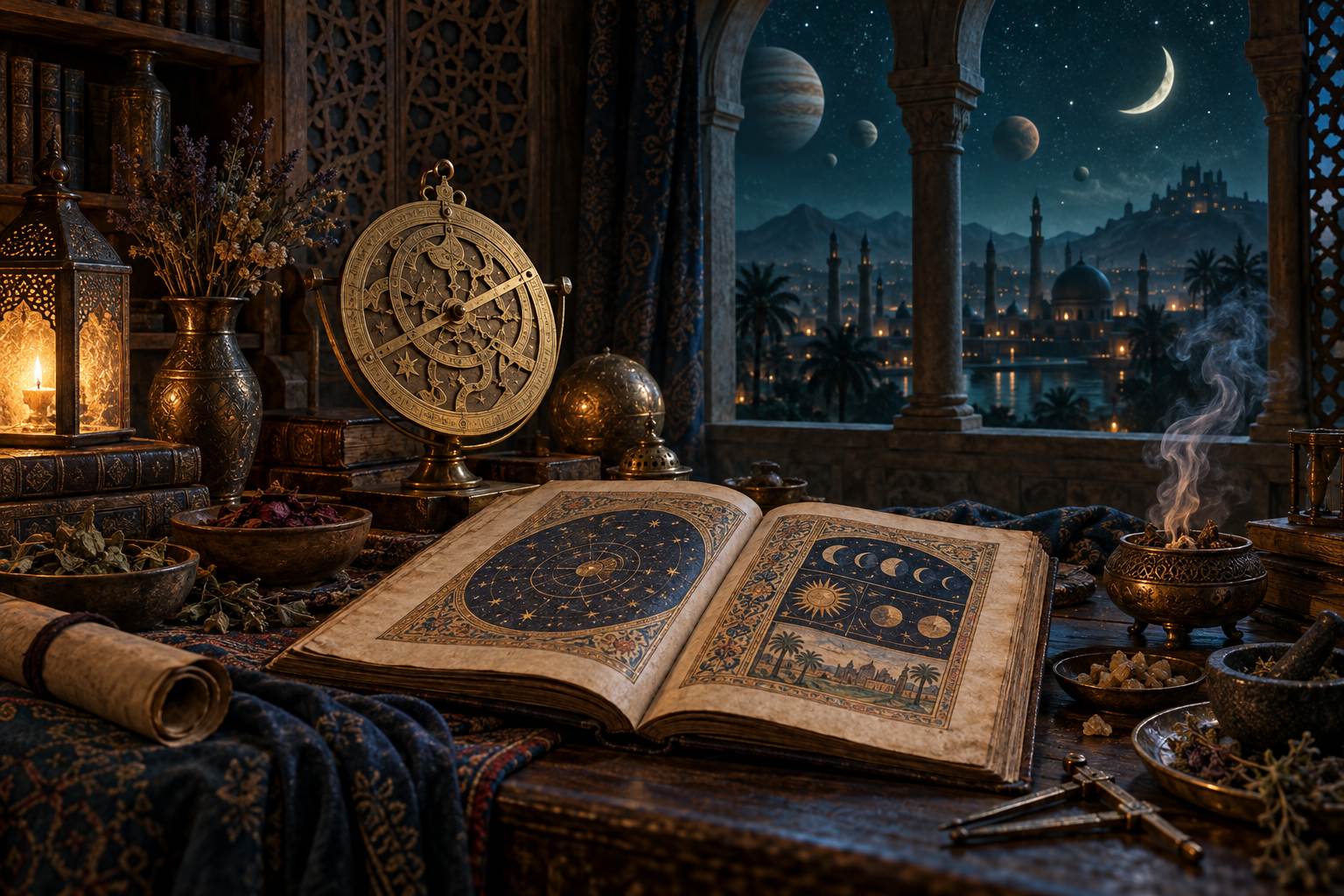
Picatrix explained: what the Ghayat al-Hakim is, who wrote it, its four books of astral magic and talismans, and how it shaped Renaissance occult thought.
Quick answer: Picatrix is the Latin name of the Ghayat al-Hakim, "The Goal of the Sage," an Arabic handbook of astral magic written in Islamic Spain in the tenth or eleventh century. It was translated into Castilian in 1256 at the court of Alfonso X and then into Latin, becoming the most influential magical text of medieval and Renaissance Europe. Its four books cover planetary spirits, talismans, lunar mansions, and the philosophy behind drawing down celestial influence.
Related guides: grimoire meaning and famous grimoires, Hermeticism and Hermes Trismegistus, amulets and talismans through history, the Greater Key of Solomon, how to read occult manuscripts, occult symbols and their meanings.
| Book | Main subject | Notable contents |
|---|---|---|
| Book I | Philosophy of magic and the cosmos | Definition of magic as practical wisdom; the soul's ascent; the "perfect nature" as a personal celestial guide |
| Book II | Astrological foundations | Planets, zodiac signs, decans and images; the 28 lunar mansions; timing of operations |
| Book III | Planetary spirits and correspondences | Prayers and suffumigations to the planets; Sabian rites of Harran; plants, stones and animals assigned to each planet |
| Book IV | Practical compilations | Recipes, talisman designs, the "Nabataean" material, miscellaneous astral operations |
Key Takeaways
The Picatrix is the Latin title of a medieval Arabic book called Ghayat al-Hakim, usually translated as “The Goal of the Sage” or “The Aim of the Wise.” It is a long, sprawling manual of what scholars call astral magic: the belief that the planets and stars pour influence into the lower world, and that a learned person can capture that influence in objects, especially engraved talismans, by acting at the right astrological moment with the right materials and the right words.
The work is organized into four books. The first lays out a philosophy of magic as the practical branch of wisdom, rooted in the Neoplatonic idea that everything below the moon is shaped by what is above it. The second explains the astrological machinery, including planets, signs, decans and the twenty-eight mansions of the moon. The third assigns plants, stones, animals, colors and incenses to each planet and records long prayers addressed to them. The fourth gathers practical operations and miscellaneous lore.
Unlike the later Solomonic grimoires, the Picatrix is not mainly a book of spirit lists and seals. It is closer to a textbook of natural philosophy with a magical application, and it quotes or paraphrases hundreds of earlier sources. Readers who know the famous grimoires of Europe will find it more philosophical and more astrological than most of them.
The Arabic text names no author. Medieval tradition attributed it to Maslama al-Majriti, a mathematician and astronomer of Cordoba who died around 1007, and the Latin version repeats that claim. Modern scholarship is skeptical. The historian Maribel Fierro argued in the 1990s that the real compiler was Maslama ibn Qasim al-Qurtubi, a traveler and esoteric writer from Cordoba who died in 964, and whose known interests match the book far better. The confusion of two men named Maslama from the same city is easy to understand.
Internal evidence points to composition in al-Andalus, Islamic Spain, sometime in the tenth or early eleventh century. The compiler drew on a vast library: Greek philosophy in Arabic translation, Hermetic treatises, the astrology of Abu Ma’shar, the so-called Nabataean Agriculture of Ibn Wahshiyya, Indian and Persian material, and reports about the star-worshipping Sabians of Harran in upper Mesopotamia. Much of the book consists of excerpts and summaries, which is one reason it reads as a compilation rather than a single argument.
The name “Picatrix” itself is a puzzle. It appears in the Latin translation as the author’s name. The most common explanation is that it is a corrupted rendering of “Buqratis,” the Arabic form of Hippocrates, perhaps because one of the sources quoted in the book was attributed to him. Other suggestions exist, but none is certain, and the word has no meaning outside the book.
Does this touch your own situation? Many readers come to these pages because something in their home, dreams or family feels unexplained. Reading history helps, but it cannot look at your specific case.
Consult the Sheikh Private, confidential, and free to ask.
The Picatrix owes its European career to Alfonso X of Castile, called “the Wise,” who sponsored a school of translators at Toledo. In 1256 the Arabic text was rendered into Castilian Spanish, and from that Spanish version a Latin translation was made shortly afterward. The Spanish text survives only in fragments; the Latin text survives in many manuscripts and is the form in which the book was read by European magicians, physicians and philosophers for the next four centuries.
The Latin translators did not reproduce the Arabic faithfully. They dropped some overtly Islamic references, rearranged material and occasionally misunderstood technical terms. As a result, the Arabic and Latin Picatrix are related but distinct works, and scholars study both. This is a common pattern for occult manuscripts, and understanding it is part of learning how to read occult manuscripts in context.
For most English readers the Attrell and Porreca translation is the scholarly reference, while Greer and Warnock is widely used in practitioner circles.
The theory behind the Picatrix is simple to state and complex to apply. The cosmos is a hierarchy: a single source at the top, then intellect, then the world soul, then the planetary spheres, then the elements and the earth. Influence flows downward. A talisman, which the Arabic calls a tilasm, is a material object prepared so that it receives and stores a specific celestial influence, much as a mirror catches light. The craftsman must choose the moment when the relevant planet is strong, the materials that belong to it, and an image that expresses its nature.
Much of Book II is devoted to the images of the decans, the thirty-six ten-degree divisions of the zodiac, and to the twenty-eight lunar mansions, each with its own talisman and purpose. Book III adds the planetary prayers, lengthy invocations in which the operator addresses Saturn, Jupiter, Mars, the Sun, Venus, Mercury and the Moon by their qualities and asks them to lend their power. The book attributes these rites to the Sabians of Harran, whom it treats as the last keepers of ancient star religion.
The Picatrix also describes the “perfect nature,” a personal celestial spirit assigned to each person, which the philosopher may come to know through study and purification. This idea connects the book with Hermetic philosophy and with later European notions of a guardian spirit. Alongside the lofty passages sit crude recipes involving animal parts and foul-smelling incenses, a mixture that puzzled early readers and still does.
In the Islamic world the Ghayat al-Hakim belonged to a broad literature on the “science of talismans” that also included works attributed to Jabir ibn Hayyan and the astrological writings of al-Kindi and Abu Ma’shar. It was read, copied and criticized; many jurists regarded talismanic magic as forbidden, and the book’s survival owed much to scholars who valued its philosophy. It does not discuss jinn in the Quranic sense. Its spirits are planetary intelligences, the ruhaniyyat, who answer to the stars rather than living as a created community alongside humans.
In Europe the Latin Picatrix was known to Peter of Abano, condemned by Johannes Trithemius as a dangerous book, and used carefully by Marsilio Ficino, whose Three Books on Life (1489) borrows its theory of attracting planetary spirit through images, music and scent. Heinrich Cornelius Agrippa’s Three Books of Occult Philosophy (1533) draws tables of correspondences from it. Through Agrippa the Picatrix shaped the vocabulary of planetary hours, metals and images used in the Greater Key of Solomon and later grimoires.
Jewish scholars in Spain and Provence also knew the Arabic text, and some of its astral-magical ideas appear in Hebrew works of the thirteenth and fourteenth centuries.
Because the book has a sinister reputation, it attracts claims that the text does not support. A few corrections help.
A related confusion is between the Picatrix and talismanic objects in general. The book is one source among many for the history of amulets and talismans, which long predate it and continued without it.
Interest in the Picatrix has grown since the first full English translations appeared. Three audiences overlap. Historians of science and religion study it as evidence of how medieval thinkers understood the cosmos and the boundary between natural philosophy and magic. Modern astrologers, especially those working in the revived traditional and “electional” styles, read it for its material on lunar mansions, decans and planetary timing. Practitioners of contemporary occultism treat it as a foundational text of Western astral magic and build on its correspondences.
The book also appears in fiction, games and online videos, often described as the most dangerous grimoire ever written. That reputation is largely a Renaissance inheritance: Trithemius and others warned against it, and warnings make good copy. The actual content is scholarly, repetitive and frequently obscure, with far more pages about philosophy and astrology than about anything that resembles spell-casting in the popular sense.
The Picatrix is also a bridge: anyone tracing how Greek philosophy, Islamic astrology and European magic connect ends up at this book.
Start with a scholarly translation and read the introduction before the text. The Attrell and Porreca edition explains the manuscript history, the sources and the differences between Arabic and Latin versions, which prevents the most common mistakes. Book I is the most readable and gives the philosophical frame; Book II is dense with astrology; Books III and IV reward skimming for structure before reading in detail.
Keep a few questions in mind. Which passages are the compiler’s own and which are quotations? Where does the Latin differ from the Arabic, and why might the translators have changed it? How do the planetary correspondences compare with later tables in Agrippa? Treating the book as a historical document rather than a manual makes it far more intelligible.
This site discusses the Picatrix as a work of intellectual and religious history. It describes the practices the book records; it does not provide instructions for making talismans or performing planetary rites, and it makes no claim that any such operation has an effect. Beliefs about celestial influence are presented as beliefs held by the people who wrote and read these texts.
Still have a question about your own experience? Describe what you are seeing, feeling or dreaming, and when it started. The Sheikh reads every message personally and replies in private.
Drawn to these ideas for a reason? The Picatrix grew from the belief that the heavens and a human life are linked, a theme many readers still reflect on. A Full Personal Reading from our partner PuraTarot offers a personal look at the questions shaping your own path. Join the free Djinn Guide newsletter and, once you confirm, you will unlock a 50% code for your first reading.
Further reading
As an Amazon Associate we earn from qualifying purchases.
The Picatrix is a medieval handbook of astral magic. It explains a cosmos in which planetary and stellar influence flows down to earth, and it describes how talismans, images, incenses and prayers were thought to capture that influence at astrologically chosen moments. It also contains long philosophical passages on wisdom, the soul and the structure of the universe.
The text is anonymous. Medieval tradition credited Maslama al-Majriti of Cordoba, but modern scholarship, following Maribel Fierro, favors Maslama ibn Qasim al-Qurtubi, who died in 964. Either way the book was compiled in Islamic Spain in the tenth or eleventh century from many earlier Greek, Arabic, Persian and Indian sources.
The Latin translation presents "Picatrix" as the author's name. Most scholars think it is a garbled form of Buqratis, the Arabic spelling of Hippocrates, possibly because a source quoted in the book was attributed to him. The word has no other known meaning, and the original Arabic title is Ghayat al-Hakim, "The Goal of the Sage."
Historically, yes in the sense that religious authorities in both Islamic and Christian contexts condemned talismanic magic, and Renaissance writers such as Trithemius warned against the book. In content, it is a scholarly compilation of astrology and philosophy. Its fearsome reputation owes more to those warnings than to anything unusual in the text itself.
For scholarly purposes, the 2019 translation of the Latin text by Dan Attrell and David Porreca, published by Penn State University Press, is the standard reference. The 2010 Greer and Warnock translation is widely used among practitioners. No complete English translation of the Arabic Ghayat al-Hakim exists yet; the Ritter and Plessner German version remains the main route to it.
Disclaimer
This article treats the Picatrix as a document of medieval intellectual and religious history. The astrological and talismanic beliefs it records are described, not endorsed, and no instructions for ritual practice or claims about results are given.
Did this guide help you understand the subject? Rate it and share your honest opinion to help other readers. Every review is checked by our editors before it appears.
There are no reviews yet. Be the first one to write one.


Sheikh Youssef
Tayeb El Merzouki
For inquiries about personalized spiritual work, private rituals, and traditional talismans, connect directly with Sheikh Youssef Tayeb El Merzouki.
Chat on WhatsApp