






Join Djinn Guide: Get 50% Off a Personal Reading
Get new guides to jinn, folklore and occult history. Confirm your subscription to unlock a 50% code for a first personal reading with our partner PuraTarot.
Discover the unseen
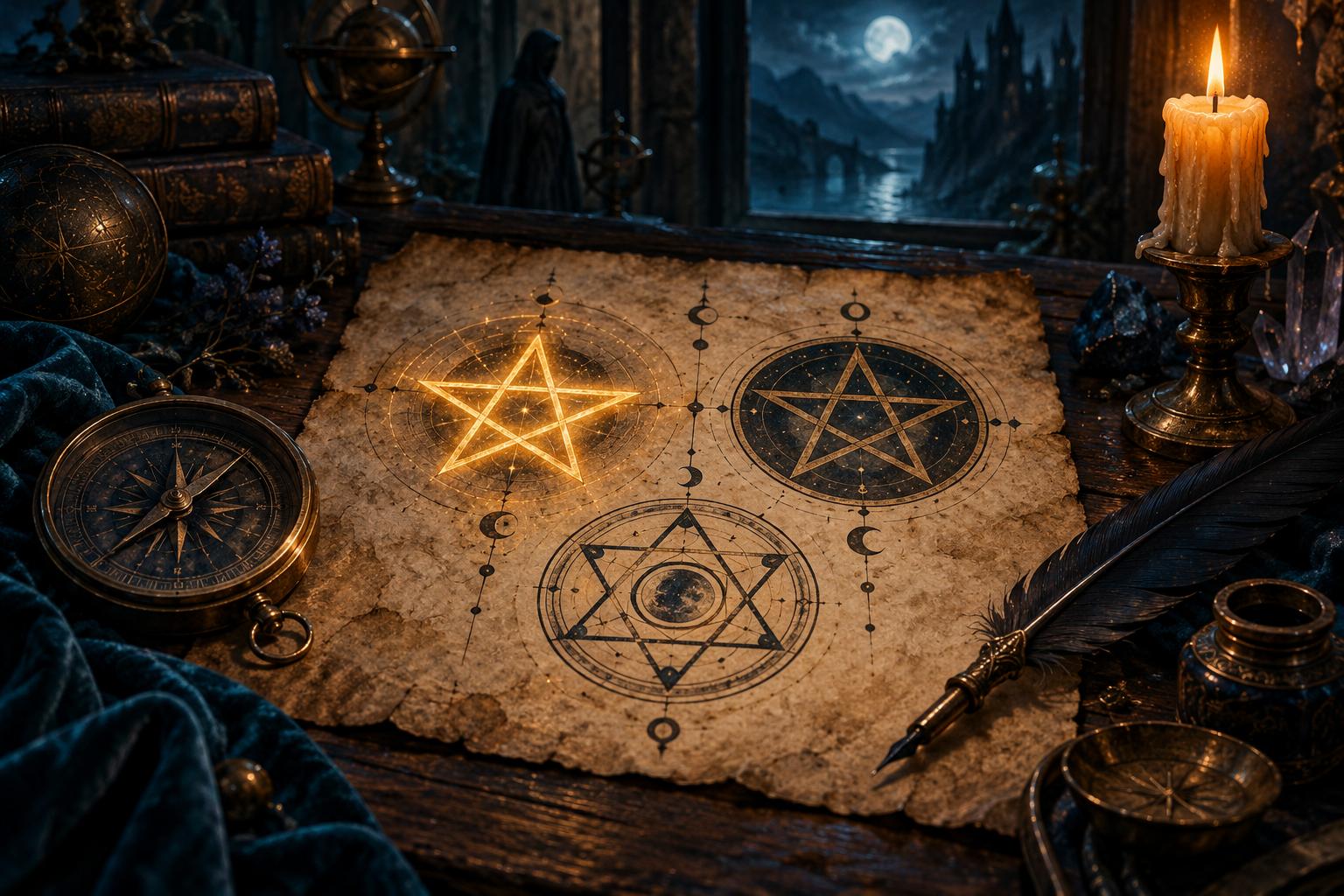
Pentagram vs pentacle explained: the five-pointed star, the circled star, Solomon's pentacles, the inverted pentagram, and how each meaning developed.
Quick answer: Pentagram vs pentacle comes down to one distinction: a pentagram is the five-pointed star itself, drawn in a single continuous line, while a pentacle is a star enclosed in a circle, or more broadly any talismanic figure drawn on a disc. In Wicca the two words are often used for the bare star and the circled star respectively. In older sources such as the Key of Solomon, however, a 'pentacle' can be any protective seal and need not contain a star at all.
Related guides: Seal of Solomon history and meaning, Seal of Solomon vs Star of David, what a sigil is, the Greater Key of Solomon, Agrippa's Three Books of Occult Philosophy, occult symbols and their meanings.
| Feature | Pentagram | Pentacle |
|---|---|---|
| Basic form | Five-pointed star drawn in one stroke | Star within a circle, or any inscribed talismanic disc |
| Word origin | Greek pentagrammon, 'five lines' | Uncertain; possibly Old French pentacol (neck ornament) or Latin pentaculum |
| Earliest uses | Mesopotamian pottery and seals; Pythagorean symbol of health | Medieval grimoires, especially the Key of Solomon |
| In the Key of Solomon | One figure among many | The general word for 44 protective seals, most without a star |
| In the Lesser Key (Goetia) | 'Pentagram of Solomon' worn on the breast | Term used loosely for seals and the 'Hexagram of Solomon' |
| In Wicca | The bare star; element spirit above four elements | Circled star; an altar tool, usually a disc |
| In tarot | Rarely named | Suit of Pentacles (coins), Rider-Waite 1909 |
| Inverted form | Two points up; linked to Baphomet after Eliphas Levi | Inverted pentacle used in some Wiccan second-degree symbolism |
Key Takeaways
The simplest answer to the pentagram vs pentacle question is a matter of geometry and vocabulary. A pentagram is a five-pointed star formed by five straight lines that cross one another, the kind you can draw without lifting your pen. The word comes from the Greek pentagrammon, ‘five lines.’ A pentacle, in the sense most people meet today, is a pentagram enclosed in a circle. In Wicca and much modern Paganism, the uncircled star is called a pentagram and the circled star a pentacle, and the pentacle is also a physical object: a disc of wood, metal, or clay bearing the symbol, placed on the altar.
History complicates this neat split. The word pentacle entered English from French in the sixteenth and seventeenth centuries, and in the grimoires of that period it meant a talismanic figure drawn or engraved on parchment or metal, whatever its shape. The Key of Solomon describes dozens of ‘pentacles’ that contain Hebrew letters, crosses, hexagrams, and geometric diagrams, and only a few feature a five-pointed star. So the pentacle meaning you find in a Wiccan handbook and the one you find in a seventeenth-century manuscript are not the same.
A useful rule: pentagram always refers to the five-pointed star; pentacle refers either to a circled pentagram (modern usage) or to a sealed talismanic design (older usage), and context tells you which.
The five-pointed star is one of the oldest drawn figures. It appears on pottery and seals from Mesopotamia in the fourth and third millennia BCE, where scholars suggest it carried an astronomical or administrative sense rather than a magical one. In ancient Greece, the followers of Pythagoras treated the pentagram as a symbol of health and of mathematical harmony, since its proportions involve the golden ratio. Later writers reported that the Pythagoreans wrote the letters of hygieia, ‘health,’ at its points.
In medieval Christian Europe, the pentagram was a positive symbol. The fourteenth-century poem Sir Gawain and the Green Knight explains that Gawain bears a gold pentangle on his shield, called the ‘endless knot,’ standing for the five wounds of Christ, the five joys of Mary, the five senses, the five fingers, and five knightly virtues. Nothing about it was sinister. Builders and masons also used the figure as a geometric mark.
Renaissance occult philosophy gave the star a new layer. Heinrich Cornelius Agrippa, in his Three Books of Occult Philosophy (1533), printed the famous diagram of a man with arms and legs outstretched inside a pentagram, aligning the five points with the limbs and head and with the five planets, a picture that influenced every later esoteric reading of the symbol. Readers can learn more in Agrippa’s Three Books of Occult Philosophy.
Does this touch your own situation? Many readers come to these pages because something in their home, dreams or family feels unexplained. Reading history helps, but it cannot look at your specific case.
Consult the Sheikh Private, confidential, and free to ask.
The older meaning of pentacle belongs to the Solomonic tradition. In the Key of Solomon (Clavicula Salomonis), a Latin and vernacular grimoire known from manuscripts of the fifteenth to eighteenth centuries, the word pentacle names the protective seals the text attributes to King Solomon. S. L. MacGregor Mathers’ 1889 English edition arranges them as 44 pentacles assigned to the seven planets, each a circular design packed with Hebrew names, biblical verses, and symbols. The site’s entry on the Greater Key of Solomon describes that book’s structure.
The Lesser Key of Solomon, or Lemegeton, uses related terms in a different way. Its first book, the Ars Goetia, describes two figures: the ‘Pentagram of Solomon,’ a five-pointed star with names and signs inside, to be worn on the breast, and the ‘Hexagram of Solomon,’ a six-pointed figure worn at the hem. Here the five-pointed figure is explicitly a pentagram, and the word pentacle is reserved for seals in general.
Why the confusion? Partly because the word’s origin is uncertain. One proposal traces it to Old French pentacol, ‘something hung around the neck,’ which would make a pentacle any pendant talisman. Another links it to the Latin pentaculum, ‘a little five-thing,’ which ties it to the star. Both etymologies have supporters, and the two senses have coexisted for centuries. The relationship between these seals and the better-known hexagram is explained in Seal of Solomon vs Star of David.
Several specific figures are often searched under the heading ‘pentacle of Solomon,’ and they are not all the same object.
A five-pointed star inside a circle with divine names between the points, described in the Ars Goetia as a protective emblem for the operator. Mathers and Crowley reproduced it in the 1904 edition.
A six-pointed star in a circle, with a Tau cross and other marks, which the Goetia says should be shown to a spirit to compel its proper form. Despite the different number of points, popular books sometimes call this a pentacle.
The 44 circular seals of the Greater Key, arranged under Saturn, Jupiter, Mars, the Sun, Venus, Mercury, and the Moon. Most contain planetary magic squares, crosses, or Hebrew inscriptions rather than stars.
A broad term for the ring or signet in the Testament of Solomon and later legend, usually drawn as a hexagram and sometimes as a pentagram.
Knowing which figure a source means prevents the common error of assuming that every Solomonic seal is a five-pointed star.
For most of its history, the orientation of the pentagram carried no fixed meaning. The reading of the inverted pentagram, with two points upward, as a sign of evil can be dated with unusual precision. The French occultist Eliphas Levi, in Dogme et Rituel de la Haute Magie (1854 to 1856), wrote that the upright star with one point up represents the human being and spirit ruling matter, while the reversed star with two points up resembles a goat’s head with horns and represents matter over spirit. Levi’s drawing of the goat-headed Baphomet made the association vivid.
A century later the Church of Satan, founded in 1966, adopted a goat’s head within an inverted pentagram, with Hebrew letters spelling Leviathan around the rim, as its Sigil of Baphomet. Heavy metal album art and horror films then fixed the image in popular culture. Today many people assume the inverted star has always meant Satanism, which is not the case.
Two counterexamples show how recent the stigma is. The Order of the Eastern Star, a Masonic-affiliated organization founded in 1850, uses an inverted five-pointed star as its emblem for reasons unrelated to Levi. And in some branches of traditional Wicca, the inverted pentagram is used in the second-degree initiation to represent the confrontation with the inner self, again with no diabolical meaning. The symbol’s sense depends entirely on who is drawing it.
The modern Pagan revival gave both words their current popular meanings. Gerald Gardner, whose writings from the 1950s shaped Wicca, treated the pentacle as one of the working tools of the craft, a disc inscribed with the pentagram used on the altar. Later Wiccan authors assigned the five points to earth, air, fire, water, and spirit, with spirit at the top in the upright star. The circle around the star is read as unity or protection. Pentacle jewelry became a common marker of Pagan identity.
In tarot, the suit of coins was renamed Pentacles in the Rider-Waite deck of 1909, drawn by Pamela Colman Smith under Arthur Edward Waite’s direction. Both were members of the Hermetic Order of the Golden Dawn, which used the pentagram in its rituals and associated the suit of discs with the element of earth. That is why a tarot pentacle is a coin bearing a star.
The pentacle’s public recognition reached an official milestone in 2007, when the United States Department of Veterans Affairs added the pentacle to its list of emblems of belief permitted on government-issued headstones, after a legal campaign by Wiccan families. The pentagram also appears in flags (Morocco’s green five-pointed star, for example), in corporate logos, and in military insignia, almost always without any occult sense.
A few errors appear again and again in online discussions. The first is the claim that the pentagram is inherently a ‘Satanic’ symbol. As the history above shows, it has been a Pythagorean, Christian, Masonic, and Pagan emblem, and its sinister sense is a nineteenth-century invention. The second is the idea that pentacle always means a circled star. In the grimoires, most pentacles have no star at all. Writers who describe the 44 pentacles of the Key of Solomon as ‘pentagrams’ are simply mistaken.
A third misunderstanding concerns the Seal of Solomon, which is usually a hexagram, not a pentagram. Because popular media show Solomon’s ring with a five-pointed star, readers often assume that is the historical form. The Testament of Solomon does not describe the seal’s shape, and the hexagram became the standard image in Islamic and later European art. A fourth error treats the pentagram as a sigil in itself. A sigil is a sign that stands for a specific spirit, name, or intention; the pentagram is a general geometric symbol.
When you meet the words pentagram or pentacle in a book, a museum label, or a piece of jewelry, three questions settle most cases. First, what is the date? Before the twentieth century, pentacle almost always means a talismanic seal of any design; after Gardner, it usually means a circled star or an altar disc. Second, what is the tradition? Solomonic grimoires, Golden Dawn ceremonial magic, Wicca, Freemasonry, and tarot each use the terms slightly differently. Third, is there a circle? If a modern author distinguishes the two words, the presence of the circle is nearly always the dividing line.
For readers of the Solomonic texts on this site, the practical lesson is to treat pentacle as a category rather than a shape. The Key of Solomon’s pentacles, the Goetia’s pentagram and hexagram, and the Seal of Solomon of legend are three different things that share a vocabulary. Reading them with that in mind avoids both the sensational reading of every star as a devil’s mark and the opposite error of flattening a rich history into a single symbol. This site describes these figures historically and does not provide ritual instructions for their use.
Still have a question about your own experience? Describe what you are seeing, feeling or dreaming, and when it started. The Sheikh reads every message personally and replies in private.
Curious about the tarot side of the pentacle? In tarot, the suit of Pentacles still speaks of work, money and everyday security, and our partner PuraTarot offers a Full Personal Reading if you would like a personal perspective on those themes in your own life. Join the free Djinn Guide newsletter and, once you confirm, you will unlock a 50% code for your first reading.
Further reading
As an Amazon Associate we earn from qualifying purchases.
A pentagram is the five-pointed star drawn with five crossing lines. A pentacle is that star enclosed in a circle, or, in older grimoires, any talismanic seal drawn on a disc or parchment. Modern Wicca uses the circle as the dividing line; historical texts use pentacle more broadly.
Not historically. The pentagram was a Pythagorean emblem of health, a Christian symbol of the five wounds, and a knightly device. The inverted pentagram was linked to evil only in the 1850s by Eliphas Levi, and the Church of Satan adopted it in the 1960s.
It depends on the text. The Ars Goetia describes a 'Pentagram of Solomon,' a five-pointed star in a circle with names between the points, worn on the breast. The Key of Solomon describes 44 planetary pentacles, most built from Hebrew letters, crosses, and squares rather than stars.
Eliphas Levi read the two-points-up star as matter ruling spirit and compared it to a goat's head. The Church of Satan later used it as its Sigil of Baphomet. The Order of the Eastern Star and some Wiccan traditions use the same orientation with no sinister meaning.
The Rider-Waite deck of 1909 renamed the suit of coins as Pentacles, drawing each coin with a pentagram. Its creators, Waite and Pamela Colman Smith, belonged to the Golden Dawn, which linked the disc suit to the element of earth and used the pentagram in ritual.
Disclaimer
This article explains the history and meanings of the pentagram and pentacle for educational purposes. The beliefs of the traditions discussed are described, not endorsed, and no ritual instructions or claims about effects are offered.
Did this guide help you understand the subject? Rate it and share your honest opinion to help other readers. Every review is checked by our editors before it appears.
There are no reviews yet. Be the first one to write one.


Sheikh Youssef
Tayeb El Merzouki
For inquiries about personalized spiritual work, private rituals, and traditional talismans, connect directly with Sheikh Youssef Tayeb El Merzouki.
Chat on WhatsApp