




Join Djinn Guide: Get 50% Off a Personal Reading
Get new guides to jinn, folklore and occult history. Confirm your subscription to unlock a 50% code for a first personal reading with our partner PuraTarot.
Discover the unseen
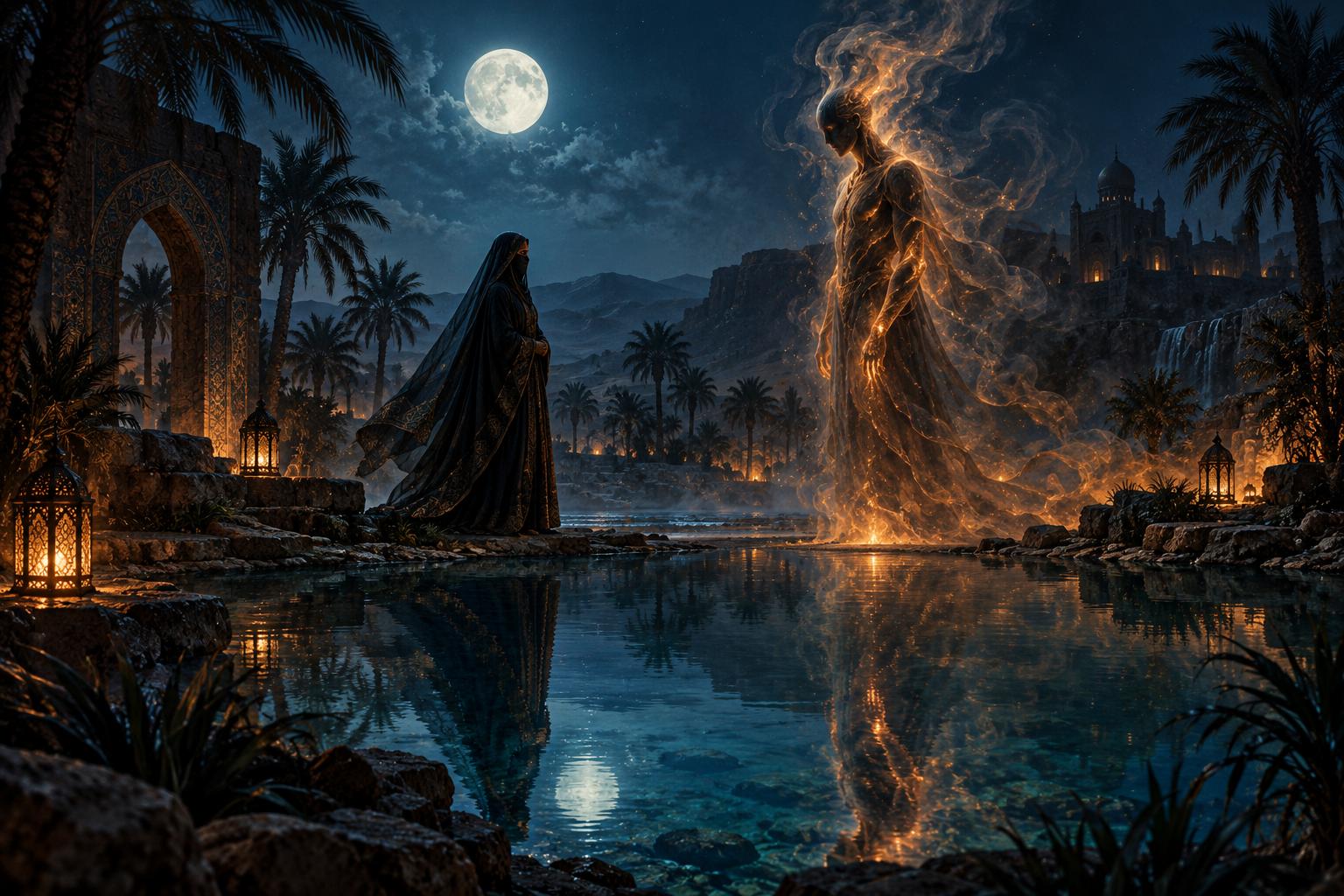
Jinn marriage explained: what Islamic jurists, the Arabian Nights, and regional folklore say about jinn and humans, love, and mixed unions, by source.
Quick answer: Jinn marriage is the idea, found in Islamic legal debate and in folklore across the Muslim world, that a jinn and a human can form a bond of love or marriage. Classical jurists disagreed about whether such a union is possible or permitted; most treated it as disliked or forbidden, while a minority allowed it in theory. Storytellers had fewer doubts: the Arabian Nights, Moroccan legend, and Malay and Indonesian tradition are full of jinn lovers, jinn brides, and the children of mixed unions.
Related guides: the main types of jinn, jinn in Islamic belief, the Aisha Kandisha legend, jinn in the Arabian Nights, incubus and succubus folklore, Solomon and the Queen of Sheba.
| Source or tradition | View of jinn marriage | Typical example |
|---|---|---|
| Quran | No direct ruling; verses on mates 'from among yourselves' (30:21) are cited against it | Surah Ar-Rum 30:21; Surah Ar-Rahman 55:56 and 55:74 |
| Classical jurists (Hanafi, Shafi'i, Hanbali, Maliki) | Mostly disliked or forbidden; a few allowed it in principle | Discussions collected by al-Suyuti and Ibn Taymiyyah |
| Qisas al-Anbiya (tales of the prophets) | Accepted as legend | The Queen of Sheba said to have a jinn mother |
| Arabian Nights | Common plot device | Sayf al-Muluk and Badi'at al-Jamal; Hasan of Basra |
| Moroccan folklore | Spirit 'marriage' as possession or binding | Aisha Kandisha and her male 'husbands' |
| Malay and Indonesian tradition | Jinn spouses, khodam companions, and inherited pacts | Stories of a jin wife or husband passed down in families |
| Modern scholarship | Studied as belief, folklore, and social practice | Anthropological and literary studies of jinn narratives |
Key Takeaways
In its narrowest sense, jinn marriage refers to a legal question asked by Muslim jurists: can a human being and a jinn contract a valid marriage, and if so, is it allowed? In its broader sense, it covers every story of love, seduction, abduction, or companionship between jinn and humans, from the Arabian Nights to village legends told today. Both senses rest on the same starting point. In Islamic belief, jinn are a created species made from smokeless fire (Quran 55:15), with free will, families, and religions of their own, living in a world that overlaps with ours.
Because jinn are believed to marry, eat, and have children among themselves, the question of whether they can do the same with humans arose early. Tradition holds that jinn can take different forms, including human form, which makes the idea of a hidden jinn spouse at least thinkable within the belief system.
It helps to keep the two senses apart. The legal debate is about rules and possibility. The folklore is about narrative: what a jinn lover wants, how a human escapes or stays, and what becomes of the children. This article looks at both, describes what the sources say, and does not offer advice or ritual instruction of any kind.
The Quran does not mention jinn marriage directly. Several verses are used in the debate. Surah Ar-Rum 30:21 says that God created for humans mates ‘from among yourselves’ so that they might find tranquility in them. Jurists who opposed jinn marriage read this as a statement of the natural order: a human’s spouse is meant to be human. Surah Ar-Rahman 55:56 and 55:74 describe the women of Paradise as untouched by any human or jinn, which some commentators took as proof that jinn, like humans, are capable of such relations, and others read as a simple expression of purity.
Surah Al-Jinn (72) describes jinn listening to the Quran and declaring faith, and Surah 72:6 mentions men who sought refuge with jinn, a verse often linked to pre-Islamic Arabian beliefs. The companion jinn, or qareen, is a separate idea: a spirit assigned to every person, not a spouse. Readers sometimes confuse the two.
Later literature filled the gaps. The Qisas al-Anbiya (tales of the prophets) genre, especially the version by al-Tha’labi (d. 1035), records a tradition that Bilqis, the Queen of Sheba, was born of a human king and a jinn mother. The story explains why Solomon, in the legend, tested her by having her lift her skirt over a glass floor, to see whether her legs were those of a jinn. The Quran itself (27:44) mentions the glass floor but says nothing about a jinn parent; that detail belongs to the storytellers.
Does this touch your own situation? Many readers come to these pages because something in their home, dreams or family feels unexplained. Reading history helps, but it cannot look at your specific case.
Consult the Sheikh Private, confidential, and free to ask.
The clearest evidence that people took jinn marriage seriously is the amount of legal ink spent on it. The Egyptian polymath Jalal al-Din al-Suyuti (d. 1505) gathered the opinions in his treatise on the jinn, usually cited as Laqt al-Marjan fi Ahkam al-Jann. Ibn Taymiyyah (d. 1328) addressed the question in his collected fatwas. Both writers treat the possibility as real while expressing strong reservations.
The arguments on the two sides can be summarized as follows.
Most schools of law concluded that such a union is either makruh (disliked) or haram (forbidden), and some held it to be simply impossible as a valid contract. The minority who allowed it in theory still discouraged it. For readers of jinn in Islam more broadly, the debate shows how seriously jinn were treated as persons with legal status.
Storytellers were far less cautious than jurists. In the One Thousand and One Nights, love between jinn and humans is a familiar engine of plot. The tale of Sayf al-Muluk and Badi’at al-Jamal tells of a prince who falls in love with a portrait of a jinn princess and crosses seas and islands to find her; the match is eventually blessed by her family. In the story of Hasan of Basra, a young man steals the feather cloak of a jinn maiden so that she cannot fly away, marries her, and later has to pursue her to the islands of Waq-Waq when she recovers the cloak and leaves with their children. That motif, the captured supernatural bride who escapes, appears in folklore around the world.
Not every union is tender. In the Second Dervish’s tale, an ifrit has abducted a human bride on her wedding night and keeps her in an underground palace; when he finds her with a visitor, the ifrit’s jealousy turns deadly. The pattern of the possessive jinn who hoards a human partner recurs often enough to count as a type.
These tales reached Europe through Antoine Galland’s French translation (1704 to 1717). Western readers often remember only the genie of the lamp and miss that the collection’s jinn are frequently lovers, spouses, and in-laws rather than wish-granters.
Across the Muslim world, local traditions describe jinn-human bonds in distinct ways. In Morocco, the most famous figure is Aisha Kandisha, a female jinn said to appear near water or at night and to attach herself to men. Folk accounts describe her ‘husbands’ as men who cannot leave her, who fall ill if they try to marry a human woman, and who must be treated by healers. The bond is framed less as romance than as possession.
In the Arabian Peninsula and the Gulf, stories of the sila, a shape-shifting female jinn who seduces travelers, overlap with the marriage theme, and desert lore speaks of men who vanished with a jinn wife. In Egypt and Sudan, the zar possession tradition describes spirits that demand gifts and ceremonies from the humans they ‘own,’ sometimes described in the language of marriage.
In Malaysia and Indonesia, the vocabulary shifts. A jin (jinn) or a khodam may be described as a companion inherited through a family, bound to an heirloom such as a keris, or attached to a person as a spiritual spouse. Some families tell of an ancestor who married a jin and of descendants who must honor the relationship. These stories blend Islamic terms with older Southeast Asian spirit beliefs.
If jinn can marry humans, what about their children? The sources that accept the idea usually give such offspring a special status. The Queen of Sheba’s legendary jinn parentage is the most prominent example, used to explain her wisdom, her unusual beauty, or, in some versions, a physical feature such as hairy legs or a hoof. Medieval Arabic writers also spoke of the nasnas, sometimes described as the offspring of a human and a shiqq (a half-formed jinn), with one eye, one arm, and one leg.
Some Islamic scholars discussed whether jinn-human children would be counted as human or jinn for legal purposes, and most concluded that the question could not be answered because the union itself was doubtful. Folk tradition is more generous. In Southeast Asian accounts, descendants of a jin ancestor are said to carry sensitivity to the unseen or to inherit a family khodam. In Moroccan narratives, children are rarely mentioned; the bond with Aisha Kandisha is about the man, not a lineage.
European folklore developed a parallel idea. Medieval demonologists wrote about the incubus and succubus, spirits that visit sleepers, and medieval legends about Merlin and about the founders of certain noble houses claimed a demon or fairy parent. Readers interested in the comparison can see incubus and succubus folklore.
Because the topic sits between law, scripture, and legend, several confusions recur. First, the qareen is not a spouse. The companion jinn assigned to each person is, in the hadith literature, a tempter or a constant presence, and no mainstream source describes it as a partner. Second, the ‘jinn wife’ of folklore is not the same as a jinn in the Quran. The Quran describes jinn as a community of believers and unbelievers; it never describes individual jinn romancing humans.
Third, modern online claims that a person can acquire a jinn spouse for protection or wealth have no basis in classical sources, which uniformly warned against such bonds. Fourth, the dramatic ‘possession marriage’ of Aisha Kandisha is a regional belief, not a universal Islamic teaching, and healers who deal with it work within a folk tradition rather than formal law. Finally, the main types of jinn relate differently to the theme: sila and peri-like figures appear as lovers, the ghul as a devourer.
Scholars today approach jinn-human relationships as narrative and belief rather than as events to be confirmed. Literary historians trace the captured-bride and jealous-ifrit motifs across Persian, Indian, and Arabic storytelling. Anthropologists study how spirit marriage talk expresses social pressures: a man who cannot marry, a woman whose illness has no medical name, a family that explains unusual fortune by an ancestral jin. Legal historians read al-Suyuti and Ibn Taymiyyah as evidence of how far the medieval imagination extended personhood to unseen beings.
For the general reader, the most useful habit is to ask what kind of text you are reading. A legal opinion tells you what a jurist thought should happen. A tale from the Nights tells you what an audience enjoyed hearing. A folk account from Morocco or Java tells you how a community explains misfortune and ties the unseen to everyday life. None of them is a how-to guide, and this site does not provide one.
Read together, the sources show one pattern: jinn were imagined as close enough to humans to love and marry, and different enough that any such bond was fraught or forbidden. That tension is the real subject of jinn marriage.
Still have a question about your own experience? Describe what you are seeing, feeling or dreaming, and when it started. The Sheikh reads every message personally and replies in private.
Thinking about your own relationships? Stories of jinn brides and jinn lovers are, in the end, stories about human longing and commitment, and our partner PuraTarot offers a Relationship Harmony Ritual for readers who want to reflect on balance and connection with their own partner. Join the free Djinn Guide newsletter and, once you confirm, you will unlock a 50% code for your first reading.
Further reading
As an Amazon Associate we earn from qualifying purchases.
Classical Islamic jurists disagreed. Most held that a marriage between a jinn and a human is disliked or forbidden, citing Quran 30:21, which says mates were created for humans from among themselves. A minority considered it possible in principle but still discouraged it. The Quran itself contains no explicit ruling on jinn marriage.
In folklore, a jinn marriage is a bond between a human and a jinn described in the language of a spouse. It appears as romance in the Arabian Nights, as possession in Moroccan accounts of Aisha Kandisha, and as an inherited spiritual companion in Malay and Indonesian family stories.
Tradition and stories say they can. The Arabian Nights contains jinn princesses who marry princes and ifrits who abduct brides out of jealousy. Islamic scholars treated jinn as beings with emotions and free will, which is why the question of love and marriage was taken seriously enough to be debated in law.
A popular legend recorded in tales-of-the-prophets literature says Bilqis, the Queen of Sheba, had a jinn mother. The Quran (27:44) mentions Solomon's glass floor but not a jinn parent, so the detail belongs to later storytelling rather than scripture.
Legends give them unusual gifts or features: the Queen of Sheba's wisdom, the one-sided nasnas of medieval lore, or a family's inherited sensitivity to spirits in Southeast Asia. Jurists mostly declined to rule on such children because they doubted the union itself.
Disclaimer
This article describes religious, legal, and folkloric views about jinn and human relationships for educational and cultural purposes. Beliefs are reported, not endorsed, and nothing here should be taken as spiritual, legal, or personal advice.
Did this guide help you understand the subject? Rate it and share your honest opinion to help other readers. Every review is checked by our editors before it appears.
There are no reviews yet. Be the first one to write one.


Sheikh Youssef
Tayeb El Merzouki
For inquiries about personalized spiritual work, private rituals, and traditional talismans, connect directly with Sheikh Youssef Tayeb El Merzouki.
Chat on WhatsApp