




Join Djinn Guide: Get 50% Off a Personal Reading
Get new guides to jinn, folklore and occult history. Confirm your subscription to unlock a 50% code for a first personal reading with our partner PuraTarot.
Discover the unseen
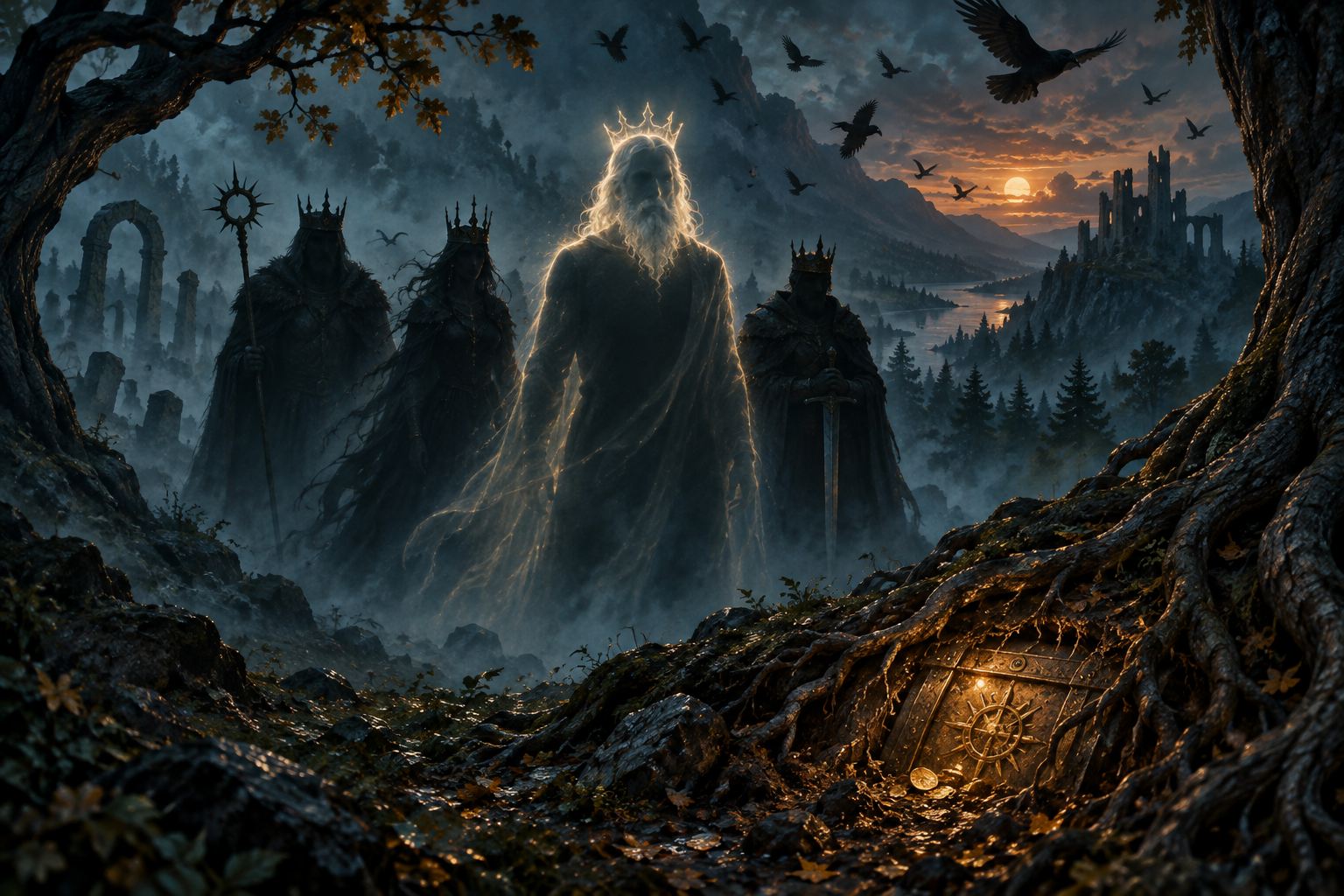
Barbatos demon explained: his number and rank in the Goetia, his 30 legions, his sigil, and how Weyer, de Plancy and modern culture describe the duke.
Quick answer: Barbatos is the eighth spirit of the Ars Goetia, ranked a Great Duke and said to command thirty legions of spirits. The Lesser Key of Solomon describes the Barbatos demon as appearing when the Sun is in Sagittarius, accompanied by four noble kings and their troops. His listed offices are understanding the voices of animals, revealing treasure hidden by enchantment, knowing things past and to come, and reconciling friends and those in power. The name is usually read as Latin barbatus, meaning bearded.
Related guides: full list of the 72 demons, Goetia ranks and hierarchy explained, Ars Goetia names, offices and seals, Amon, the marquis who reconciles friends, Bune, the three-headed duke, the five books of the Lemegeton.
| Spirit | Number and rank | Legions | Form in the Lemegeton | Shared office with Barbatos |
|---|---|---|---|---|
| Barbatos | 8, Great Duke | 30 | Attended by four noble kings and their troops | Hidden treasure, past and future, reconciling friends |
| Amon | 7, Marquis | 40 | Wolf with a serpent's tail, later a man with a raven's head | Reconciles controversies between friends |
| Purson | 20, King | 22 | Man with a lion's face, riding a bear, carrying a viper | Discovers hidden treasure, tells past and future |
| Bune | 26, Great Duke | 30 | Dragon with three heads: dog, gryphon and man | Gives riches, answers questions truly |
Key Takeaways
Barbatos is the eighth of the seventy-two spirits catalogued in the Ars Goetia, the first book of the Lesser Key of Solomon (the Lemegeton). The text names him a Great Duke and says he governs thirty legions of spirits. In the Goetia’s internal ranking, dukes sit below kings and above princes, marquises, counts, presidents and knights, so Barbatos holds a high but not supreme office. The Goetia ranks and hierarchy are not consistent from edition to edition, but Barbatos is a duke in every major version.
Unlike many Goetia spirits, Barbatos is not given a monstrous body. The Lemegeton says he appears when the Sun is in Sagittarius, with four noble kings and their companies of great troops. His powers are described as understanding the singing of birds, the barking of dogs, the lowing of cattle and the voices of all creatures; breaking open treasures hidden by the enchantment of magicians; knowing all things past and to come; and reconciling friends and those who hold power. The text adds that he was partly of the Order of Virtues, one of the angelic choirs, a detail that places him among the so-called fallen angels of the grimoire tradition.
The name is nearly always read as the Latin adjective barbatus, bearded. That reading is a plausible guess rather than a documented etymology, and no surviving source explains why a bearded figure should be associated with bird song and buried treasure. What the sources do agree on is that Barbatos is a spirit of knowledge and reconciliation rather than destruction, which is one reason he has been treated gently by later writers.
The 1904 edition of the Goetia prepared by S. L. MacGregor Mathers and published by Aleister Crowley is the version most readers know, and it is the source for most online descriptions of the Barbatos demon. Its entry is short, so it is worth breaking down piece by piece.
No animal form, no flames, no instruments. The entry gives only a timing condition, the Sun in Sagittarius, and a retinue. Readers who expect a picture of Barbatos usually come away with an image of a procession rather than a creature.
The four kings who accompany him are never named. Some modern writers connect them with the four directional kings of other Solomonic texts, but the Lemegeton itself makes no such link. The detail mainly signals status: a duke who arrives with kings in attendance is a spirit of consequence.
The seal printed in the Mathers edition is a horizontal, symmetrical design built on a central bar with small circles at its ends and paired crescents and crossbars above and below, giving a roughly bird-like or winged outline. Like all Goetia seals it is a geometric signature, not a portrait, and its meaning is explained in the article on Ars Goetia names, offices and seals.
Does this touch your own situation? Many readers come to these pages because something in their home, dreams or family feels unexplained. Reading history helps, but it cannot look at your specific case.
Consult the Sheikh Private, confidential, and free to ask.
The oldest printed source for Barbatos is Johann Weyer’s Pseudomonarchia Daemonum, an appendix to the 1577 edition of his De Praestigiis Daemonum. Weyer, a physician and a critic of witch trials, printed the catalogue partly to show how unimpressive the spirits of the grimoires were. His Barbatos entry calls the spirit a great count and duke, repeats the Sun in Sagittarius condition and the four noble kings, and lists the same offices: understanding the song of birds and the voices of animals, discovering treasure hidden by enchanters, knowing past and future, and reconciling friends and rulers. Weyer also mentions the Order of Virtues and gives thirty legions.
Reginald Scot translated Weyer’s list into English for his Discoverie of Witchcraft in 1584, which is how the Barbatos entry entered the English-speaking world more than a century before the Lemegeton manuscripts reached their familiar form. Scot’s wording is close to Weyer’s and is the ancestor of the phrases still repeated today.
Comparing the three texts shows how stable this particular entry has been. The Ars Goetia drops the word count from Weyer’s title and gives the spirit a seal, but the description is otherwise nearly identical. For a spirit whose entry has changed so little, the differences between editions matter less than the differences in how each author intended the list to be read.
Jacques Collin de Plancy’s Dictionnaire Infernal, first published in 1818 and reissued with Louis Le Breton’s illustrations in 1863, reorganized the grimoire spirits into an alphabetical encyclopedia for a general French readership. Its Barbatos entry depends on Weyer, as nearly all of de Plancy’s Goetia material does, and it repeats the rank of duke, the thirty legions, the four kings and the offices of understanding animal voices and finding hidden treasure.
De Plancy’s tone was different from Weyer’s. Where Weyer catalogued spirits to mock their pretensions, de Plancy wrote as a collector of curiosities, and the 1863 edition’s engravings turned several spirits into memorable images. Barbatos is one of the spirits that later readers tend to picture as a huntsman or forester, an association that fits a spirit who understands the sounds of birds and dogs and who arrives with a company of troops, though readers should treat that picture as a product of nineteenth-century imagination rather than of the Lemegeton.
The Dictionnaire’s influence on later occultism is hard to overstate. Through it, and through the Mathers edition that followed, the spirits of the Goetia passed from manuscript magic into popular reference material, which is why a reader searching for the Barbatos demon today finds a mixture of grimoire text, nineteenth-century elaboration and twentieth-century invention layered on top of one another.
Reading the Goetia as a whole rather than one entry at a time reveals how often offices repeat. Barbatos shares each of his powers with other spirits, which suggests the compilers were drawing on a common pool of stock attributes. Amon, the seventh spirit and a marquis, is also said to reconcile controversies between friends. Purson, a king, discovers hidden treasure and tells of past, present and future. Bune, a duke like Barbatos, gives riches and answers questions truly.
What makes Barbatos distinctive is the animal-language office. Only a handful of Goetia spirits are said to teach the speech of creatures, and the motif has a long history outside the grimoires. Islamic tradition, drawing on Surah An-Naml 27:16, says Solomon was taught the speech of birds, and the ant and the hoopoe both speak in that chapter. Legends of King Solomon’s authority over animals and jinn are the background against which a Solomonic spirit who translates bird song makes sense, a connection discussed in the article on King Solomon and the jinn.
The treasure office also connects Barbatos to a wider genre. Early modern Europe produced many treasure-hunting manuals that invoked spirits to reveal buried gold, and the specific phrase about treasure hidden by the enchantment of magicians reflects the belief that treasures were guarded by spells that only another spirit could undo. Barbatos, Purson and Gusion are the Goetia’s main treasure-finders, and that office probably reflects what seventeenth-century users most wanted from these books.
The name has traveled well beyond occult literature. In DC Comics, Barbatos is a bat-shaped cosmic entity introduced as the central villain of the 2017 crossover Dark Nights: Metal, where the name was chosen for its resemblance to Batman as much as for its grimoire origin. In Japanese animation, Gundam Barbatos is the lead mobile suit of Mobile Suit Gundam: Iron-Blooded Orphans, one of several machines in that series named after Goetia spirits.
Barbatos also appears as a demon in the Shin Megami Tensei and Persona video game families, which draw heavily on the seventy-two spirits, and as one of the Demon God Pillars in Fate/Grand Order. In these settings the spirit’s design often leans on the huntsman image, with bows, horns or animal companions, and the Lemegeton’s offices of animal speech and treasure are sometimes translated into game abilities.
None of this tells us anything about the historical Barbatos, but it explains the search traffic. Most people looking up the Barbatos demon arrive from a comic, game or anime and want to know whether the name has an older meaning. It does, and the older meaning is more modest than the modern versions: a duke of thirty legions who listens to birds.
A careful reader can trace the Barbatos entry through four layers. The first is Weyer’s Latin catalogue of 1577 and Scot’s English version of 1584. The second is the seventeenth-century Lemegeton manuscripts, which added seals and reorganized the list. The third is the Mathers and Crowley edition of 1904, which fixed the wording most people quote. The fourth is the popular layer of de Plancy’s dictionary, nineteenth-century illustration and modern media.
When a website describes Barbatos in detail beyond what these layers contain, the extra material is modern. Claims about his personality, his preferences, his color or his planetary correspondences come from twentieth-century and later authors and should be labeled as such. The full list of the 72 demons on this site keeps the grimoire text separate from later commentary for exactly this reason.
This site describes the grimoire tradition as history and folklore. It does not provide ritual instructions, and it does not claim that any spirit, seal or ceremony produces a result. Readers interested in Barbatos as a figure in the history of ideas will find the primary texts short, repetitive and, in their own way, revealing about what early modern readers hoped magic could do for them.
Still have a question about your own experience? Describe what you are seeing, feeling or dreaming, and when it started. The Sheikh reads every message personally and replies in private.
Drawn to these stories for a reason? Barbatos is credited with understanding the voices of birds and reconciling estranged friends, gifts that speak to anyone trying to read the signs around them or mend a broken tie. If that is close to your own situation, our partner PuraTarot offers a Full Personal Reading for calm, personal reflection on what you are facing. Join the free Djinn Guide newsletter and, once you confirm, you will unlock a 50% code for your first reading.
Further reading
As an Amazon Associate we earn from qualifying purchases.
Barbatos is the eighth spirit of the Ars Goetia, a Great Duke who commands thirty legions. The Lesser Key of Solomon says he appears when the Sun is in Sagittarius with four noble kings, understands the voices of animals, reveals treasure hidden by enchantment, knows past and future, and reconciles friends and rulers.
The seal printed in the 1904 Mathers edition is a horizontal, symmetrical figure built on a central bar with small circles at the ends and crescents and crossbars above and below, giving a loosely winged outline. Like every Goetia seal it is a geometric signature rather than a picture of the spirit.
The name is usually explained as Latin barbatus, meaning bearded. No surviving grimoire gives an etymology, so this is a reasonable guess rather than a documented fact. The bearded reading, combined with his power over animal voices, is why later art tends to show him as a huntsman or forester.
Yes. Weyer's 1577 catalogue lists Barbatos as a great count and duke with thirty legions, appearing with four noble kings when the Sun is in Sagittarius, and gives him the same offices as the later Lemegeton. Reginald Scot translated the entry into English in 1584.
Barbatos is the bat-like villain of DC Comics' Dark Nights: Metal, the name of the lead mobile suit in Mobile Suit Gundam: Iron-Blooded Orphans, a recurring demon in the Shin Megami Tensei and Persona games, and one of the Demon God Pillars in Fate/Grand Order. These uses borrow the name, not the grimoire description.
Disclaimer
This article describes the Barbatos demon as a figure in the history of European grimoires and later popular culture. Beliefs about spirits are presented as beliefs, not endorsed, and no ritual instructions or outcomes are offered.
Did this guide help you understand the subject? Rate it and share your honest opinion to help other readers. Every review is checked by our editors before it appears.
There are no reviews yet. Be the first one to write one.


Sheikh Youssef
Tayeb El Merzouki
For inquiries about personalized spiritual work, private rituals, and traditional talismans, connect directly with Sheikh Youssef Tayeb El Merzouki.
Chat on WhatsApp